
Back to Oregon
Oregon Class C Passenger Permit Practice Test
Full test preview Question 1 of 35
0 answered 35 remaining
Passing target: 80% (28/35)
Weather, Visibility & EmergenciesStandalone practice
You drive at 35 mph. A car pulls out of a driveway into your lane just ahead, and you cannot stop in time. A moment ago you checked the lane on your left, which goes your way, and it is empty. What is usually your best move?
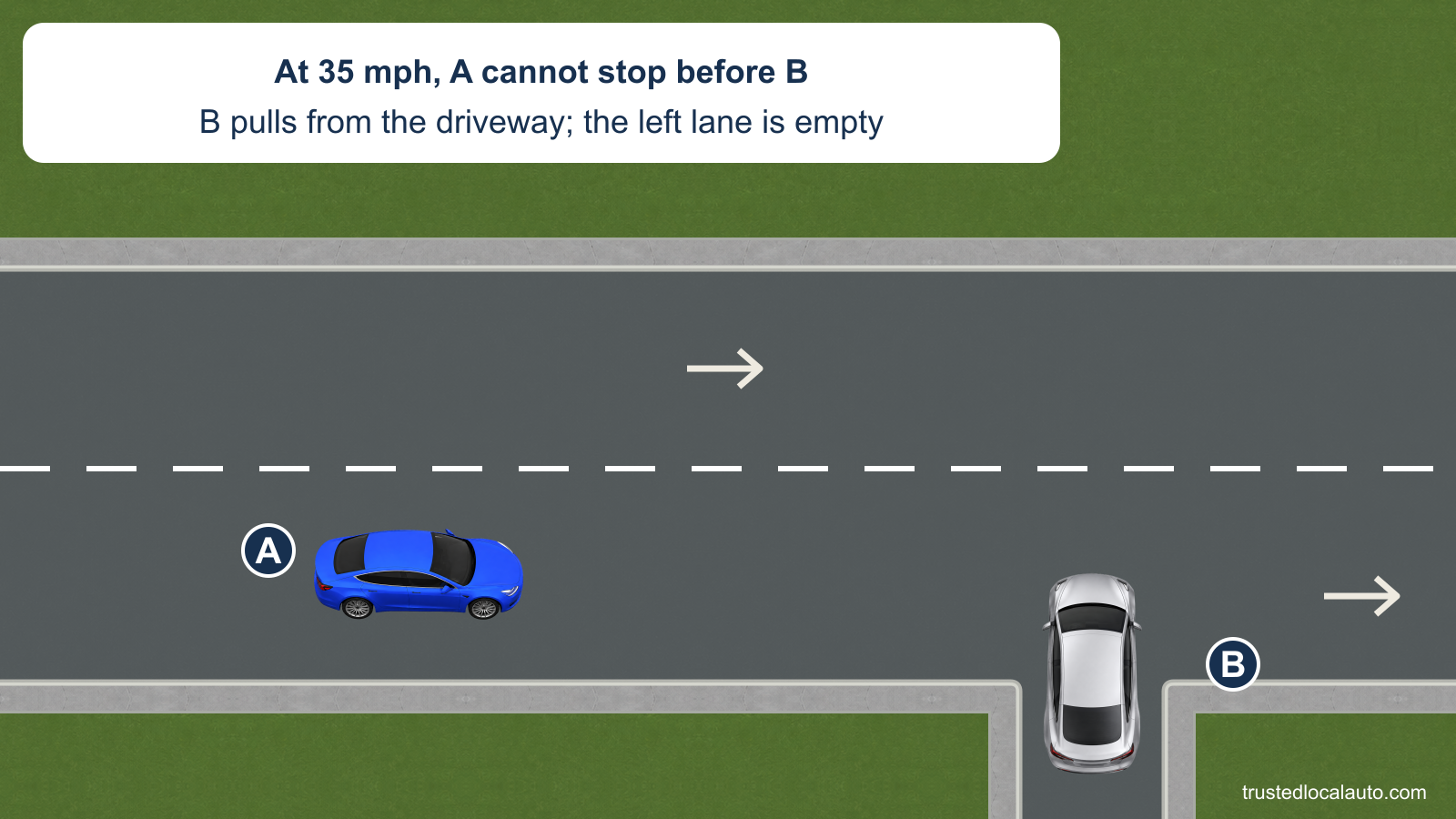
A travels east in the right of two same-direction lanes. B pulls north out of a driveway into A’s lane. The left lane is empty, and the card states that A cannot stop in time at 35 mph.
Correct answer: Steer away from the car into the empty lane on your left
Why
Stopping quickly, turning quickly and speeding up are the three ways to avoid a crash or make it less severe. Choose the one that fits the situation. Scan ahead and to the sides all the time, so you know where your escape path is before you need it.
Verified against Oregon Driver Manual · Avoiding a collision · p. 82, 81
Report a question issueContinue learning
Related Oregon questions
You press the brake pedal as you approach a red light ahead, and the pedal sinks with almost no effect. You still have some distance before the intersection. What should you do?Rain begins to fall on a highway where you have been using cruise control. Which plan follows the Oregon manual's advice for wet roads?You drive on a dark rural highway with your high beams on. An oncoming car comes over a hill about 700 feet away and keeps coming toward you. At what distance does Oregon law require you to switch to low beams?At night on an empty two-lane road, you use your high beams. You come up behind a slower pickup truck in your lane and plan to stay behind it. At what distance must you switch to low beams?You drive slowly through a deep puddle that covers the road. Afterward, the car does not slow down as well as usual when you press the brake pedal. What should you do?After a heavy storm, water covers a low part of the road ahead. You cannot see the pavement or tell how deep the water is. What should you do?