
Practice question, Question 1 of 35
Passing target: 80% (28/35)
You drive into thick fog on a highway at night. You can see only a short distance ahead. How should you set your headlights and your speed?
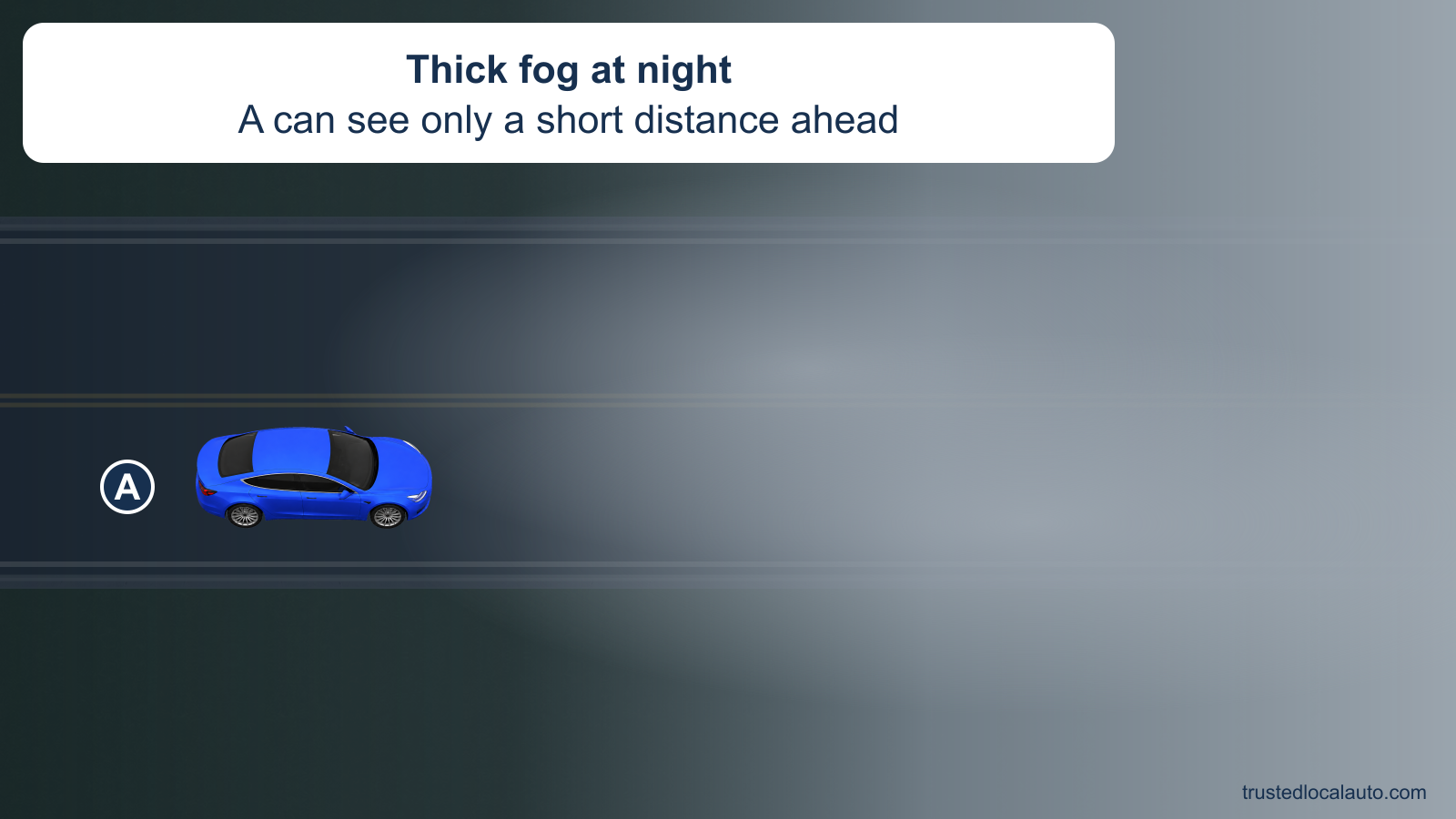
Correct answer: Use low beams, slow down, and be ready to stop for slow or stopped vehicles ahead.
Why
Fog, dust and smoke hide hazards and make distances hard to judge. Use low beams, reduce your speed, and watch for slow or stopped vehicles and other obstacles. If the fog is too thick to drive safely, leave the road completely, pull as far to the right as you can, and turn on your hazard lights so that other drivers can see where you are.
Verified against Oregon Driver Manual · Fog, dust and smoke · p. 85
Is this question correct and clear?
Continue learning
Related Oregon questions
- You press the brake pedal as you approach a red light ahead, and the pedal sinks with almost no effect. You still have some distance before the intersection. What should you do?
- You drive through an intersection on a green light. A car on the cross street runs its red light and is about to strike the side of your car. The road ahead of you is open, and the lanes beside you are not clear. What is usually your best move?
- You drive east at 35 mph in the right of two lanes that go your way. A car pulls out of a driveway into your lane just ahead, and you cannot stop in time. The lane on your left is empty. Which statement is correct?
- You drive at 35 mph. A car pulls out of a driveway into your lane just ahead, and you cannot stop in time. A moment ago you checked the lane on your left, which goes your way, and it is empty. What is usually your best move?
- Rain begins to fall on a highway where you have been using cruise control. Which plan follows the Oregon manual's advice for wet roads?
- You drive on a dark rural highway with your high beams on. An oncoming car comes over a hill about 700 feet away and keeps coming toward you. At what distance does Oregon law require you to switch to low beams?