
Back to Oregon
Oregon Class C Passenger Permit Practice Test
Full test preview Question 1 of 35
0 answered 35 remaining
Passing target: 80% (28/35)
Parking, Reversing & Roadside StopsStandalone practice
You parallel park on a two-way street that has no painted parking spaces. When you get out, you see that your right wheels are about 18 inches from the curb. What should you do?
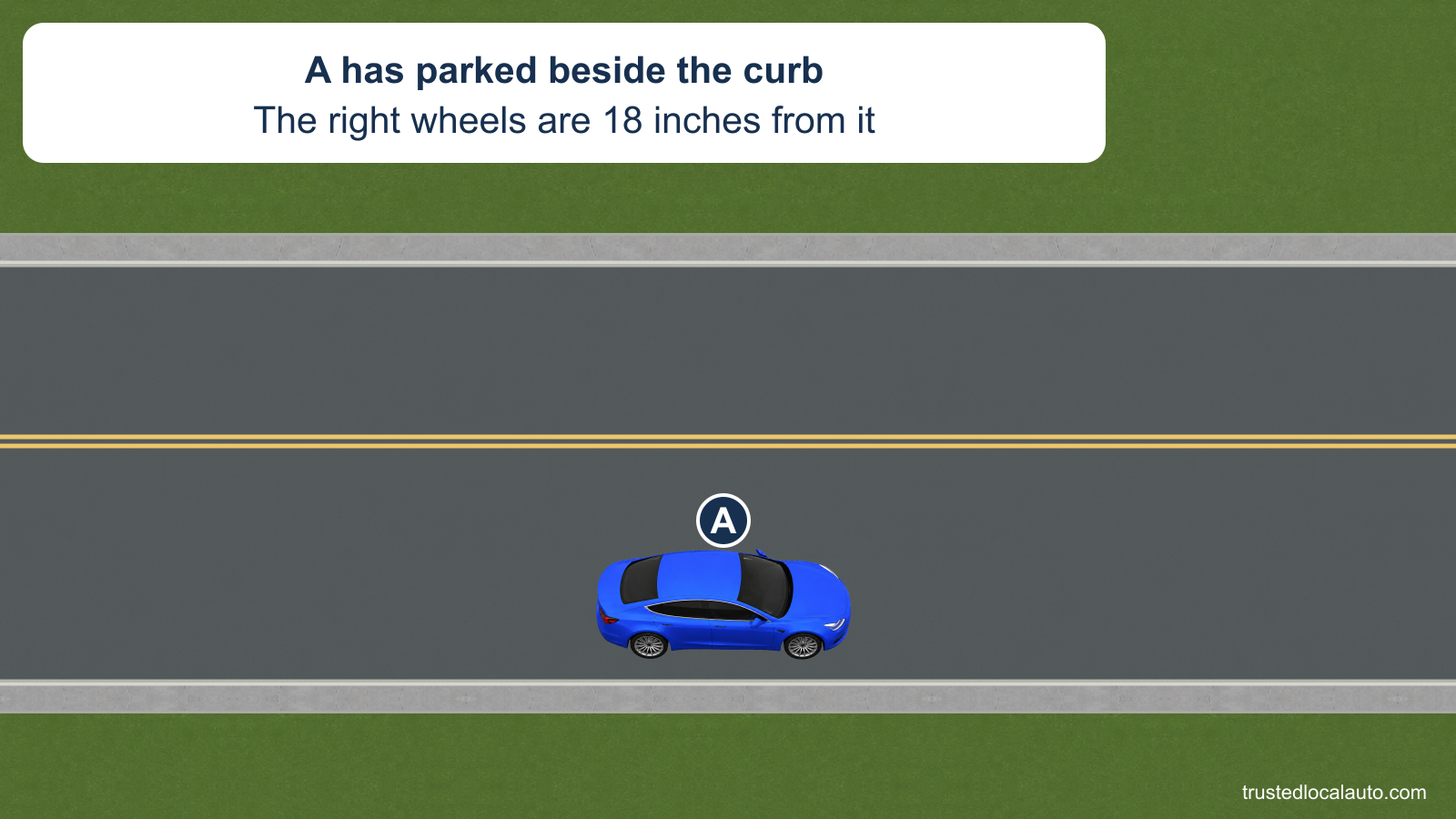
A is parked facing with traffic beside the right curb. The caption states that A’s right wheels are 18 inches from the curb.
Correct answer: Park again so that your right wheels are within 12 inches of the curb
Why
A parked car that sticks out narrows the travel lane and can be hit by traffic or force bicyclists toward other vehicles. Park in the direction of the traffic in the lane next to you. Where there is no curb, park as close as you can to the edge of the shoulder. In a marked space, keep all wheels inside the lines.
Verified against Oregon Driver Manual · Parallel parking · p. 76
Report a question issueContinue learning
Related Oregon questions
You need to run into a pharmacy for two minutes. The only open space near the door is marked for persons with disabilities. You do not have a disabled parking permit. What should you do?Your car breaks down on the shoulder of a curving two-lane highway. Drivers from both directions cannot see it until they are about 100 feet away. You have turned on your hazard lights. What else should you do?You park your car, which has an automatic transmission, facing downhill next to a curb. Which set of steps secures it best?Your engine starts to lose power while you drive in the right lane of a freeway. What should you do?You park on a steep country road that has a gravel shoulder and no curb. Which way should you turn the front wheels?At night, a police car signals you to stop. You pull to the right edge of the road, stop and turn off the engine. The officer is walking toward your car. What should you do now?