
Practice question, Question 1 of 18
Passing target: 83.3% (15/18)
You parallel park on a two-way street that has a curb. When you get out, you see that your right wheels are about 18 inches from the curb. What should you do?
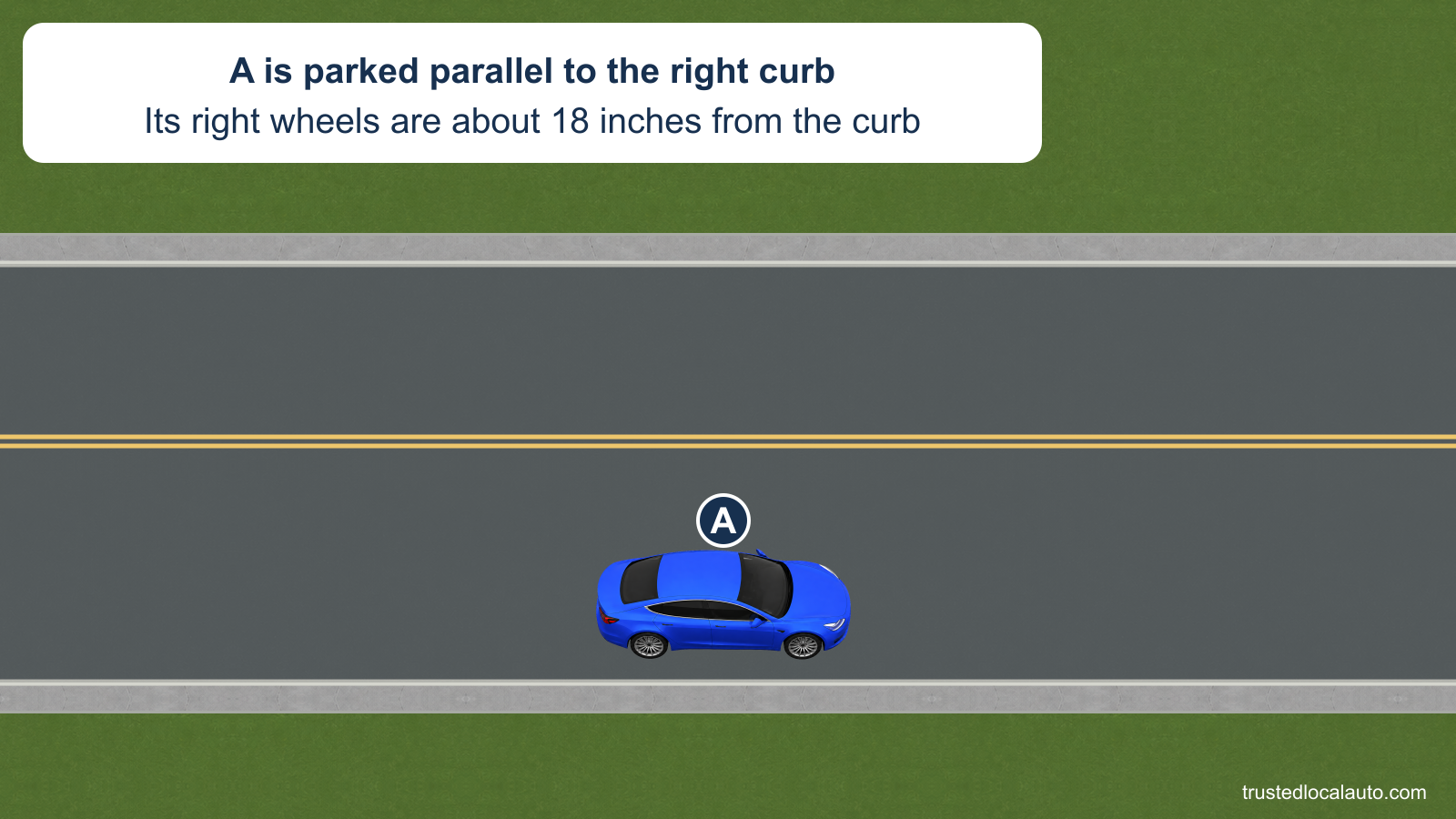
Correct answer: Park again so that the right wheels are 12 inches or less from the curb.
Why
A car that sticks out from the curb makes the travel lane narrower, so passing drivers and bicyclists have less room. Pennsylvania law (75 Pa.C.S. 3354) requires the right wheels to be within 12 inches of the right curb on a two-way road. Where there is no curb, park as close as practicable to the right edge of the shoulder.
Verified against Pennsylvania Driver's Manual · Parking · p. 56, 57
Is this question correct and clear?
Continue learning
Related Pennsylvania questions
- You are about to back your car out of your home driveway. Children often play in this area, and your car has a backup camera. Which plan is safest?
- You borrow your grandmother's car, which has a disability parking placard. She is not with you. You want to use a parking space reserved for persons with disabilities while you shop. May you park there?
- On a street with a STOP sign at the next corner, the only open curb space ends 25 feet before the sign. No parking signs are posted. May you park there?
- On a street with a YIELD sign at the next corner, the only open curb space ends 25 feet before the sign. No parking signs are posted. May you park there?
- An open curb space starts 11 feet past a fire hydrant, and the hydrant is behind you. You stop with the rear of your car at the start of the space. What is the least distance that you must move forward to park legally?
- An open curb space starts 12 feet past a fire hydrant, and the hydrant is behind you. You stop with the rear of your car at the start of the space. What is the least distance that you must move forward to park legally?