
Practice question, Question 1 of 50
Passing target: 20 correct signs and 20 correct rules
Traffic is backed up at a work-zone zipper merge. How should drivers use the two approaching lanes?
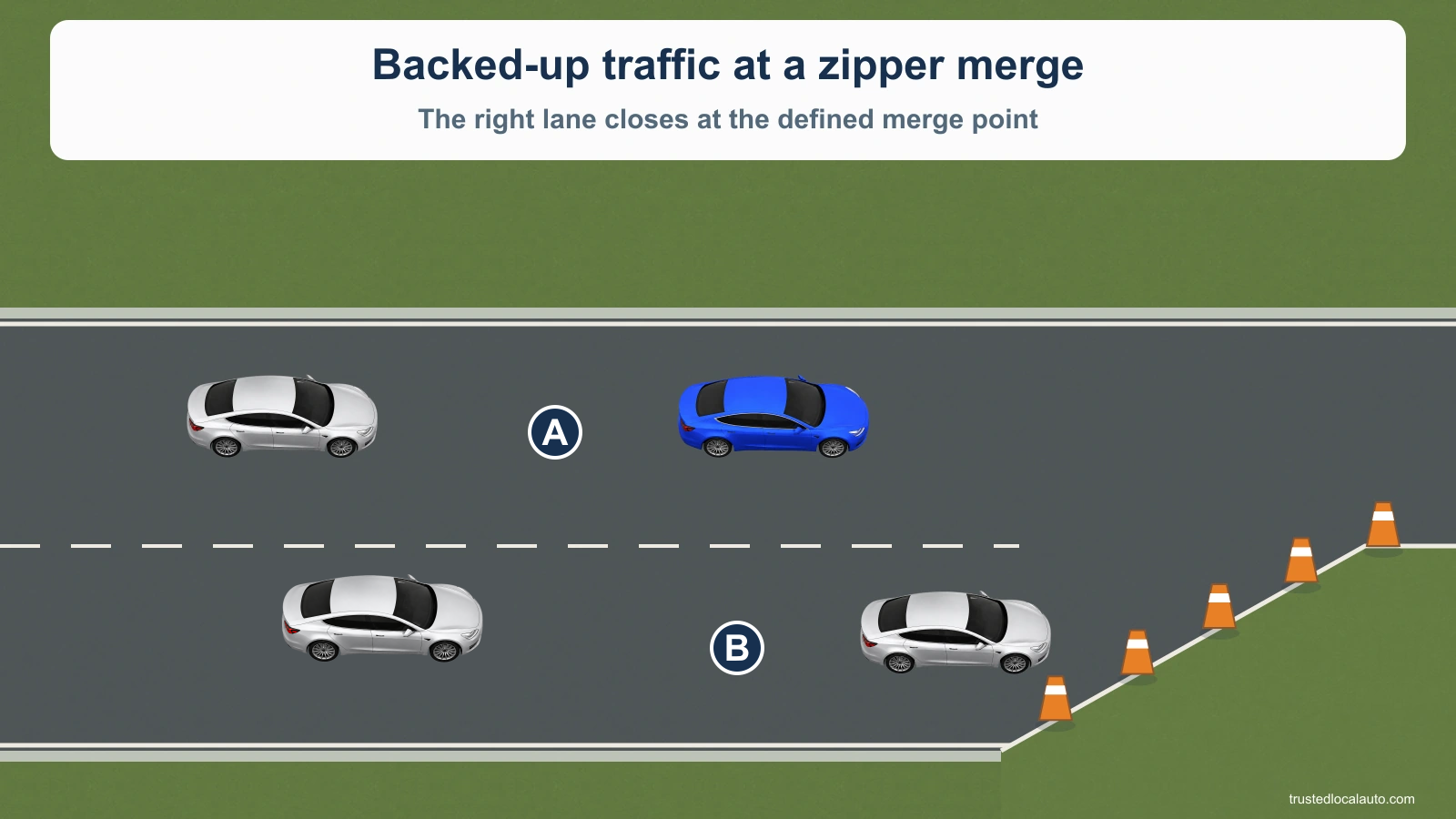
Correct answer: Use both lanes to the merge point, then take turns one by one.
Why
At a zipper merge, use both lanes up to the merge point and then take turns, one vehicle from each lane. Signal, check the blind spot and merge only when safe. Each driver in the continuing lane should allow one vehicle in. Follow temporary signs and workers’ directions; the depicted B-then-A order is this example’s sequence, not permanent priority for one lane.
Verified against Saskatchewan Driver's Handbook: A Guide to Safe Driving · Basic information and rules of the road · p. 72
Is this question correct and clear?
Continue learning
Related Saskatchewan questions
- You drive on an undivided Saskatchewan highway with a usual posted limit of 100 km/h. In a work zone, you are about to pass a highway worker beside your lane. No lower work-zone limit is posted. What is the highest permitted speed while you pass the worker?
- On an undivided Saskatchewan highway with a usual posted limit of 100 km/h, you are about to pass a highway worker in a work zone. No lower work-zone limit is posted. What is the highest permitted speed while passing the worker?
- A railway crossing gate is down across your lane and its red warning lights are active. You cannot see a train. What should you do?
- You approach a railway crossing with automatic warning lights and gates. The gates are up, the lights are not flashing and no train is in sight. Traffic ahead of you is stopped in a queue just beyond the tracks. What should you do?
- You approach a railway crossing equipped with automatic warning lights and gates. Which check is still necessary?
- You drive on a divided highway. On the opposite roadway, a school bus has stopped with its red lights flashing and its stop arm out. Which statement is correct?