
Back to South Carolina
South Carolina Class D Knowledge Test Practice
Full test preview Question 1 of 30
0 answered 30 remaining
Passing target: 80% (24/30)
Weather, Visibility & EmergenciesStandalone practice
You drive on a dark two-lane road with your high beams on. An oncoming car appears ahead. By what point must you switch to your low beams?
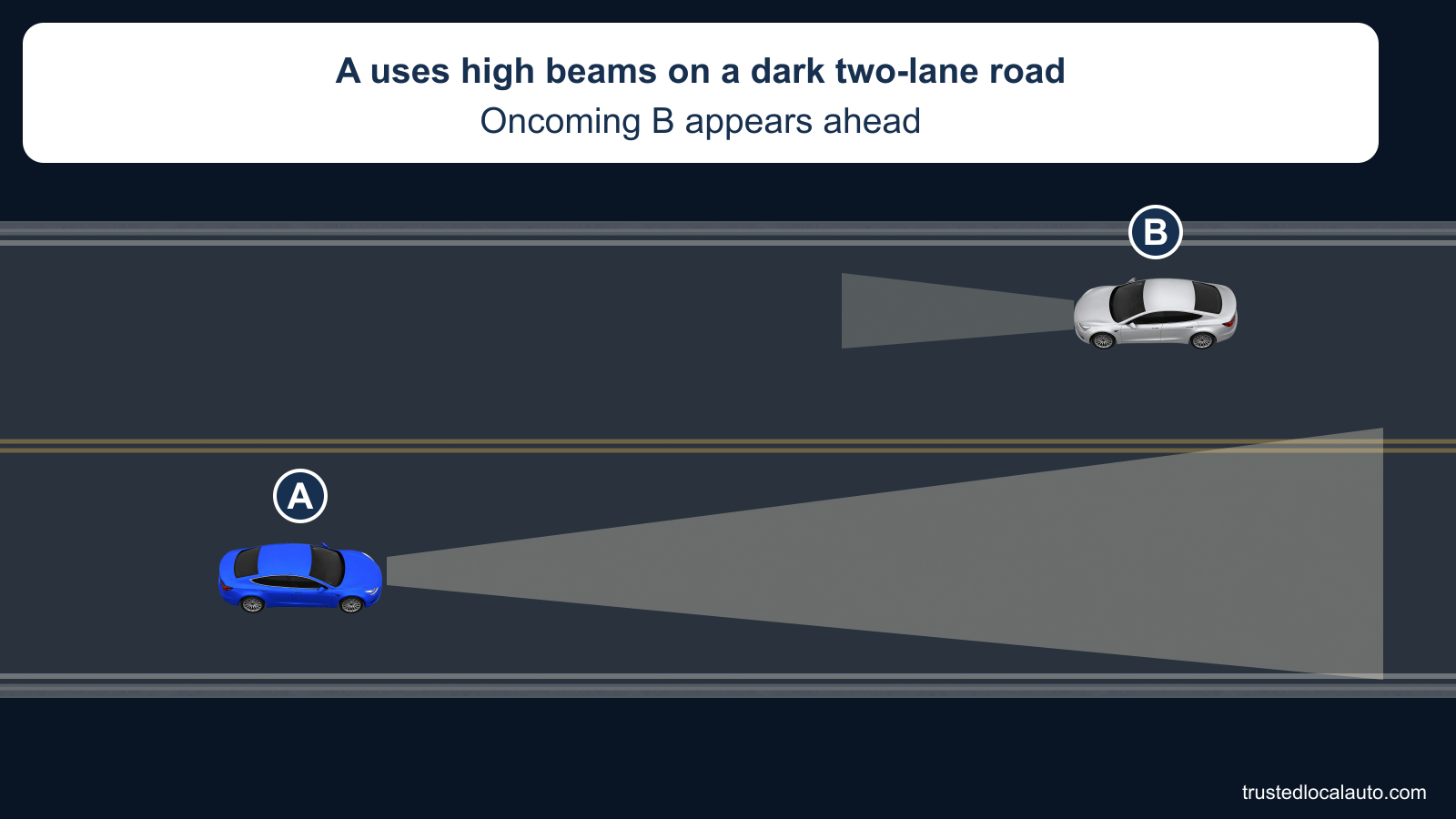
A uses high beams on a dark two-lane road while oncoming B is in its own opposing lane. No distance or dimming threshold is displayed before the answer.
Correct answer: By the time the oncoming car is within 500 feet of you.
Why
High beams let you see about twice as far as low beams, so use them on dark roads when no vehicle is near. If an oncoming driver does not dim, look toward the right edge of the road so the glare does not blind you. Switch back to high beams after the other vehicle passes.
Verified against South Carolina Driver's Manual · Night Driving · p. 126
Report a question issueContinue learning
Related South Carolina questions
It is a cold, wet winter morning. The road you are on looks wet but not icy. Ahead is a bridge over a river. What should you expect?A child runs into the street ahead. You brake as hard as you can in a car with anti-lock brakes (ABS). The pedal pulses, and you hear a clicking sound. What should you do?Your engine suddenly shuts off while you drive at 45 mph. The steering wheel feels much heavier. What should you do?It is noon, and heavy rain makes you run your windshield wipers all the time. Which lights should you use?At night on a rural highway, you come up behind a slower car and follow it while you wait for a safe place to pass. Your high beams are on. When must you switch to low beams?You drive on a highway in heavy rain. Water has pooled in low spots in the lanes ahead. What is the best way to keep your tires from hydroplaning?