
Practice question, Question 1 of 30
Passing target: 80% (24/30)
You approach a sharp curve on a two-lane highway, and you cannot see where it ends. When should you reduce your speed?
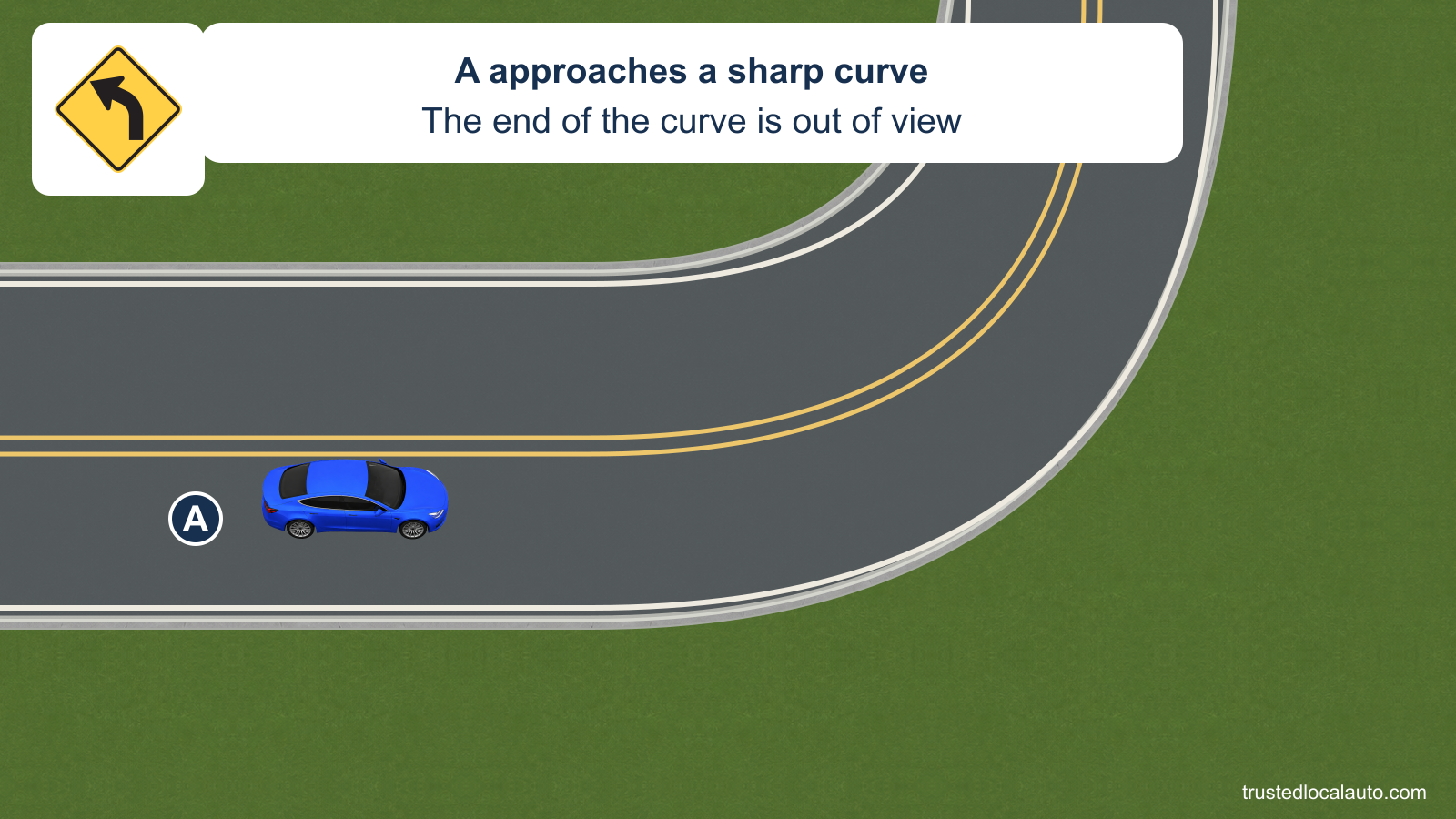
Correct answer: Before you enter the curve, so you can use light, steady gas through it.
Why
Slow even more when traction is poor, when you follow other vehicles, or when you cannot see the end of the curve. A yellow advisory speed plate under a curve sign shows a safe speed for good conditions.
Verified against South Dakota Driver License Manual · Speed management · p. 50
Is this question correct and clear?
Continue learning
Related South Dakota questions
- On a dry road in daylight, the car ahead passes a road sign. You count, and your front bumper reaches the same sign at "one thousand three." What should you do?
- You drive at 50 mph on dry pavement, and a hazard appears ahead. Your perception and reaction take about 1 1/2 to 2 seconds. About how far does your car travel before the brakes start to work?
- You follow a car at a four-second gap on a highway. Snow starts to fall, the road gets slippery, and it is getting dark. What should you do with your following gap?
- On a dry city street in daylight, you count a three-second gap to the car ahead. Which statement is correct?
- On a dry road in daylight, the car ahead passes a road sign. You count, and your front bumper reaches the same sign at "one thousand two." What should you do?
- You drive at night on a dark rural highway. Your headlights light only a limited distance ahead. How should you choose your speed?