
Practice question, Question 1 of 40
Passing target: 70% (28/40)
You drive in the right lane of a four-lane street with no traffic signal. In the left lane beside you, a car has stopped at a marked crosswalk to let a boy on a skateboard cross from the sidewalk. The stopped car blocks your view of the crosswalk ahead of it. What must you do?
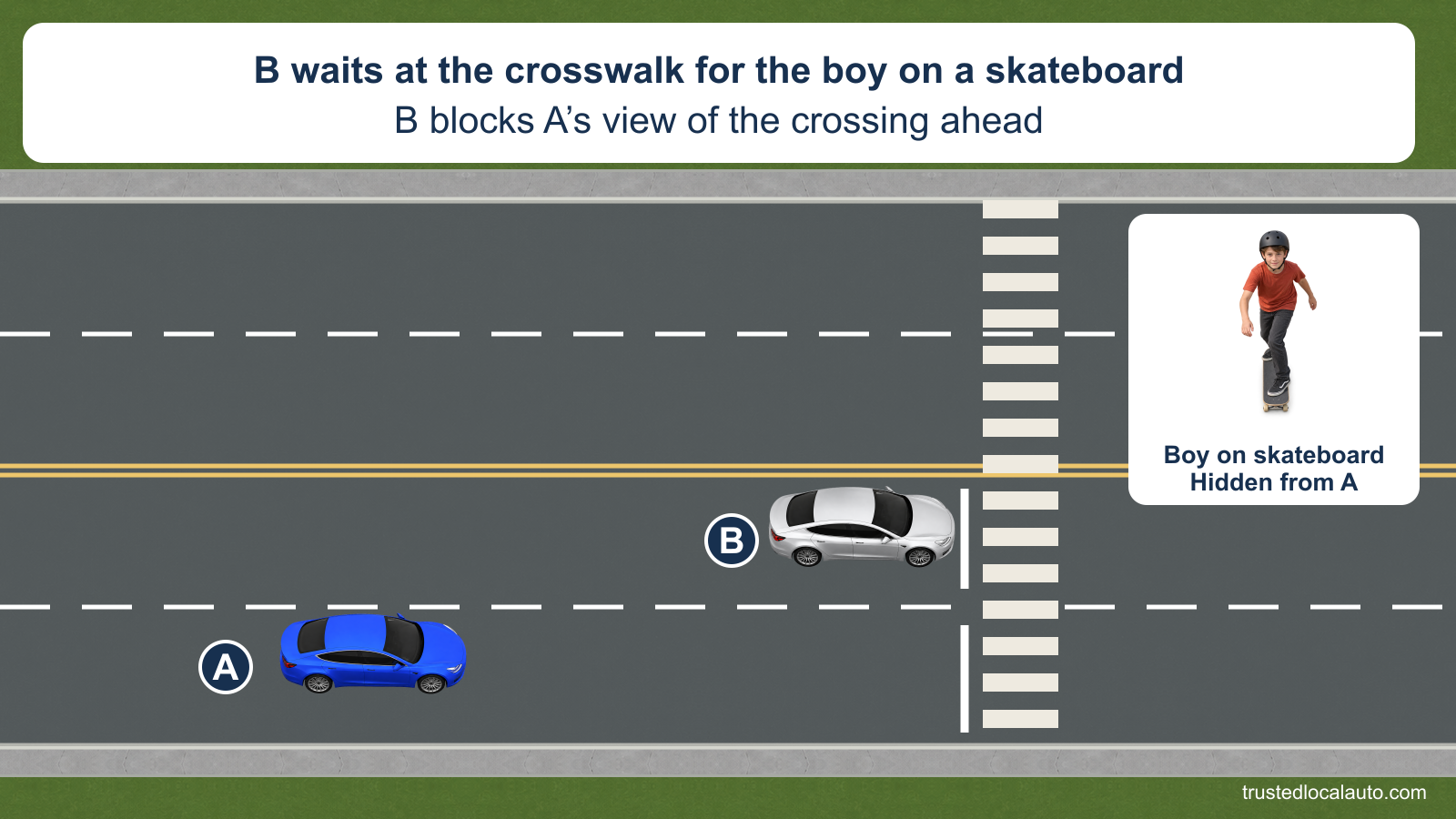
Correct answer: Stop, and do not pass the car that waits at the crosswalk
Why
A car that stops at a crosswalk often hides a person who crosses in front of it. If you pass it, you can hit that person in the next lane before either of you sees the other. Texas law does not let you pass a vehicle that has stopped at a crosswalk for a pedestrian or, since September 1, 2025, for a sidewalk user such as a skater or a bicyclist on the sidewalk.
Verified against Texas Driver Handbook · Laws and Safety Tips for Motorists · p. 67, 29
Is this question correct and clear?
Continue learning
Related Texas questions
- You drive on a narrow city street with a posted speed limit of 20 mph and one lane in your direction. Ahead, an animal control officer's truck is stopped with approved warning lights flashing while the officer removes a dead dog from the road. What does Texas law require as you pass?
- You are in the middle of an intersection, driving through on a green light. An ambulance with its siren on and red lights flashing comes up behind you. What should you do?
- You stop at a stop sign. On the cross street, which has no stop sign, a bicyclist rides toward the intersection and is already close to it. What should you do?
- You drive in the right lane of a city street. The lane is about 11 feet wide, and there is no bicycle lane. A bicyclist ahead rides slower than traffic, near the middle of the lane. What is true?
- On a road with two lanes in each direction, two bicyclists ride side by side in the right lane. Cars can pass them easily in the left lane. What is true?
- You drive on a city street with one lane in each direction. Your lane is 16 feet wide, and there is no bicycle lane. A bicyclist ahead rides slower than traffic. Before the next corner, where the rider will turn left, the rider moves from near the right edge to near the middle of the lane. What is true?