
Practice question, Question 1 of 40
Passing target: 70% (28/40)
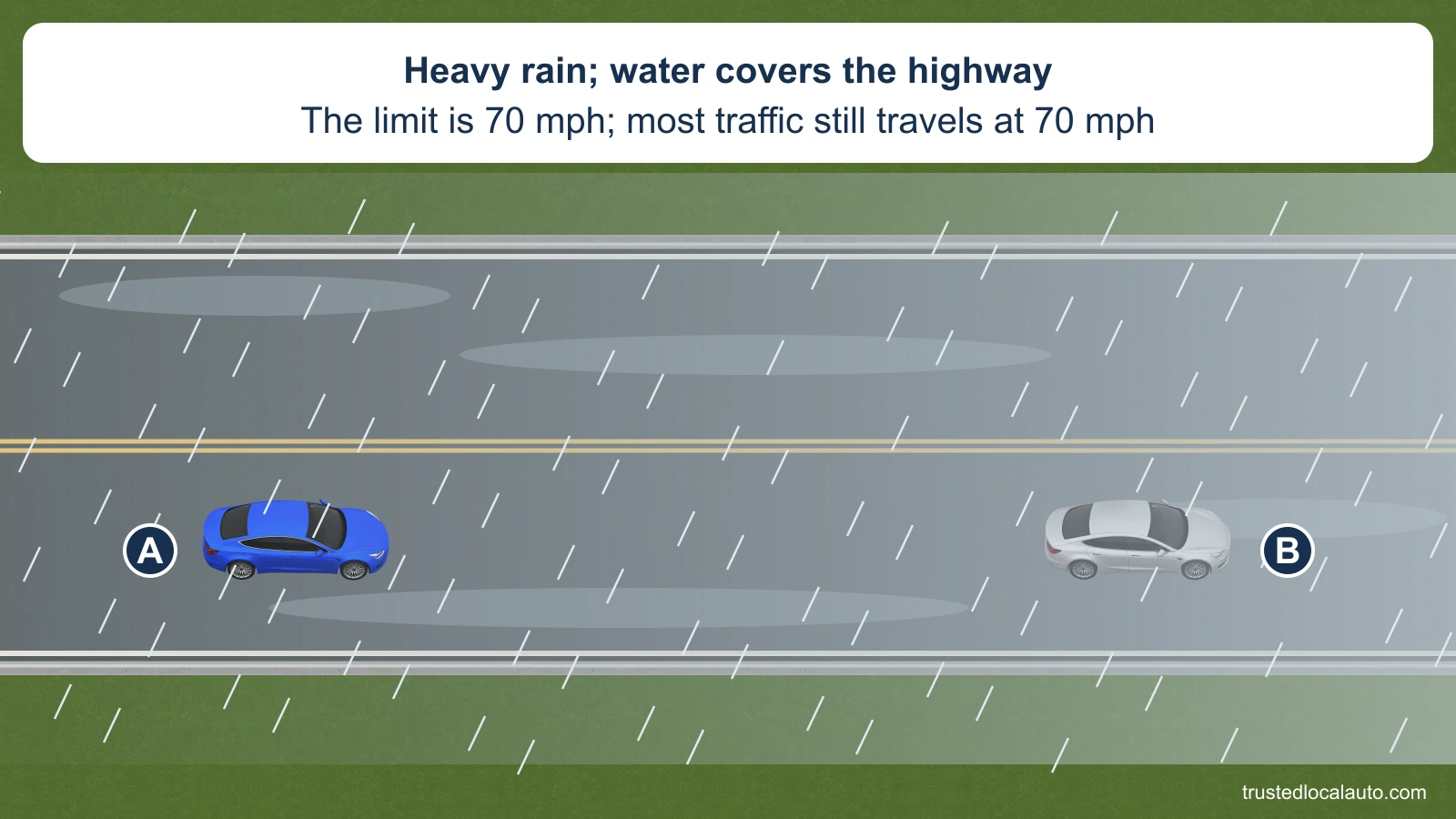
You drive on a highway with a posted limit of 70 mph. Heavy rain starts, water covers the road, and you can see only a short distance ahead. Most of the other traffic still moves at about 70 mph. What should you do?
Correct answer: Slow to a speed that fits the rain and the view, and leave more following distance
Why
A posted limit is the most you may drive in normal conditions, not a safe speed for every condition. Texas law requires a speed that is reasonable and prudent for the conditions, and a reduced speed when weather makes a special hazard, so 70 mph can be unlawful in a storm. A wet road gives less grip and longer stops, so a larger gap to the car ahead is also necessary.
Verified against Texas Driver Handbook · Speed Limits · p. 51, 52
Is this question correct and clear?
Continue learning
Related Texas questions
- You use an alley behind a row of shops in a Texas town to reach a delivery door. No speed limit sign is posted in the alley. What is the highest speed that Texas law sets for you there?
- You drive at exactly 30 mph on a dry street in good weather. Under the handbook's following-distance rule, what is the minimum gap behind the car ahead?
- You drive at 55 mph on a dry highway in good weather. The car ahead passes a road sign, and you count: your car reaches the same sign 3 seconds later. Under the handbook's following-distance rule for your speed, what is true about your gap?
- You drive at 25 mph on a dry city street in good weather. The car ahead passes a light pole, and your car reaches the pole about 1 second later. What is true about your gap?
- Outside an urban district, no speed limit sign is posted and conditions are good. What is the highest lawful speed for a car on each of these roads?
- On a highway with two lanes in your direction, you drive in the left lane. For the last mile, your car has stayed just behind the left-rear corner of a car in the right lane, at the same speed. What should you do?