
Practice question, Question 1 of 40
Passing target: 70% (28/40)
You approach an intersection that has no traffic signal. At the corner, a person with a white cane stands at the curb and is about to cross the street in front of you. What should you do?
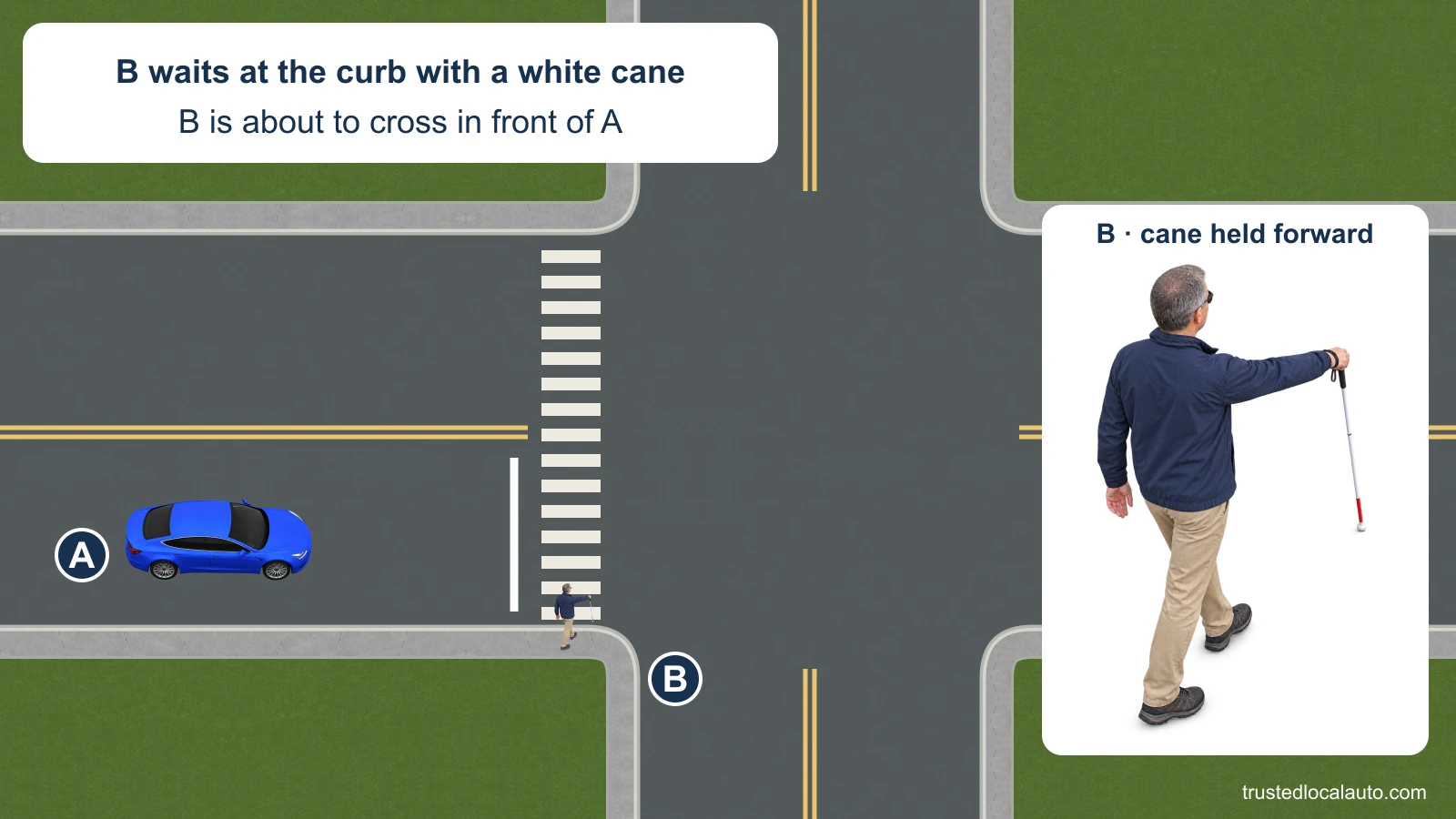
Correct answer: Stop and let the person cross, and take extra care because the person may not see you.
Why
The white cane shows that the person may be blind or partly blind and may not see your car. Texas law requires drivers to take the necessary care for these pedestrians at intersections and crosswalks, and to stop fully when that is the only way to keep them safe. Watch for people who are blind near bus stops, intersections, business areas and schools for the blind.
Verified against Texas Driver Handbook · Laws and Safety Tips for Motorists · p. 67
Is this question correct and clear?
Continue learning
Related Texas questions
- You drive on a narrow city street with a posted speed limit of 20 mph and one lane in your direction. Ahead, an animal control officer's truck is stopped with approved warning lights flashing while the officer removes a dead dog from the road. What does Texas law require as you pass?
- You are in the middle of an intersection, driving through on a green light. An ambulance with its siren on and red lights flashing comes up behind you. What should you do?
- You stop at a stop sign. On the cross street, which has no stop sign, a bicyclist rides toward the intersection and is already close to it. What should you do?
- You drive in the right lane of a city street. The lane is about 11 feet wide, and there is no bicycle lane. A bicyclist ahead rides slower than traffic, near the middle of the lane. What is true?
- On a road with two lanes in each direction, two bicyclists ride side by side in the right lane. Cars can pass them easily in the left lane. What is true?
- You drive on a city street with one lane in each direction. Your lane is 16 feet wide, and there is no bicycle lane. A bicyclist ahead rides slower than traffic. Before the next corner, where the rider will turn left, the rider moves from near the right edge to near the middle of the lane. What is true?