
Practice question, Question 1 of 20
Passing target: 80% (16/20)
You are driving on a dry road in good weather. The rear of the car ahead passes a utility pole. You count "one thousand one, one thousand two, one thousand three," and then your car reaches the same pole. What should you do?
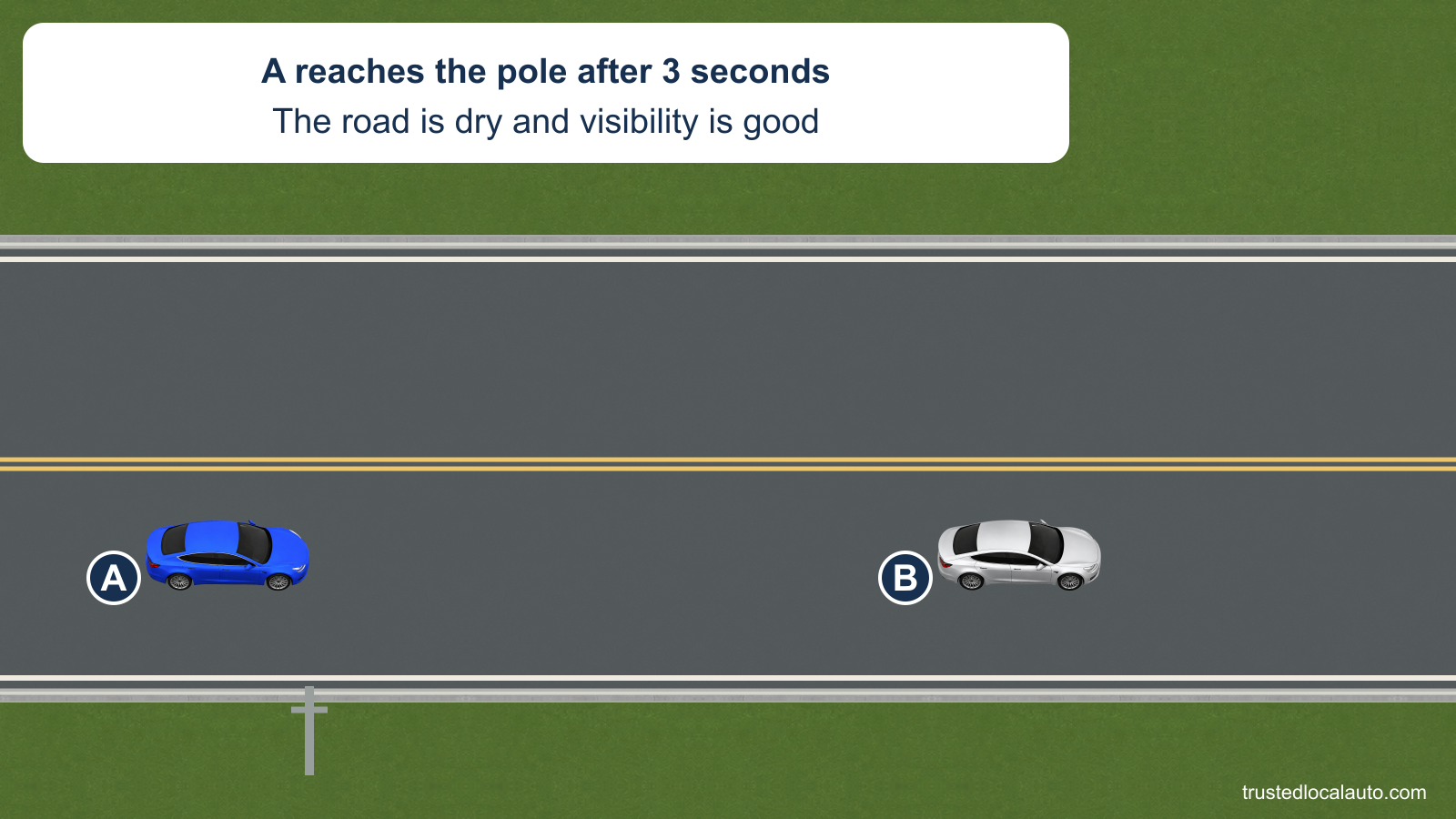
Correct answer: Drop back to a four-second gap or more, because three seconds is too close.
Why
The four-second method measures your following distance at any speed. Pick a fixed checkpoint such as a sign or a pole, start to count when the rear of the vehicle ahead passes it, and stop when your vehicle reaches it. Four seconds gives you time to see a problem, react and stop without hitting the vehicle ahead. Use more than four seconds when the road is poor, when you cannot see well, or at higher speeds.
Verified against Vermont Driver's Manual · Four Seconds - A Safe Following Distance · p. 28, 29
Is this question correct and clear?
Continue learning
Related Vermont questions
- You are on the interstate and want to move from the right lane to the left lane to pass. Your inside mirror and your left side mirror show no vehicles. What should you do before you move over?
- Which statement about driving slower than other traffic is NOT correct?
- On a dry road in good weather, the rear of the car ahead passes a utility pole. You count "one thousand one, one thousand two, one thousand three," and then your car reaches the pole. Which statement is correct?
- You drive at 25 mph on a dry town street in good weather. The rear of the car ahead passes a sign post. You count "one thousand one, one thousand two, one thousand three," and then your car reaches the same post. Which statement is correct?
- Snow covers the road, and you are driving an all-wheel-drive SUV behind another car. How much following distance should you keep?
- Where no other speed limit is set and posted, Vermont has one maximum speed for the Interstate and one for other highways. Which pair is correct?