
Back to Vermont
Vermont Operator License Permit Practice Test
Full test preview Question 1 of 20
0 answered 20 remaining
Passing target: 80% (16/20)
Traffic Signals & Road MarkingsStandalone practice
You drive in a lane marked with a white arrow that curves left and the word ONLY. At the intersection, you realize that you want to go straight. The lane to your right is for straight traffic. What should you do?
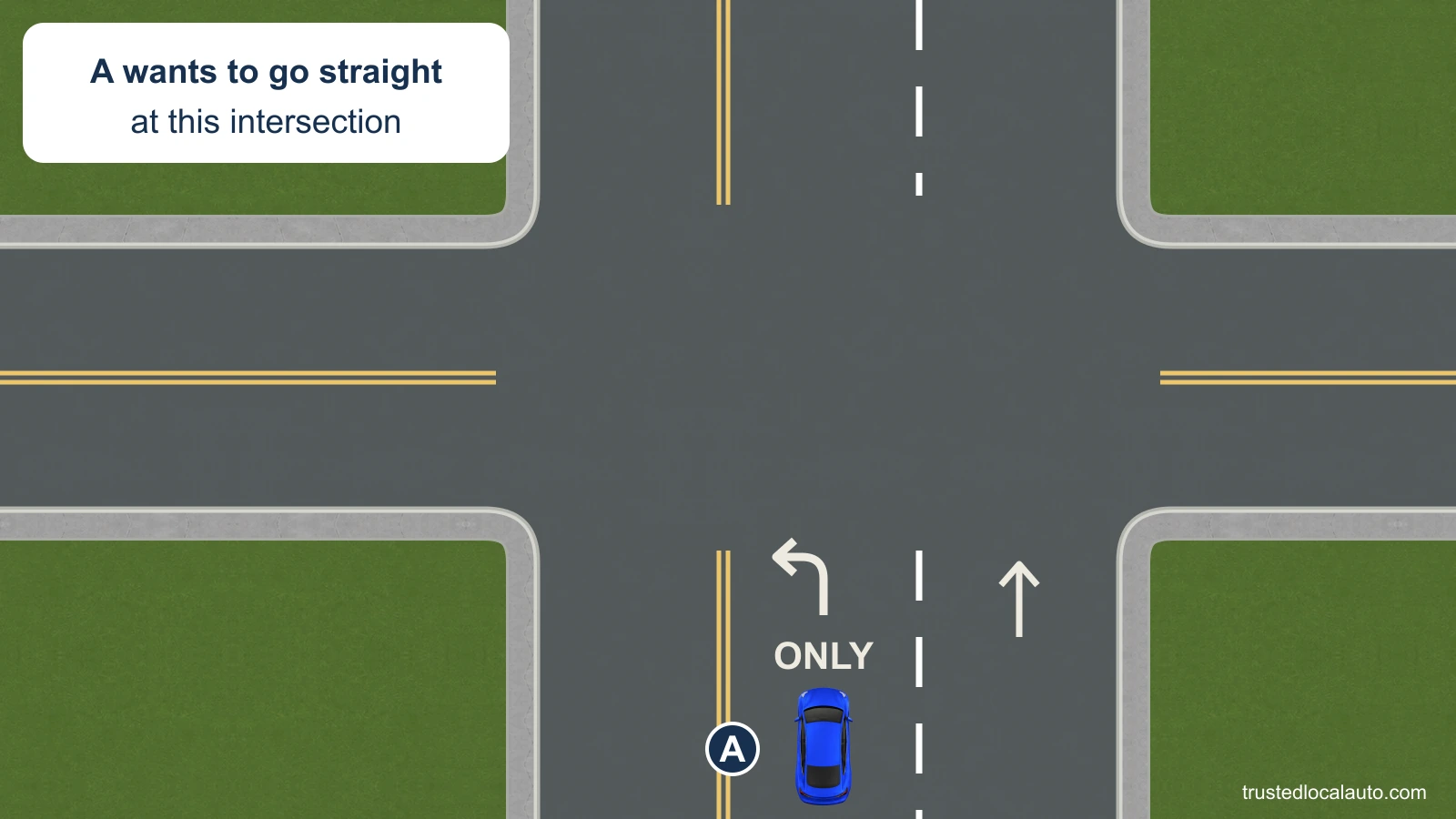
Blue car A is in a lane marked with a curved left arrow and ONLY as it reaches an intersection. The adjacent lane to its right has a straight arrow. A card says that A wants to go straight.
Correct answer: Turn left as your lane requires, then find another route
Why
Lane arrows and signs tell you which way each lane must go at the intersection. Read them early and move into the correct lane well before you reach the intersection. The same message can be on a white sign above the lane, with a turn arrow over the word ONLY.
Verified against Vermont Driver's Manual · Pavement arrows · p. 35, 36
Report a question issueContinue learning
Related Vermont questions
On a five-lane street, the center lane has a solid yellow line and a broken yellow line on each side, and left-turn arrows that point in opposite directions. How should you use this lane?Late at night, the traffic signal for your direction flashes red. The signal for the cross street flashes yellow. What must you do?You wait to turn left at a signal that shows a flashing yellow arrow pointing left. Oncoming cars are still coming. What should you do?You come to an intersection where the traffic signal for your direction flashes yellow. You plan to go straight. What must you do?You drive on a road with a signal above each lane. Above your lane is a steady green arrow that points down at the lane. What does it tell you?You come to a railroad crossing marked with a white X-shaped sign that reads RAILROAD CROSSING. The crossing has two tracks and no gates or lights. A train passes on the near track and moves away. What should you do next?