
Practice question, Question 1 of 40
Passing target: 85% (34/40)
You drive behind a slow car on a two-lane road. The center marking is a solid yellow line on your side and a broken yellow line on the oncoming side. The oncoming lane looks clear. Which statement is correct?
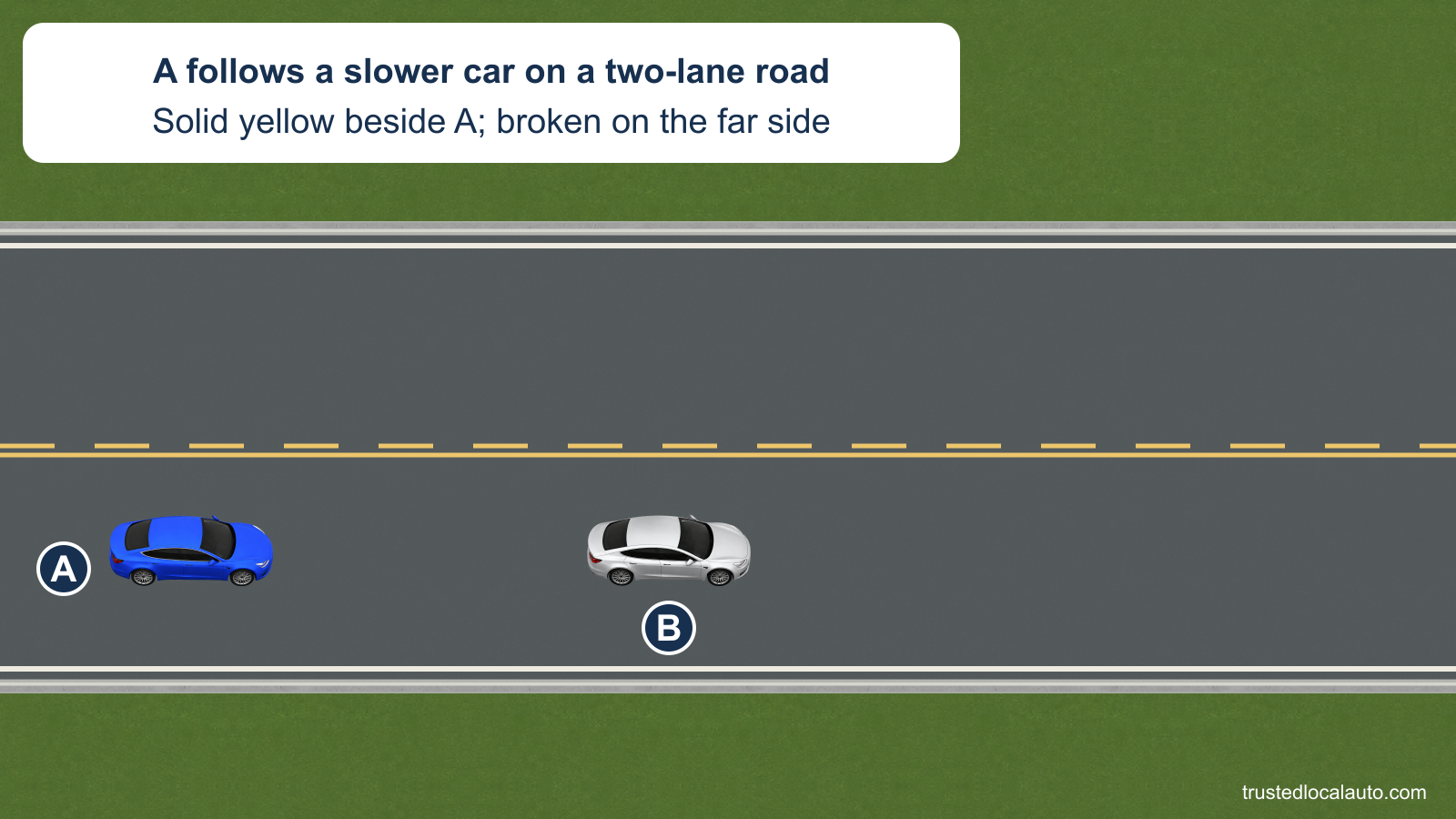
Correct answer: You may not cross to pass the car, but oncoming drivers may pass when safe
Why
Yellow center lines separate traffic that moves in opposite directions. Virginia law lets a driver on the solid side cross only to turn left into a road or entrance, or to pass a pedestrian or a person on a bicycle, skateboard or foot scooter when it is safe (§ 46.2-804). A clear oncoming lane does not change the rule, because the marking controls where passing is legal.
Verified against Virginia Driver's Manual · Pavement Markings: Yellow center lines (solid line beside a broken line) · p. 13
Is this question correct and clear?
Continue learning
Related Virginia questions
- As you near an intersection, you see that your lane has a white curved arrow that points left and the word ONLY painted on it. You want to go straight. What should you do?
- On an expressway, double solid white lines separate your lane from an HOV lane on your left. Your vehicle meets the HOV rules, and you want to use that lane. What must you do?
- Late at night, the signal at an intersection flashes red for your direction and flashes yellow for the cross street. A car on the cross street comes toward the intersection. What must you do?
- Late at night, the signal at an intersection flashes red for your direction and flashes yellow for the cross street. What must you do?
- At an intersection, the traffic signal that faces you shows a circular yellow light that keeps flashing. What does this mean?
- You are in a left-turn lane. The signal for your lane shows a flashing yellow arrow. An oncoming car is close to the intersection, and the crosswalk that you will cross is empty. What does the signal let you do?