
Practice question, Question 1 of 40
Passing target: 80% (32/40)
A railroad crossing has a STOP sign but no lights or gates. You see and hear no train. What must you do?
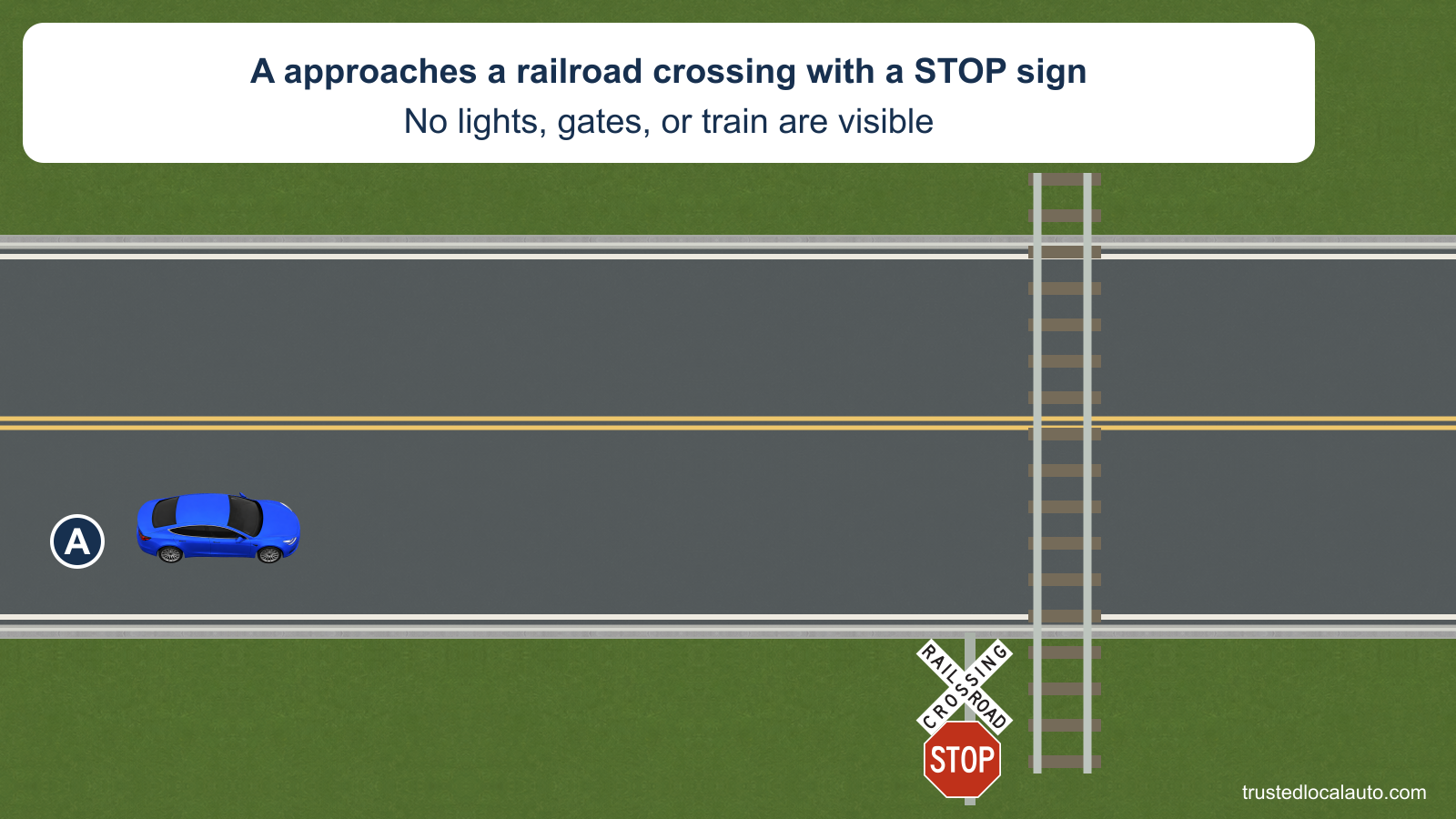
Correct answer: Stop between 15 and 50 feet from the nearest rail, then go when it is safe
Why
The state and local authorities put STOP signs at railroad crossings that they find especially dangerous. You must stop there even when no train is in view, because a train can arrive quickly and quietly. The 15 to 50 foot zone keeps the vehicle clear of the train and still lets you look both ways along the tracks.
Verified against Washington Driver Guide · Railroad crossings · p. 105
Is this question correct and clear?
Continue learning
Related Washington questions
- You come to an intersection with a green light. In a work area just past the intersection, a flagger holds a STOP paddle toward you. What should you do?
- By law, a school or playground speed zone can extend a set distance from a marked school crosswalk or from the school grounds. What is the largest distance that the zone can extend?
- A long freight train has just cleared a railroad crossing. The gates are still down and the red lights still flash, but you see no other train. What should you do?
- You drive in the right lane of a freeway with two lanes in your direction. Ahead, a tow truck with its warning lights flashing is stopped on the right shoulder to help a driver. The left lane is clear. What should you do?
- You pass a stopped tow truck with flashing warning lights, and you cannot move over safely. What is the fastest speed allowed on a road posted at 50 mph, and on a road posted at 70 mph?
- A railroad crossing has a STOP sign, but no lights and no gates. You see and hear no train. Which statement is correct?