
Practice question, Question 1 of 40
Passing target: 80% (32/40)
You drive on an interstate with a posted limit of 70 mph. A tow truck with flashing warning lights is stopped on the right shoulder, and traffic beside you makes a lane change unsafe. What is the fastest speed allowed as you pass it?
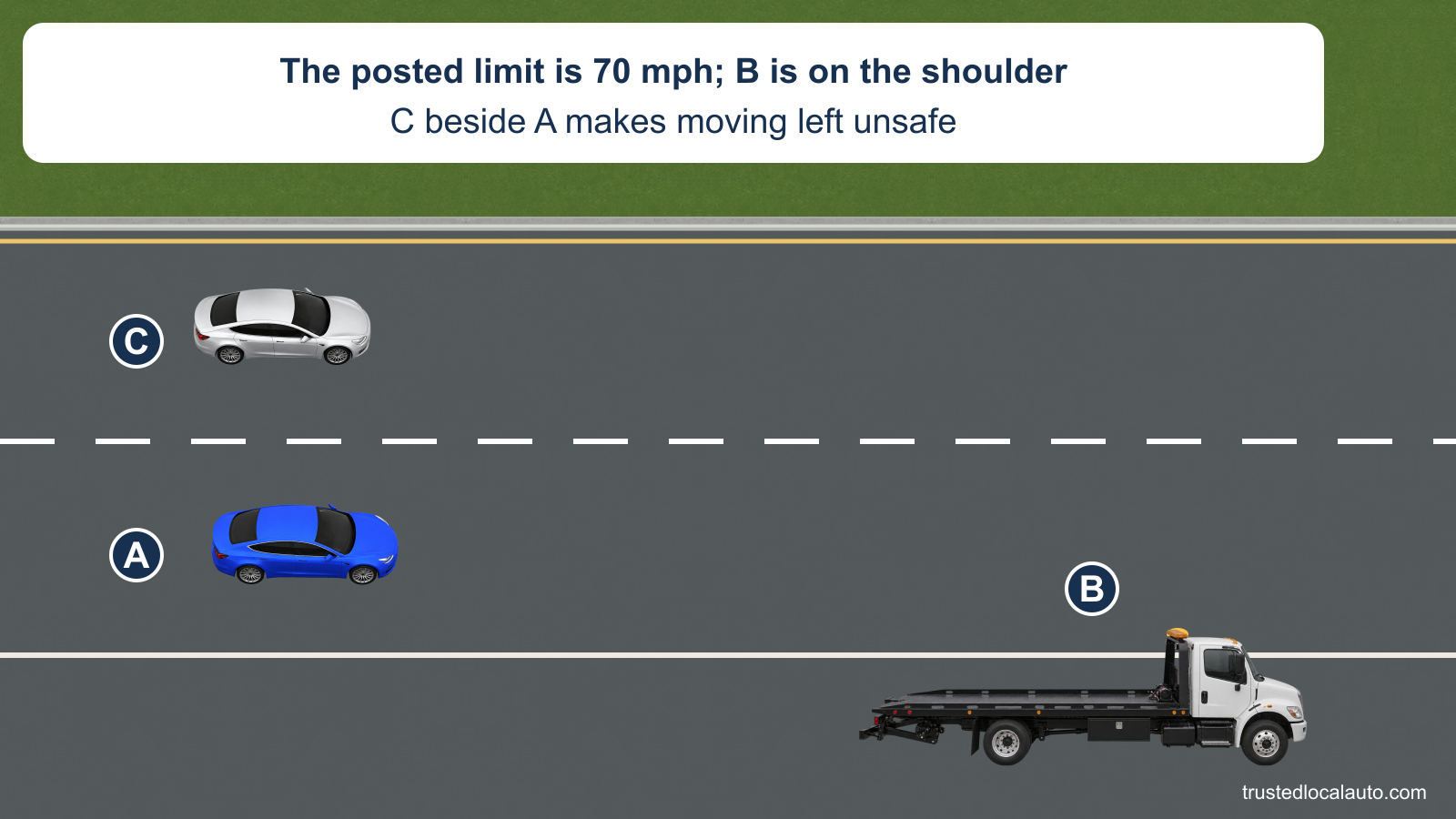
Correct answer: 50 mph
Why
The zone covers the lanes from 200 feet before to 200 feet after a stopped vehicle with warning lights, such as a police car, fire truck, ambulance, tow truck, or a road maintenance, utility or solid waste truck. Your first choice is to move to a lane farther away when it is safe; the slower speed is for when you cannot move over. Workers and responders stand only a few feet from passing traffic.
Verified against Washington Driver Guide · Emergency and work zones · p. 142, 143
Is this question correct and clear?
Continue learning
Related Washington questions
- You come to an intersection with a green light. In a work area just past the intersection, a flagger holds a STOP paddle toward you. What should you do?
- By law, a school or playground speed zone can extend a set distance from a marked school crosswalk or from the school grounds. What is the largest distance that the zone can extend?
- A long freight train has just cleared a railroad crossing. The gates are still down and the red lights still flash, but you see no other train. What should you do?
- You drive in the right lane of a freeway with two lanes in your direction. Ahead, a tow truck with its warning lights flashing is stopped on the right shoulder to help a driver. The left lane is clear. What should you do?
- You pass a stopped tow truck with flashing warning lights, and you cannot move over safely. What is the fastest speed allowed on a road posted at 50 mph, and on a road posted at 70 mph?
- A railroad crossing has a STOP sign, but no lights and no gates. You see and hear no train. Which statement is correct?