
Practice question, Question 1 of 30
Passing target: 80% (24/30)
You drive at night on a rural road with your high beams on. You enter thick fog, and the light seems to bounce back at you as a white glare. What should you do?
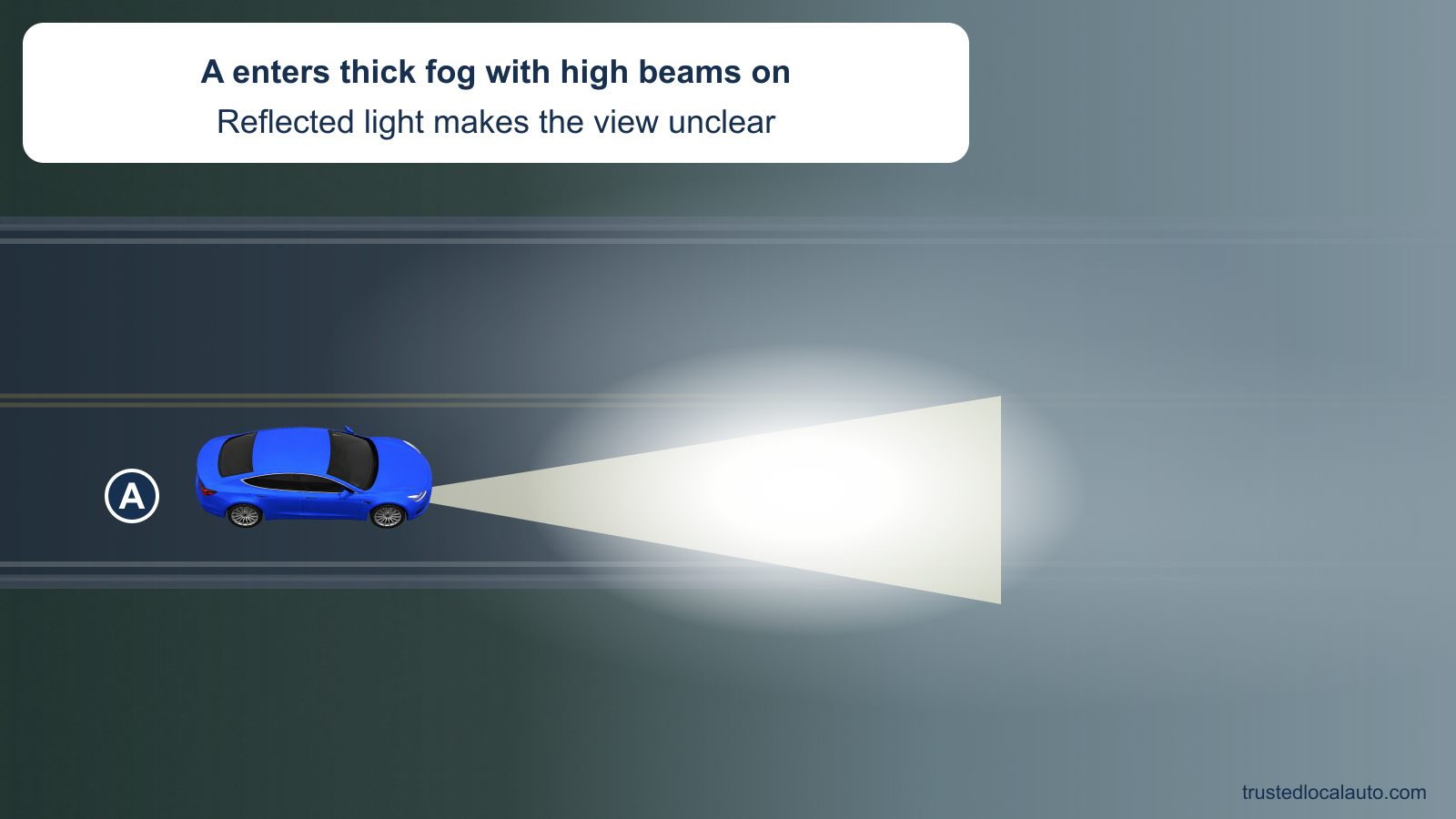
Correct answer: Use low beams and slow down, because high beams reflect off fog.
Why
Fog is made of water droplets that reflect light, so high beams make a bright wall in front of you. Low beams aim down at the road and reflect less, and other drivers can still see you. West Virginia law requires headlights, not parking lights alone, when fog is present, and the basic speed rule requires a lower speed when weather cuts your view.
Verified against West Virginia Driver's Licensing Handbook · Headlights and Their Use · p. 61
Is this question correct and clear?
Continue learning
Related West Virginia questions
- You leave a 55 mph highway and enter a town's business district, with stores and offices on both sides of the street. You have not seen a speed-limit sign yet. What is the highest speed allowed here?
- On a dry road in daylight, the car ahead passes a road sign. You start to count "one thousand one, one thousand two," and your front bumper reaches the same sign as you say "two." What does this tell you?
- You are driving at night in steady rain. The car ahead passes a mile marker, and you reach the marker just as you finish "one thousand three." What is the smallest following gap you should keep in these conditions?
- You drive at night on a dry, clear road with light traffic. What is the smallest following gap that the manual calls for in these conditions?
- At night on a dark two-lane road, you drive with your high beams on about 300 feet behind another car. Then an oncoming car appears about 450 feet ahead of you. What must you do?
- At night on a dark road, no oncoming traffic is in sight. You drive with your high beams on about 180 feet behind another car. Which statement is correct?