
Practice question, Question 1 of 65
Passing target: 80% (52/65)
On a 30 mph street, you keep a 4-second gap behind the car ahead. Now you follow a car on the freeway at 65 mph. How should your following gap change?
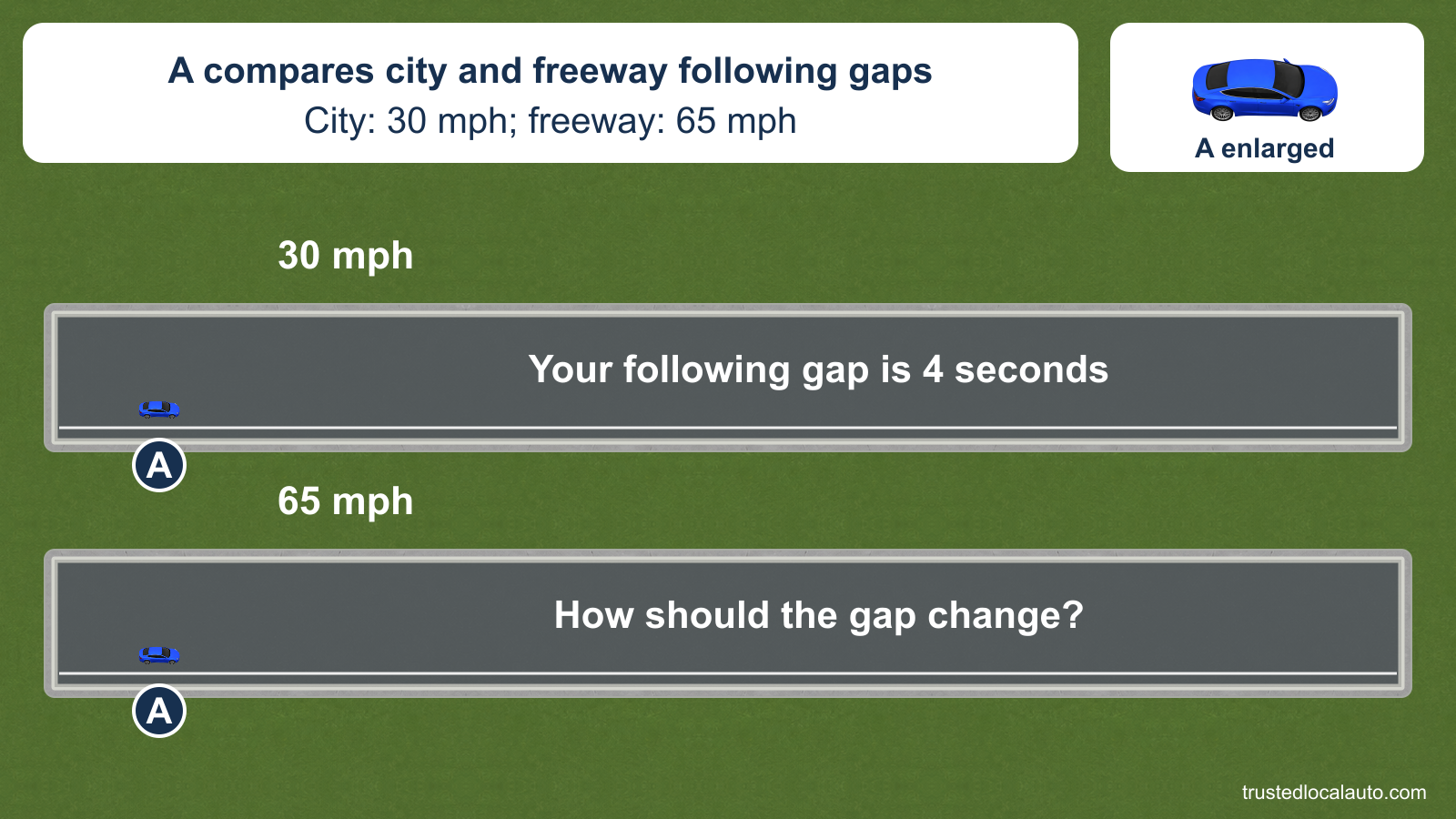
Correct answer: Keep at least 4 seconds, because a time gap grows in feet as your speed goes up.
Why
The faster you go, the more distance you need to turn, slow down or stop. A time gap grows with your speed: when the car ahead passes a fixed object, such as a sign, count the seconds until you reach it. If you get there before you count to four, drop back. Add at least one more second for each bad condition, such as rain, snow, ice or heavy traffic.
Verified against Wisconsin Motorists' Handbook · High-speed following · p. 14, 15
Is this question correct and clear?
Continue learning
Related Wisconsin questions
- Sam, 19, has just finished a 12-hour night shift. Sam plans to drive 2 hours on the freeway to visit family right after work and feels awake now. What is the safest plan?
- A signal over a freeway flex lane tells drivers that the lane is closing but is not closed yet, so they must merge out of it. Which signal shows this?
- On a Wisconsin freeway, a sign reads SHOULDER USE PERMITTED ON GREEN ARROW ONLY. You drive in the shoulder lane, and the signal above it shows a yellow X. What should you do?
- Which statement about following distance is NOT correct?
- You follow a car on a freeway at 65 mph. The road is dry, and traffic is light. What is the minimum following gap for you?
- You enter a freeway where the posted limit is 70 mph. Near the end of the acceleration lane, a car in the right freeway lane is next to you at about 70 mph. There is a large gap behind it. To merge ahead of it, you would need to go about 80 mph. What should you do?