
Practice question, Question 1 of 65
Passing target: 80% (52/65)
You follow a large truck on a highway at a distance of about 100 feet. What should you do?
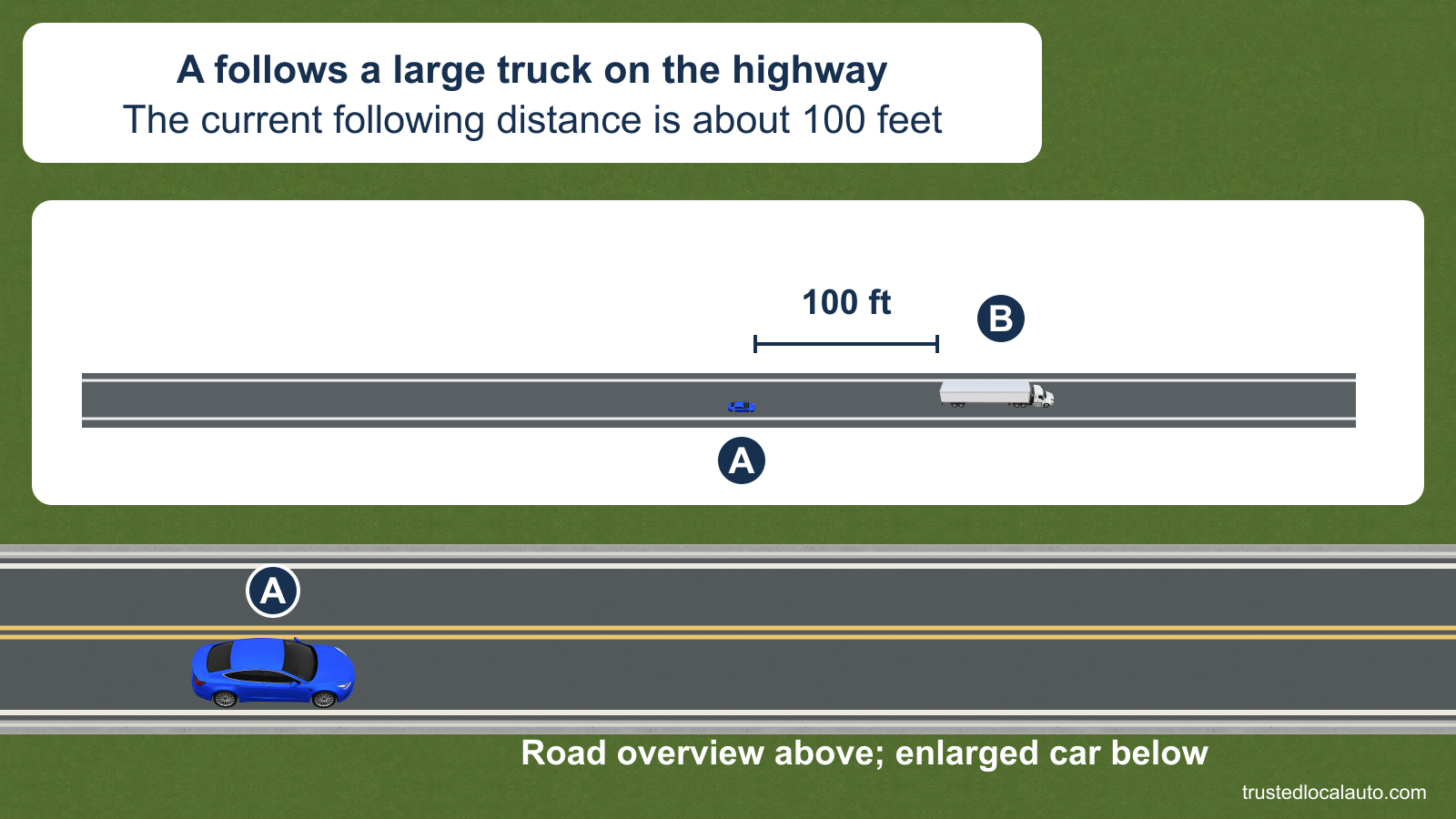
Correct answer: Drop back, because the blind area behind a large truck reaches about 200 feet.
Why
No-Zones are the areas around a large truck where its driver cannot see you: about 200 feet behind, about 20 feet in front, and along both sides. If you stay in a No-Zone, the driver can slow down or change lanes without knowing that you are there. Drop back or move ahead so that the driver can see you. When you pass a truck, get past its sides quickly.
Verified against Wisconsin Motorists' Handbook · Large trucks (No-Zones) · p. 56
Is this question correct and clear?
Continue learning
Related Wisconsin questions
- You want to pass a bicyclist who rides near the right edge of your lane. The oncoming lane is clear, and passing is allowed there. Which pass follows Wisconsin law?
- You drive on a two-lane city street. Near an intersection, a bicyclist ahead of you signals a left turn and moves from the right edge to the center of your lane. What should you do?
- On a rural road, a farmer is moving a herd of cattle along the road ahead of you. What should you do?
- On a two-lane rural highway with a 55 mph limit, you come up behind a farm tractor that moves at about 15 mph. A solid yellow line on your side marks a no-passing zone for the next mile. What should you do?
- On a highway, you follow a large truck at a distance of about 150 feet. How far behind the truck does its rear No-Zone reach, and what should you do?
- You drive in the right lane of a four-lane highway and plan to move left. A few seconds ago, your mirror showed a motorcycle far back in the left lane, closing fast. Now the mirror shows the left lane empty. What should you do?