
Practice question, Question 1 of 65
Passing target: 80% (52/65)
On a four-lane highway with a 65 mph limit, you pass a large truck at 60 mph and move back into the right lane in front of it. In your mirror you now see that the front of the truck is only about 10 feet behind your rear bumper. What should you do?
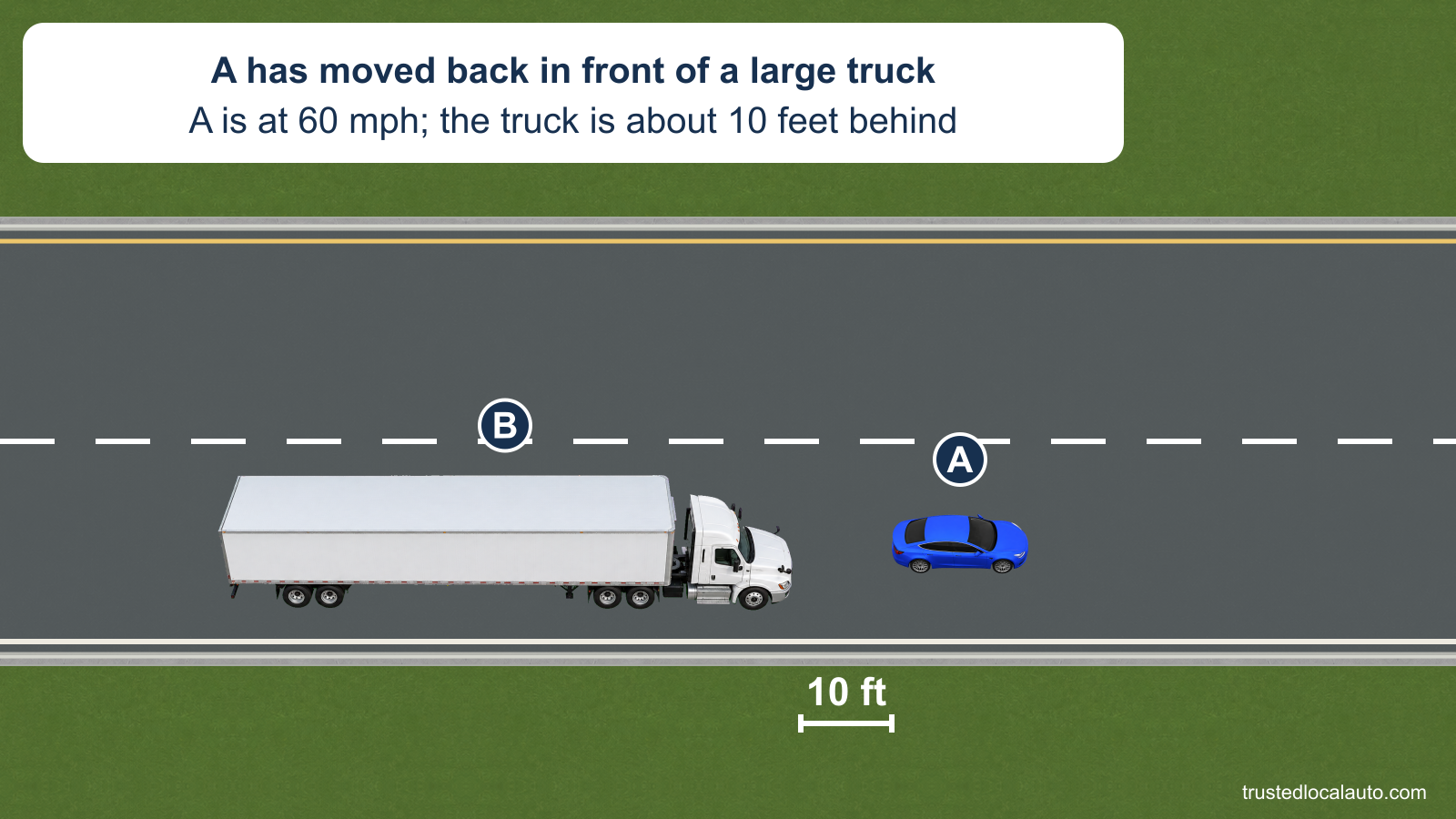
Correct answer: Speed up within the limit to open a wide gap, because at 10 feet you are in the truck's front No-Zone.
Why
No-Zones are the areas around a large truck where its driver cannot see you: about 20 feet in front, about 200 feet behind, and along the sides. Every vehicle needs clear space ahead of it to slow down and stop, and a car that cuts in close in front of a truck takes that space away. Give large vehicles extra space, and after you pass a truck, move back only when you are well clear of its front.
Verified against Wisconsin Motorists' Handbook · Large trucks (No-Zones) · p. 56, 16
Is this question correct and clear?
Continue learning
Related Wisconsin questions
- You want to pass a bicyclist who rides near the right edge of your lane. The oncoming lane is clear, and passing is allowed there. Which pass follows Wisconsin law?
- You drive on a two-lane city street. Near an intersection, a bicyclist ahead of you signals a left turn and moves from the right edge to the center of your lane. What should you do?
- On a rural road, a farmer is moving a herd of cattle along the road ahead of you. What should you do?
- On a two-lane rural highway with a 55 mph limit, you come up behind a farm tractor that moves at about 15 mph. A solid yellow line on your side marks a no-passing zone for the next mile. What should you do?
- On a highway, you follow a large truck at a distance of about 150 feet. How far behind the truck does its rear No-Zone reach, and what should you do?
- You drive in the right lane of a four-lane highway and plan to move left. A few seconds ago, your mirror showed a motorcycle far back in the left lane, closing fast. Now the mirror shows the left lane empty. What should you do?