
Back to Kansas
Kansas Class C Written Test Practice
Full test preview Question 1 of 25
0 answered 25 remaining
Passing target: 80% (20/25)
Turns, Lanes, Passing & MergingStandalone practice
How should a driver make an ordinary left turn from a two-way road into another two-way road?
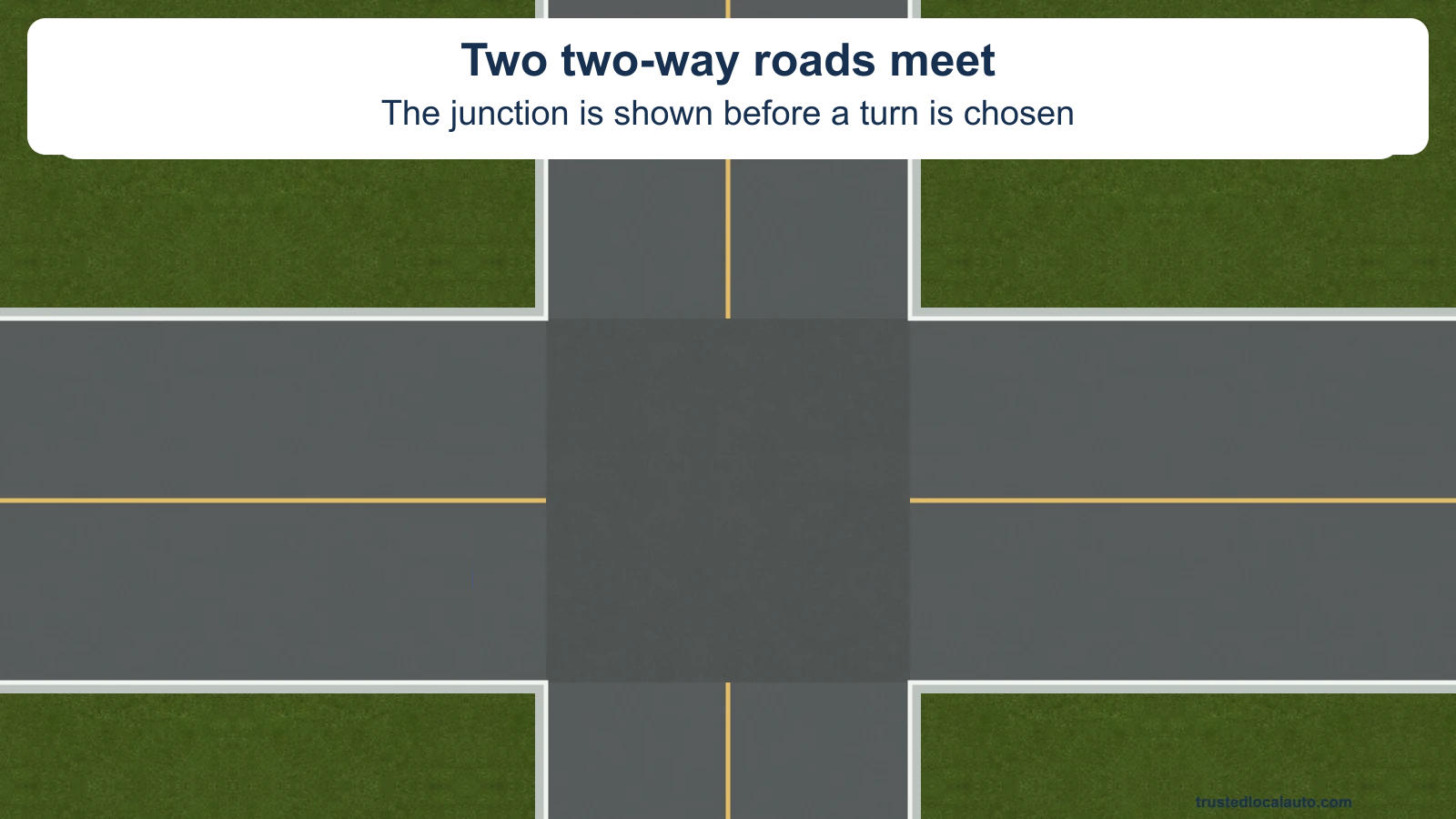
Two two-way roads meet at an empty junction. Yellow center lines separate opposing traffic; no car or turn route is shown.
Correct answer: Start near the center line and end just right of the new road's center line.
Why
For an ordinary two-way-to-two-way left turn, approach in the lawful lane nearest the center line and leave the intersection to the right of the destination road’s center line in the nearest lawful lane. Yield to conflicting traffic and crossing users. Signs or lane markings can direct a different lawful course.
Verified against Kansas Driving Handbook · Turning · p. 17, 46, 47
Report a question issueContinue learning
Related Kansas questions
Outside a city, a road has two lanes in your direction. You are not passing or preparing for a left turn, and no control or other legal exception applies. Which lane should you ordinarily use?You are driving an ordinary passenger car. When may you overtake another vehicle on the right?You want to turn left into a driveway across double solid yellow center lines. No turn prohibition applies, and you can yield and complete the turn safely. Does the no-passing marking alone forbid this turn?You pass your intended exit in a single-lane roundabout with no control requiring you to leave sooner. What should you do?On a two-way road, which side is normally used to pass a slower vehicle traveling in the same direction?A stationary obstruction blocks your side of a two-way road. You would need to move left of center, but an oncoming car is close enough to be a hazard. What must you do?