
Practice question, Question 1 of 30
Passing target: 80% (24/30)
At night on a dark, empty two-lane road, your headlights suddenly go out. You try the parking lights, the hazard warning lights and the turn signals, but none of them work. What should you do?
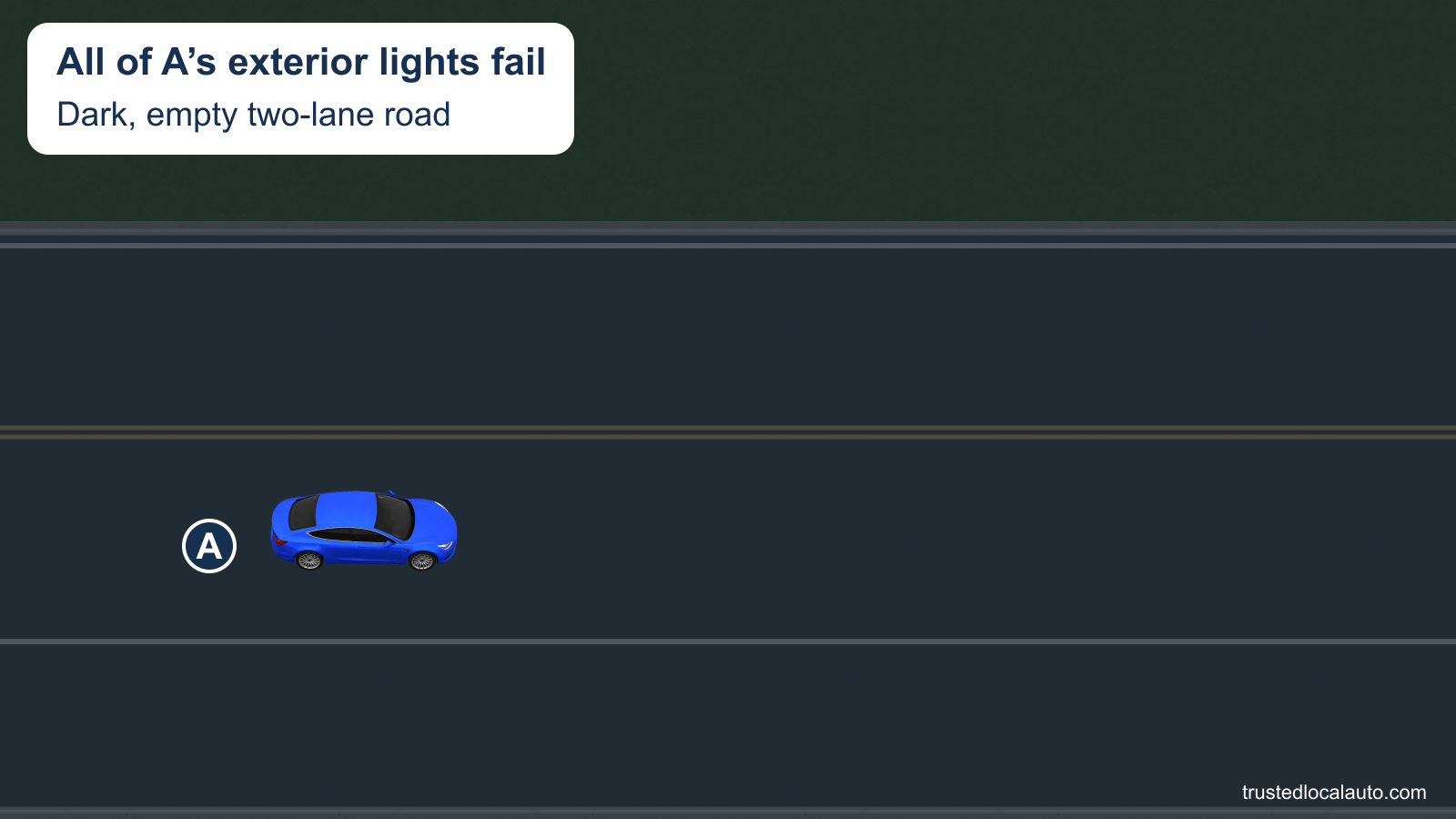
Correct answer: Slow down and keep the car on the pavement until you can move onto the shoulder safely.
Why
When your headlights go out, first try the parking lights, the hazard warning lights and the turn signals, because one of them may give enough light to guide you off the road. On a busy or lighted road, the light around you is usually enough to see by. On a dark road with no working lights, a slow, controlled move to the shoulder is safest. When you are off the road, call for help.
Verified against Minnesota Driver's Manual · Headlight failure · p. 89
Is this question correct and clear?
Continue learning
Related Minnesota questions
- You press the brake pedal, and it suddenly sinks all the way to the floor. The car does not slow down. What should you try first?
- You sit in a parked car with the engine running and the windows closed. You suddenly feel tired and dizzy, and you have a headache. What should you do?
- After an overnight snowfall, you scrape a clear patch on the windshield and on the driver's window. Snow and ice still cover the hood, the other windows, the headlights and the taillights. What should you clear before you drive?
- You are driving on a rural highway at 55 mph with cruise control on. Freezing drizzle starts, and the road surface begins to look wet and shiny. What should you do?
- At night, your high beams are on. You must switch to low beams within one distance of an oncoming vehicle and within another distance of a vehicle that you follow. Which pair of distances is correct?
- The car ahead of you stops suddenly. You press the brake pedal hard in your car, which has anti-lock brakes (ABS). The pedal pulses under your foot, and you hear a grinding sound. What should you do?