
Practice question, Question 1 of 25
Passing target: 80% (20/25)
You are driving on a one-way street with two lanes. A broken white line separates your lane from the lane on your left, and you want to move into that lane. What does the broken white line tell you?
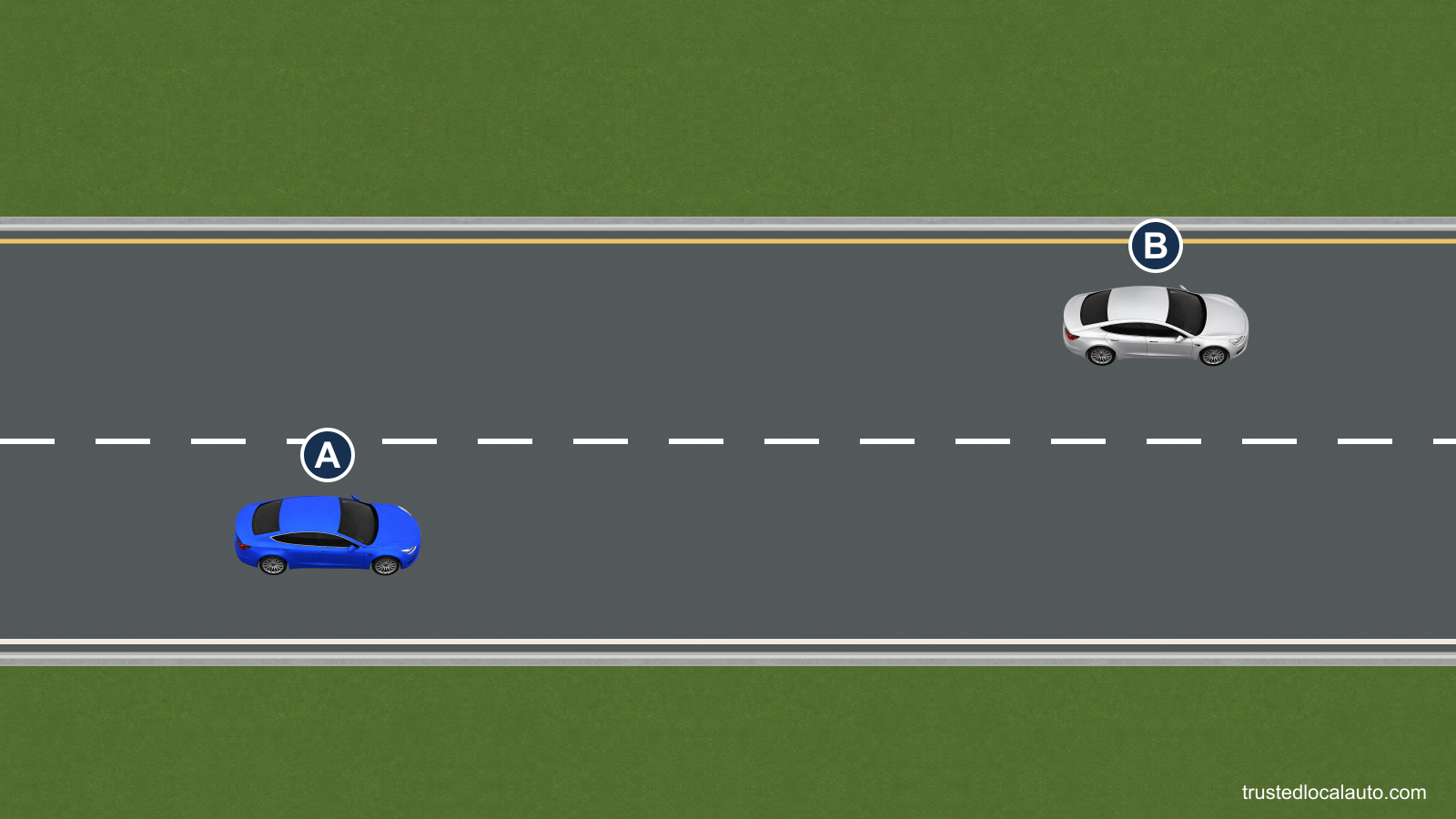
Correct answer: Both lanes go your way, so you may cross the line once you have checked that it is safe and signaled.
Why
Line color tells you the direction of traffic: white lines separate lanes that go the same way, and yellow lines separate traffic that goes in opposite directions. The line pattern tells you whether to cross: broken lines may be crossed with care, and solid lines discourage crossing. Signal at least 100 feet before you move right or left, check your mirrors and your blind spot, and do not change lanes in an intersection.
Verified against Nebraska Class O Driver's Manual · White lane line markings (3C-3) · p. 53, 62, 63
Is this question correct and clear?
Continue learning
Related Nebraska questions
- On a two-lane road, two solid yellow lines run side by side in the center. A car ahead of you is slow, and the oncoming lane looks clear for a long way. What do the lines mean?
- You are on a two-lane road marked with two solid yellow center lines. A car ahead is going 10 mph below the limit, and the oncoming lane looks clear for a long way. What do the lines mean for you?
- You drive on a two-lane road with double solid yellow center lines. A slow car is ahead of you. You will turn left into a driveway a short way ahead, and no sign prohibits the turn. May you cross the center lines?
- You approach a railroad crossing that has flashing red lights but no gate and no stop line. The lights begin to flash, but you cannot see or hear a train. What must you do?
- You approach an intersection where the traffic light is flashing red in your direction. What must you do?
- You are first in line at a red light. The light turns green, but a pedestrian is still finishing the crossing in front of you, and a car from the cross street is still clearing the intersection. What should you do?