
Practice question, Question 1 of 25
Passing target: 80% (20/25)
On a two-lane road, the center line has a solid yellow line on your side and a broken yellow line on the side of oncoming traffic. Which statement about passing is correct?
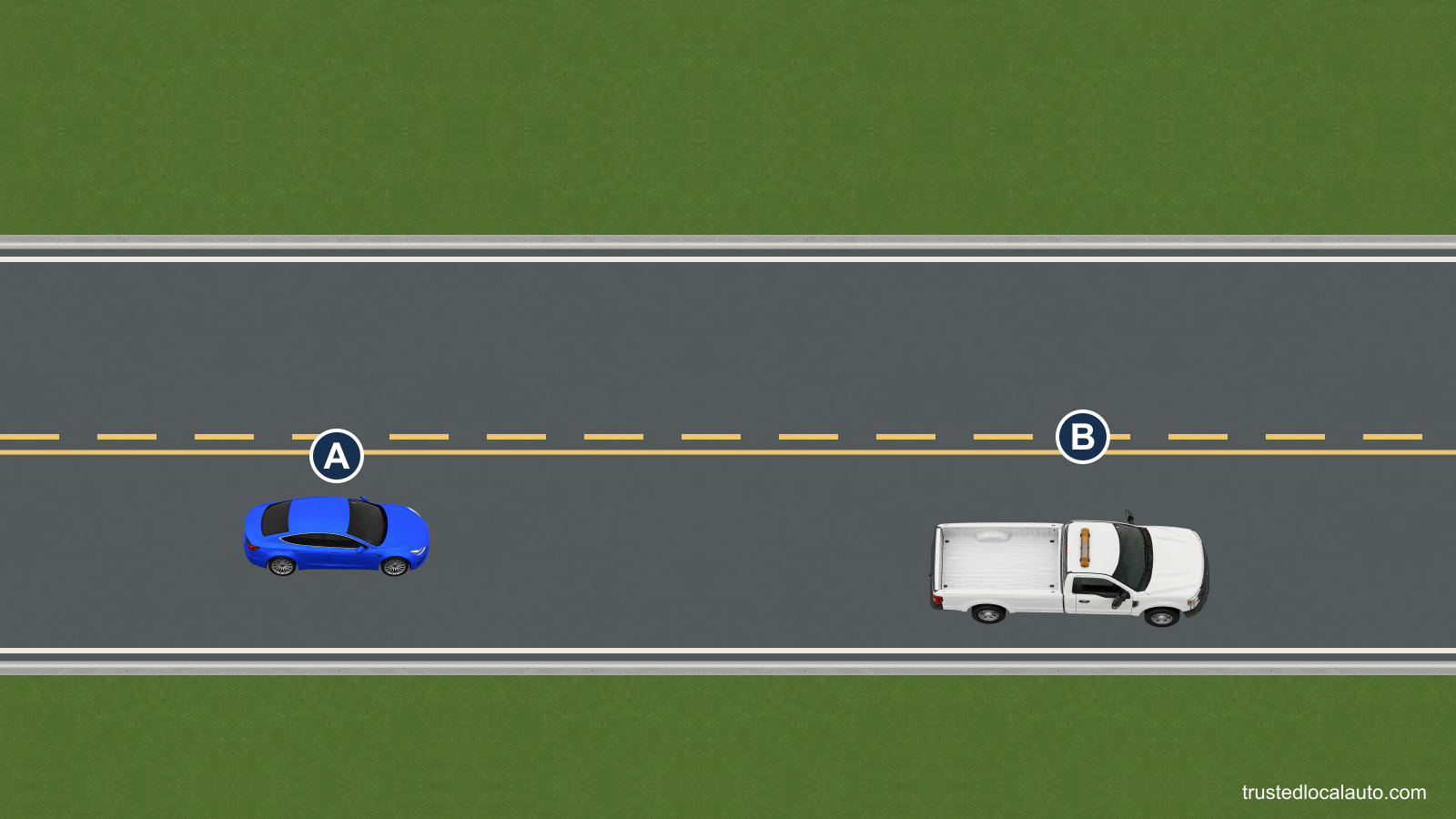
Correct answer: Oncoming drivers may pass when the way is clear, but you may not cross the line to pass.
Why
Yellow center lines separate traffic that moves in opposite directions, so a pass here puts you in the lane of oncoming vehicles. Read the line nearest you: a broken yellow line lets you pass when the way ahead is clear, a solid one does not, and double solid yellow lines stop passing in both directions. Even where passing is allowed, you must not go over the speed limit to pass.
Verified against Nebraska Class O Driver's Manual · Yellow center line markings (3C-1) · p. 52, 61
Is this question correct and clear?
Continue learning
Related Nebraska questions
- You are driving on a one-way street with two lanes. A broken white line separates your lane from the lane on your left, and you want to move into that lane. What does the broken white line tell you?
- On a two-lane road, two solid yellow lines run side by side in the center. A car ahead of you is slow, and the oncoming lane looks clear for a long way. What do the lines mean?
- You are on a two-lane road marked with two solid yellow center lines. A car ahead is going 10 mph below the limit, and the oncoming lane looks clear for a long way. What do the lines mean for you?
- You drive on a two-lane road with double solid yellow center lines. A slow car is ahead of you. You will turn left into a driveway a short way ahead, and no sign prohibits the turn. May you cross the center lines?
- You approach a railroad crossing that has flashing red lights but no gate and no stop line. The lights begin to flash, but you cannot see or hear a train. What must you do?
- You approach an intersection where the traffic light is flashing red in your direction. What must you do?