
Practice question, Question 1 of 40
Passing target: 80% (32/40)
Your car starts to lose power on a rural two-lane highway. You can still drive it a short distance, and the shoulder is narrow. Where should you stop?
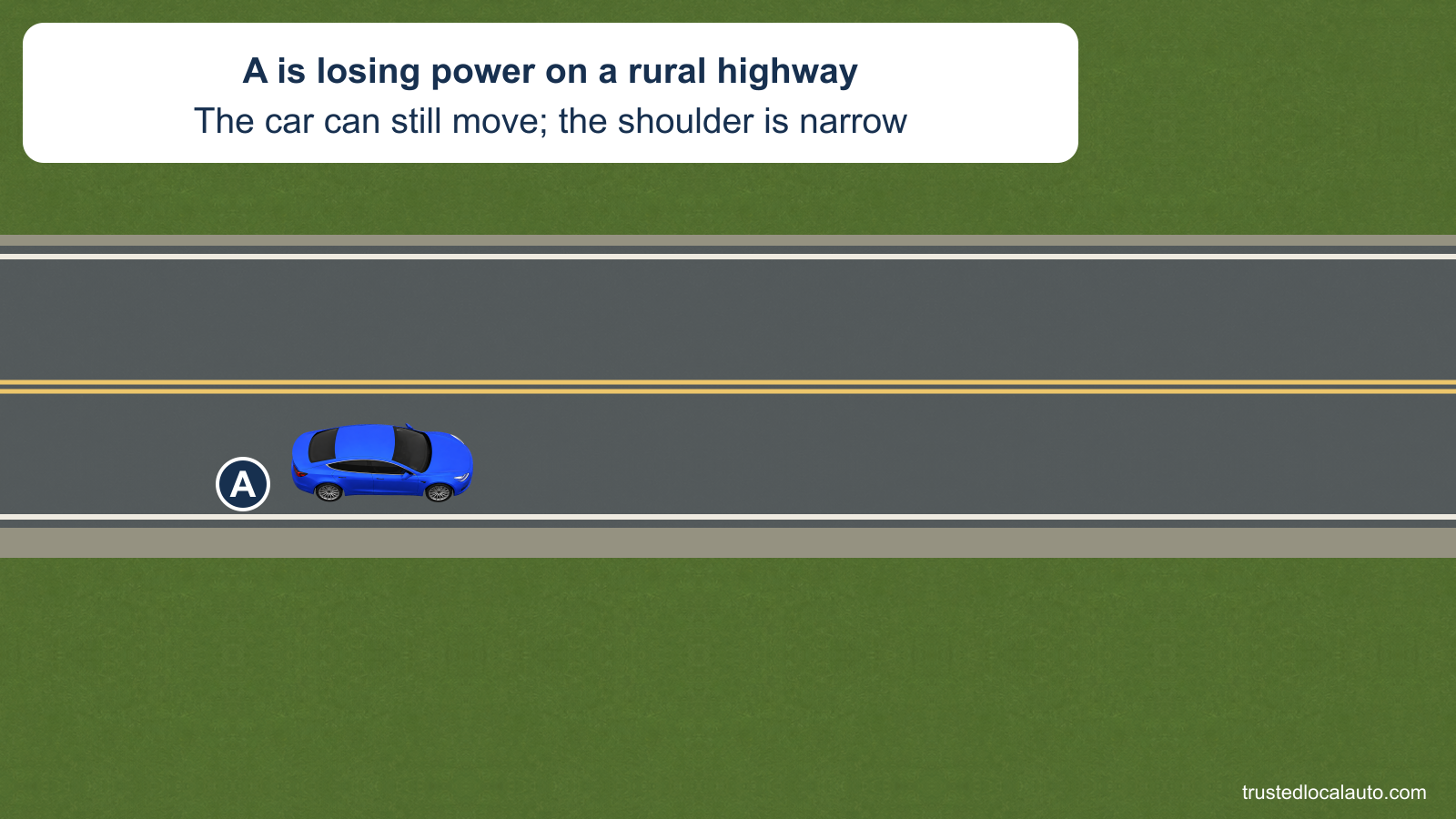
Correct answer: As far off the pavement as you can, at a spot where drivers can see the car from 200 feet each way
Why
A stopped car is a hazard for its occupants and for approaching drivers, who need time to see it and to go around it. Pull fully off the road when you can; if you cannot, leave room for traffic and a clear view of 200 feet in both directions. Then turn on the emergency flashers and, if you have them, set flares or reflectors about 200 feet in front of and behind the car.
Verified against New Hampshire Driver's Manual · Parking on rural highways · p. 33, 34, 41
Is this question correct and clear?
Continue learning
Related New Hampshire questions
- Your car has a backup camera. You are about to back out of a driveway where children often play. What is the safest way to do it?
- You find an open parallel parking space on the right side of a busy street. How should you begin to back into it?
- You park facing downhill on a street with a curb. Your car has an automatic transmission. How should you set the wheels, the brake and the gear so that the car cannot roll?
- You must park on a steep hill on a rural road that has no curb, only a gravel edge. Which way should you turn the front wheels?
- You are backing out of an angled parking space with cars parked on both sides of you. When should you turn the steering wheel?
- A fire station is on your street, and no-parking signs are posted near it. You want to park on the opposite side of the street, about 60 feet from the station's driveway entrance. Which statement is correct?