
Practice question, Question 1 of 40
Passing target: 80% (32/40)
It is night, light snow covers the road, and patches of fog cut your view. You follow another car at about 30 mph. Which following gap fits these conditions?
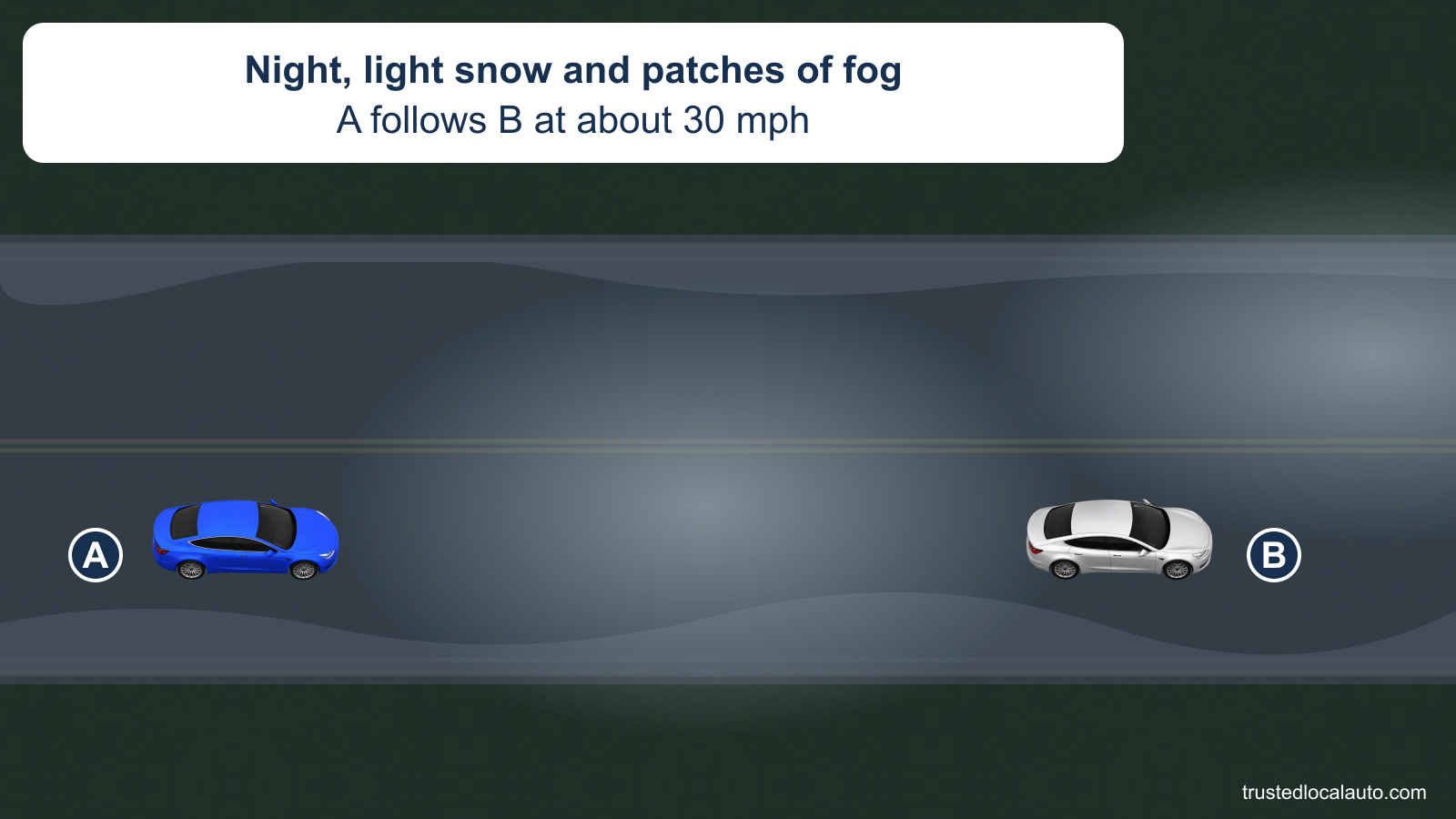
Correct answer: More than four seconds, because each of these hazards calls for extra space
Why
On a slippery road the brakes need more distance, and in darkness or fog you see a hazard later, so both your perception distance and your braking distance grow. The manual gives numbers for night driving: add at least one second to the gap at night, and at least two seconds on roads at night that you do not know. Also leave extra space behind trucks, buses, vehicles that pull a trailer and vehicles that must stop at railroad crossings.
Verified against New Hampshire Driver's Manual · Following distance · p. 37, 24
Is this question correct and clear?
Continue learning
Related New Hampshire questions
- Two drivers go 40 mph on the same road, which has a posted limit of 45 mph. Driver A drives on a dry, clear day in light traffic, with no hazards in view. Driver B drives in heavy snow, can see only about 100 feet ahead, and feels the tires slip when braking. Is each driver's speed lawful?
- You drive at 35 mph through a downtown business district. You have seen no speed limit sign since you entered it, and traffic is light. Are you within the speed limit?
- The manual sets four seconds as the minimum following gap in good conditions. What minimum time does it tell you to add at night, and at night on a road that you do not know?
- At night, on a dry road that you know well, you follow a car. There is no rain, snow or fog. By the manual, what is the smallest following gap for these conditions?
- Your car has a forward collision warning system. On the highway, it beeps and flashes because the traffic ahead has slowed sharply. What does the system do, and what must you do?
- On a dry, clear day, the car ahead of you passes a road sign. You count "one-thousand-one, one-thousand-two" and then reach the same sign. What should you do?