
Practice question, Question 1 of 40
Passing target: 80% (32/40)
You follow a large box truck on a two-lane road. You cannot see the road ahead of the truck. What should you do?
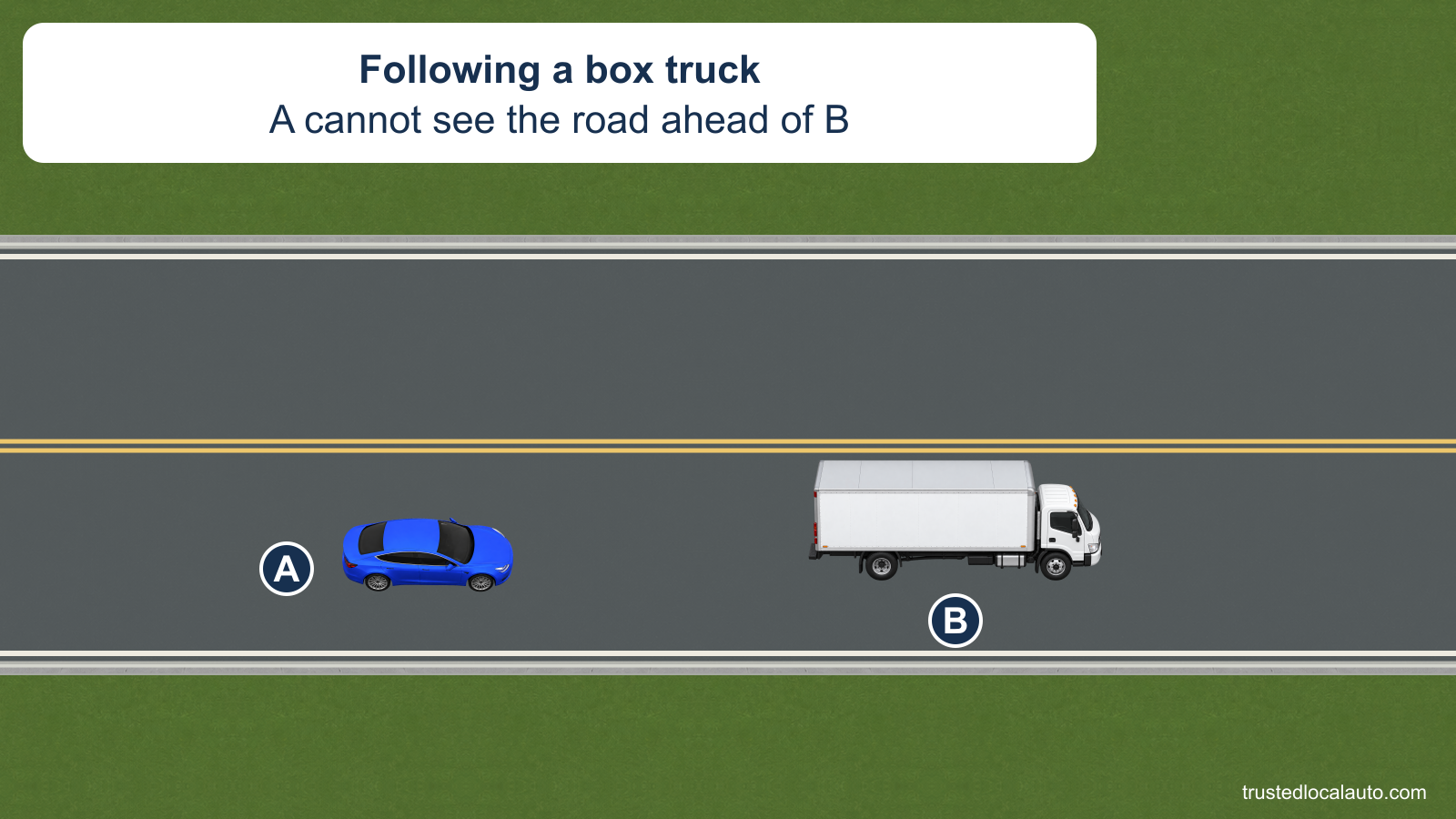
Correct answer: Drop back and adjust your position in the lane so you can see down the road past the truck.
Why
Good visual search means that you keep your eyes moving: look far ahead, search to the sides and check your mirrors often. When you can see past the vehicle in front, you notice stopped traffic or a hazard early and can slow down smoothly. A larger gap behind a truck also gives you more time to stop if the truck brakes hard.
Verified against New Hampshire Driver's Manual · Visual search · p. 36
Is this question correct and clear?
Continue learning
Related New Hampshire questions
- Two drivers go 40 mph on the same road, which has a posted limit of 45 mph. Driver A drives on a dry, clear day in light traffic, with no hazards in view. Driver B drives in heavy snow, can see only about 100 feet ahead, and feels the tires slip when braking. Is each driver's speed lawful?
- You drive at 35 mph through a downtown business district. You have seen no speed limit sign since you entered it, and traffic is light. Are you within the speed limit?
- It is night, light snow covers the road, and patches of fog cut your view. You follow another car at about 30 mph. Which following gap fits these conditions?
- The manual sets four seconds as the minimum following gap in good conditions. What minimum time does it tell you to add at night, and at night on a road that you do not know?
- At night, on a dry road that you know well, you follow a car. There is no rain, snow or fog. By the manual, what is the smallest following gap for these conditions?
- Your car has a forward collision warning system. On the highway, it beeps and flashes because the traffic ahead has slowed sharply. What does the system do, and what must you do?