
Practice question, Question 1 of 40
Passing target: 80% (32/40)
A ball rolls into the street ahead of you, and you must stop. Which distances make up your total stopping distance?
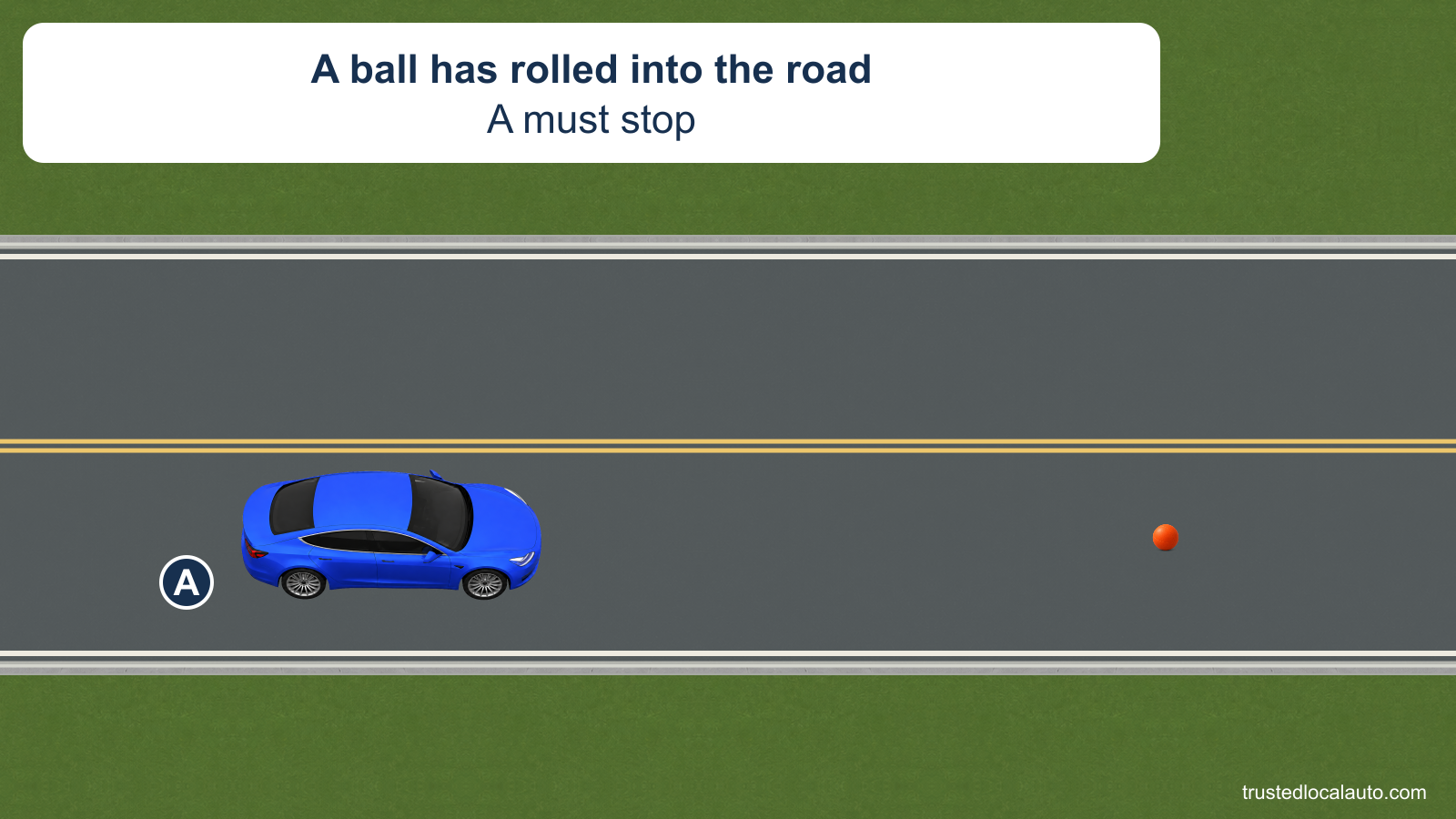
Correct answer: Perception, reaction and braking distance, from when you see the ball
Why
Perception and reaction together take an average driver about 1.5 to 2 seconds, and the car covers that distance before it starts to slow. Speed has the largest effect: the manual says that stopping distance grows about four times when speed doubles, and at 50 mph on dry pavement with good brakes the braking part alone is about 158 feet. This is why a low speed near children, parked cars and crosswalks matters so much.
Verified against New Hampshire Driver's Manual · Stopping distance · p. 22
Is this question correct and clear?
Continue learning
Related New Hampshire questions
- Two drivers go 40 mph on the same road, which has a posted limit of 45 mph. Driver A drives on a dry, clear day in light traffic, with no hazards in view. Driver B drives in heavy snow, can see only about 100 feet ahead, and feels the tires slip when braking. Is each driver's speed lawful?
- You drive at 35 mph through a downtown business district. You have seen no speed limit sign since you entered it, and traffic is light. Are you within the speed limit?
- It is night, light snow covers the road, and patches of fog cut your view. You follow another car at about 30 mph. Which following gap fits these conditions?
- The manual sets four seconds as the minimum following gap in good conditions. What minimum time does it tell you to add at night, and at night on a road that you do not know?
- At night, on a dry road that you know well, you follow a car. There is no rain, snow or fog. By the manual, what is the smallest following gap for these conditions?
- Your car has a forward collision warning system. On the highway, it beeps and flashes because the traffic ahead has slowed sharply. What does the system do, and what must you do?