
Practice question, Question 1 of 20
Passing target: 70% (14/20)
On a two-lane road, one lane is closed for repairs. A flagger at your end of the work zone faces you and holds up a STOP paddle. You see no oncoming cars. What should you do?
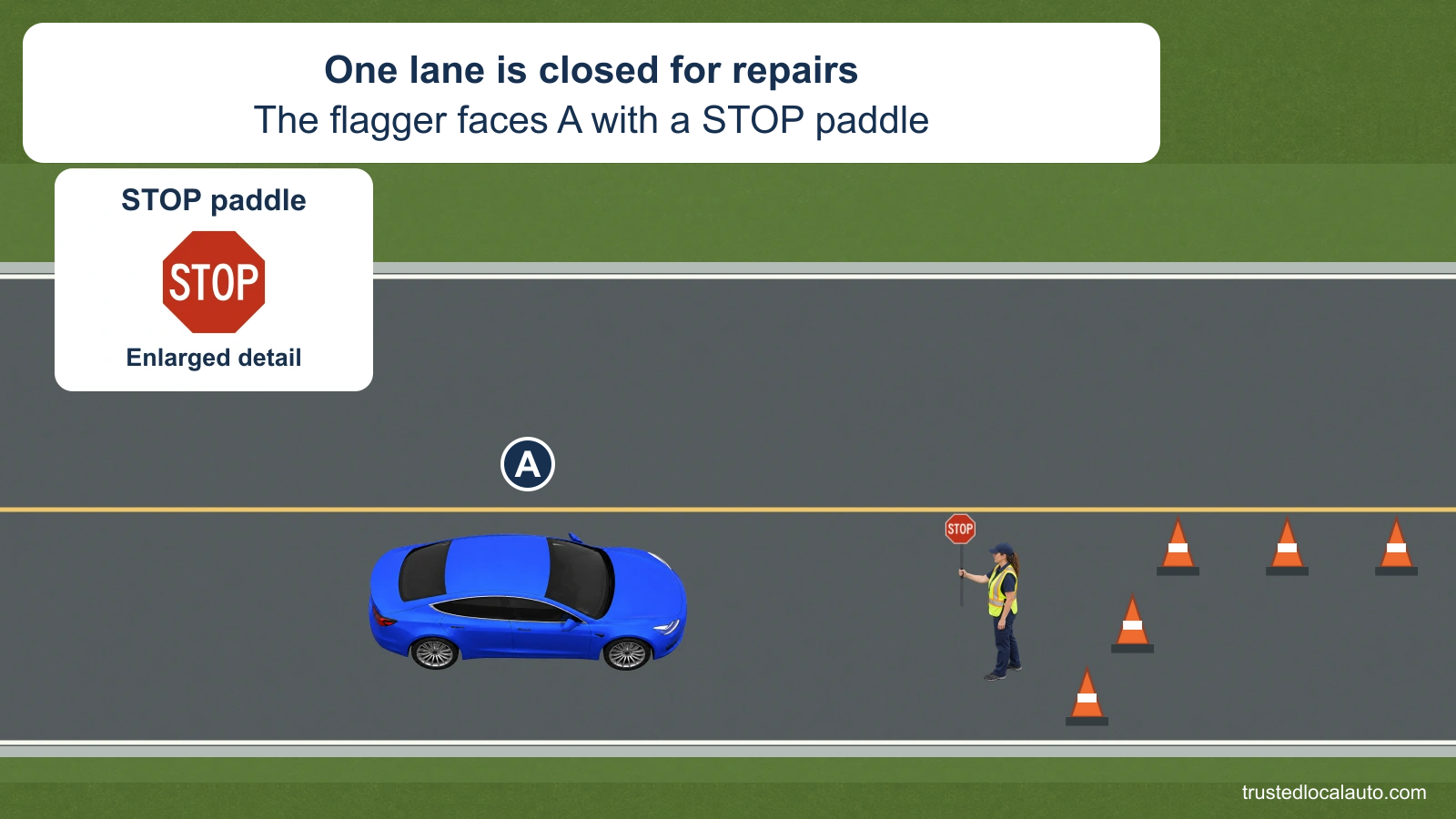
Correct answer: Stop and wait until the flagger signals you to move ahead
Why
A flagger is a worker who directs traffic through a work zone. The flagger may tell you to stop, to go ahead with caution or to change lanes. New York law requires you to obey these directions, and the manual says a flagger has the same authority as a sign. In a one-lane section, the flagger can see or coordinate traffic that you cannot, so going early can put you head-on with an oncoming vehicle.
Verified against New York State Driver's Manual · How to Drive Safely in Work Zones · p. 49
Is this question correct and clear?
Continue learning
Related New York questions
- Traffic ahead of you is backed up past a railroad crossing. The gates are up, the lights are off, and no train is coming. There is not yet room for your car on the far side of the tracks. What should you do?
- You drive toward a railroad crossing. The red lights start to flash, the bell rings, and the gate arm begins to come down while you are still about 150 feet away. What must you do?
- You are stopped at a crossing that has a crossbuck sign with a "2 TRACKS" plate but no gates or lights. A long freight train passes on the near track. As its last car goes by, what should you do before you cross?
- You pass this sign. No lower speed limit is posted, and you do not see any workers yet. What does New York require of you?
- You follow a slow car on a two-way road and see a railroad crossing ahead. At what distance before the crossing does New York law start to forbid a pass on the left?
- On a two-way road, you follow a slow car. A railroad crossing is about 80 feet ahead, and no sign is posted. Which statement is correct?