
Practice question, Question 1 of 20
Passing target: 70% (14/20)
You are stopped at a crossing that has a crossbuck sign with a "2 TRACKS" plate but no gates or lights. A long freight train passes on the near track. As its last car goes by, what should you do before you cross?
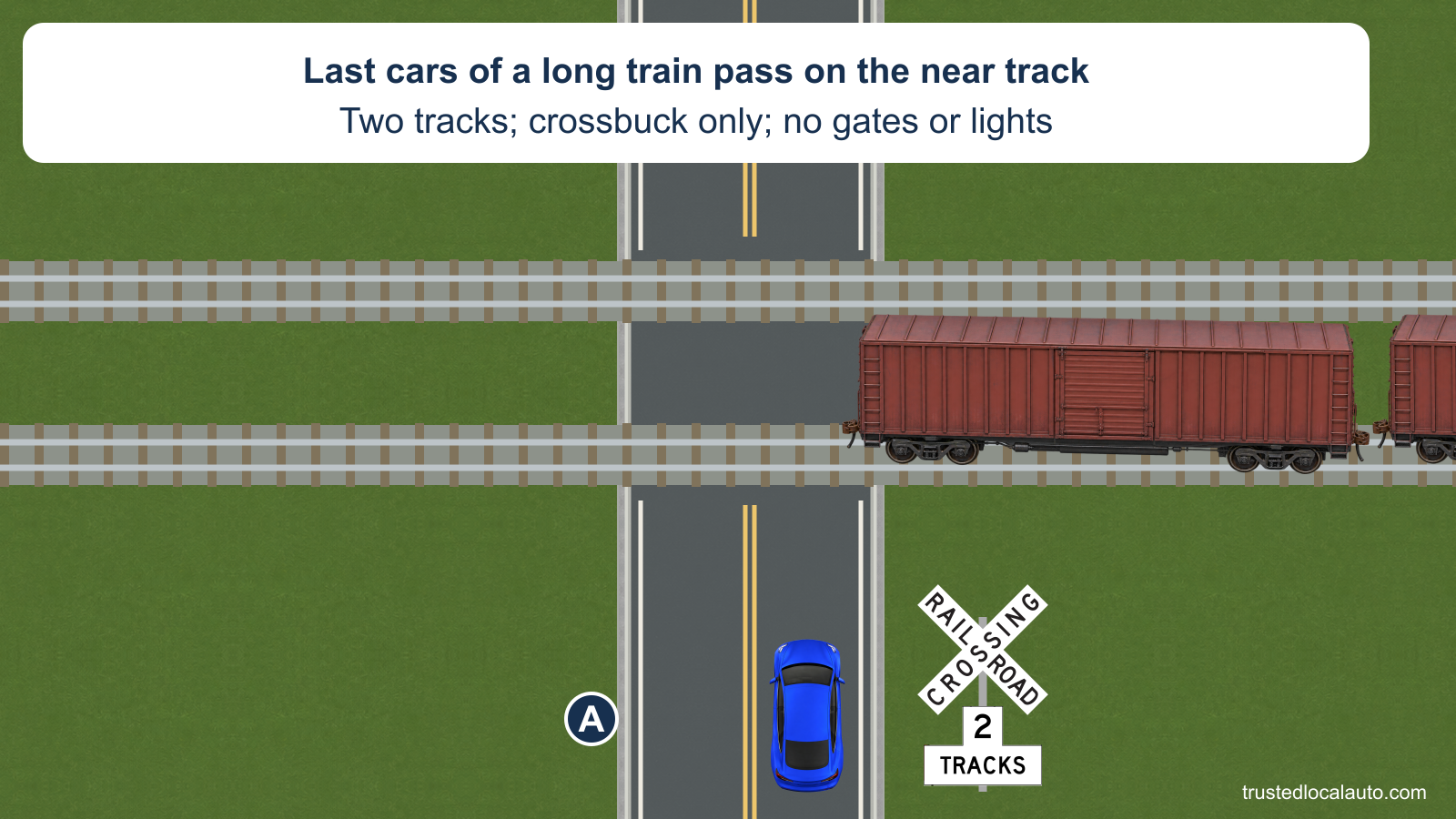
Correct answer: Wait until the train has gone far enough that you can clearly see down both tracks, both ways.
Why
At a crossing without gates or lights, the crossbuck works like a yield sign, and a plate below it shows the number of tracks. New York law requires you to stop when a train is plainly visible and close to the crossing, and to go only when you can do so safely. Keep in mind that a train you can see is nearer and faster than it looks.
Verified against New York State Driver's Manual · Railroad Crossings · p. 60, 61
Is this question correct and clear?
Continue learning
Related New York questions
- Traffic ahead of you is backed up past a railroad crossing. The gates are up, the lights are off, and no train is coming. There is not yet room for your car on the far side of the tracks. What should you do?
- You drive toward a railroad crossing. The red lights start to flash, the bell rings, and the gate arm begins to come down while you are still about 150 feet away. What must you do?
- On a two-lane road, one lane is closed for repairs. A flagger at your end of the work zone faces you and holds up a STOP paddle. You see no oncoming cars. What should you do?
- You pass this sign. No lower speed limit is posted, and you do not see any workers yet. What does New York require of you?
- You follow a slow car on a two-way road and see a railroad crossing ahead. At what distance before the crossing does New York law start to forbid a pass on the left?
- On a two-way road, you follow a slow car. A railroad crossing is about 80 feet ahead, and no sign is posted. Which statement is correct?