
Practice question, Question 1 of 30
Passing target: 80% (24/30)
You stop at an intersection that has a stop sign on each of its four approaches. A car on the cross street to your left came to a full stop a moment before you did. Both of you want to go straight. Who should go first?
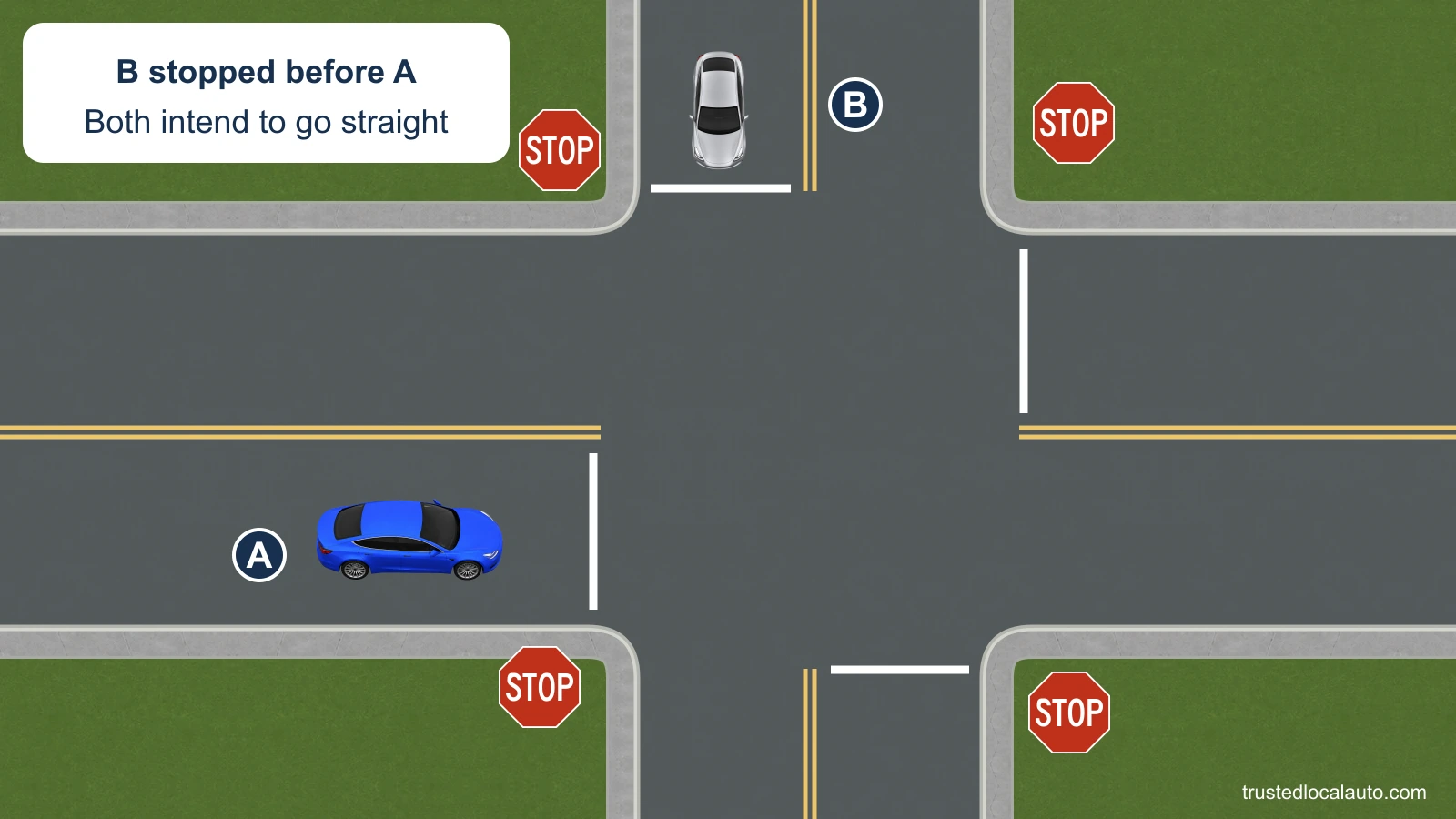
Correct answer: The car on your left, because it stopped first; you go after it clears
Why
Stop signs on all approaches make every driver stop, and no driver may go until it is safe to do so. Taking turns in the order of stopping is the accepted practice, and when two vehicles stop at the same time, the driver on the left yields to the driver on the right. Even when it is your turn, look for pedestrians and for a driver who goes out of turn. Treat a dark traffic signal the same way, as if a stop sign controls each approach.
Verified against North Carolina Driver Handbook · Intersections · p. 59, 83
Is this question correct and clear?
Continue learning
Related North Carolina questions
- You stop at an intersection that has a stop sign on each of its four approaches. A car on the cross street to your right comes to a full stop a moment after you. Both of you want to go straight. Who should go first?
- You drive on a four-lane limited-access highway with a median. An ambulance with flashing lights and a siren comes toward you on the other roadway, across the median. No officer directs traffic. Which statement is correct?
- At an intersection with no traffic signals, a pedestrian at the corner holds a white cane out in front at arm's length and starts to cross the street in front of you. What does North Carolina law require you to do?
- At an intersection with no traffic signals, a blind pedestrian with a guide dog starts to cross the street in front of you. The person does not carry a cane. What does North Carolina law require you to do?
- Your light turns green, but traffic on the far side of the intersection is backed up. If you enter now, your car will have to stop in the intersection or in the far crosswalk. What should you do?
- You are driving on a two-lane city street. An ambulance with flashing lights and a siren comes up behind you. No officer is directing traffic. What does North Carolina law require you to do?