
Practice question, Question 1 of 30
Passing target: 80% (24/30)
At dusk on a two-lane highway, you see a deer at the edge of the road ahead. As you get closer, it jumps into your lane. A car is coming in the other lane. What should you do?
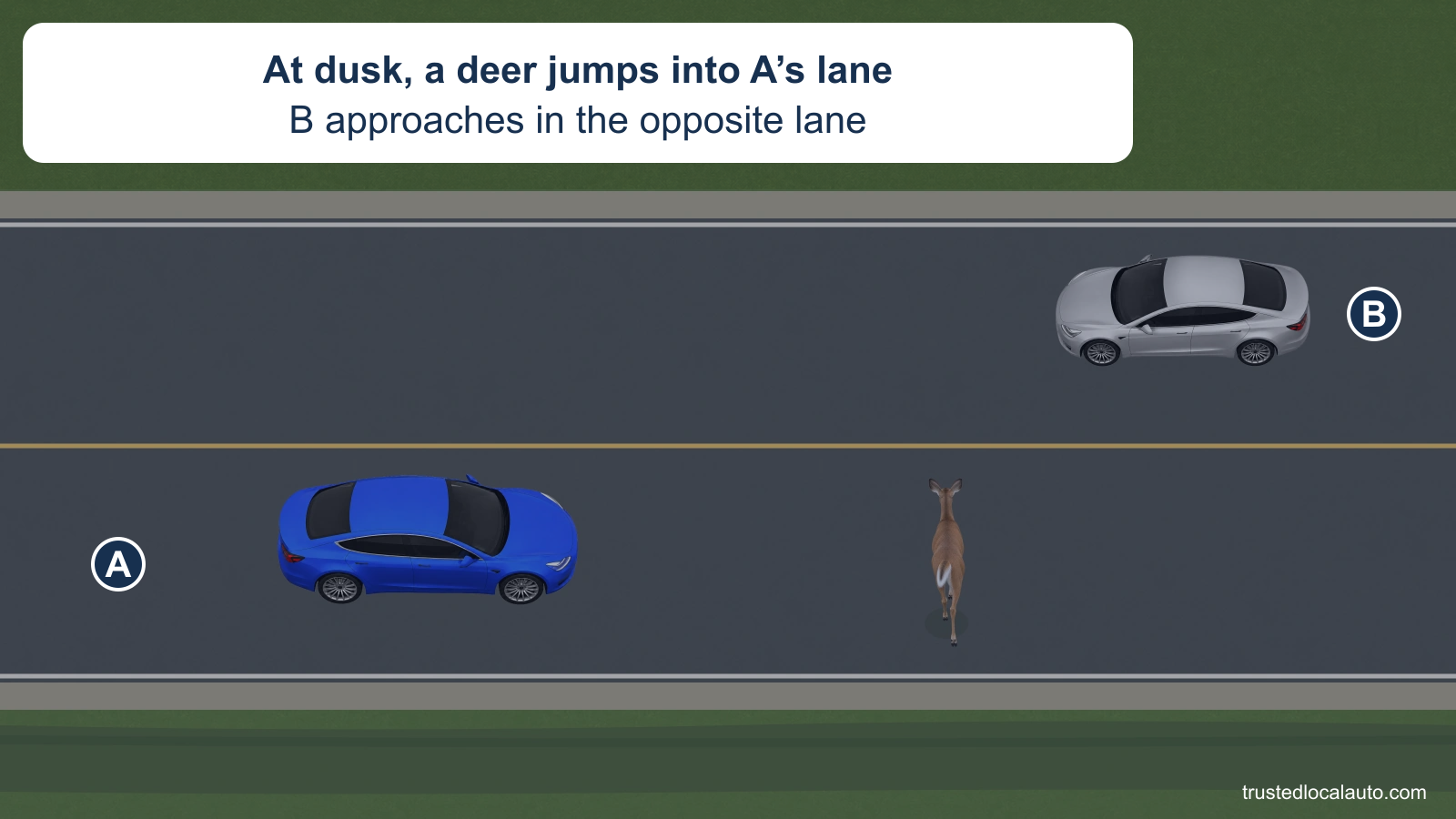
Correct answer: Brake firmly and stay in your lane, because a swerve can cause a worse crash.
Why
Watch closely for animals, and especially deer, at dawn and dusk, and slow down where deer crossing signs are posted. Scan the sides of the road, because an animal at the edge can jump into your lane. If an animal is in your path, brake and stay in your lane. Do not swerve, because a swerve can cause a collision with another vehicle or a tree, or a rollover.
Verified against 2025-2027 Class D Noncommercial Driver License Manual · Night driving · p. 29
Is this question correct and clear?
Continue learning
Related North Dakota questions
- Your car has anti-lock brakes (ABS). On an icy road, the car ahead stops suddenly. You brake hard and feel the brake pedal pulse under your foot. What should you do?
- Which of these North Dakota rules uses a distance of 300 feet?
- Heavy rain has flooded a dip in the road ahead. The water looks only a few inches deep, and there is no barricade. What should you do?
- On a two-lane highway, you come up behind a snowplow at work. It throws sand, and the blowing snow behind it makes a whiteout. What should you do?
- It is daytime, and heavy snow falls on a rural highway. North Dakota law requires headlights when snow keeps you from clearly seeing a person or a vehicle at a set distance ahead. What is that distance?
- You drive at 55 mph on a dark rural highway when both headlights suddenly go out. What should you do?