
Practice question, Question 1 of 30
Passing target: 80% (24/30)
You follow a tractor-trailer on a two-lane highway. You cannot see the truck driver's face in either of the truck's side mirrors. What does this tell you?
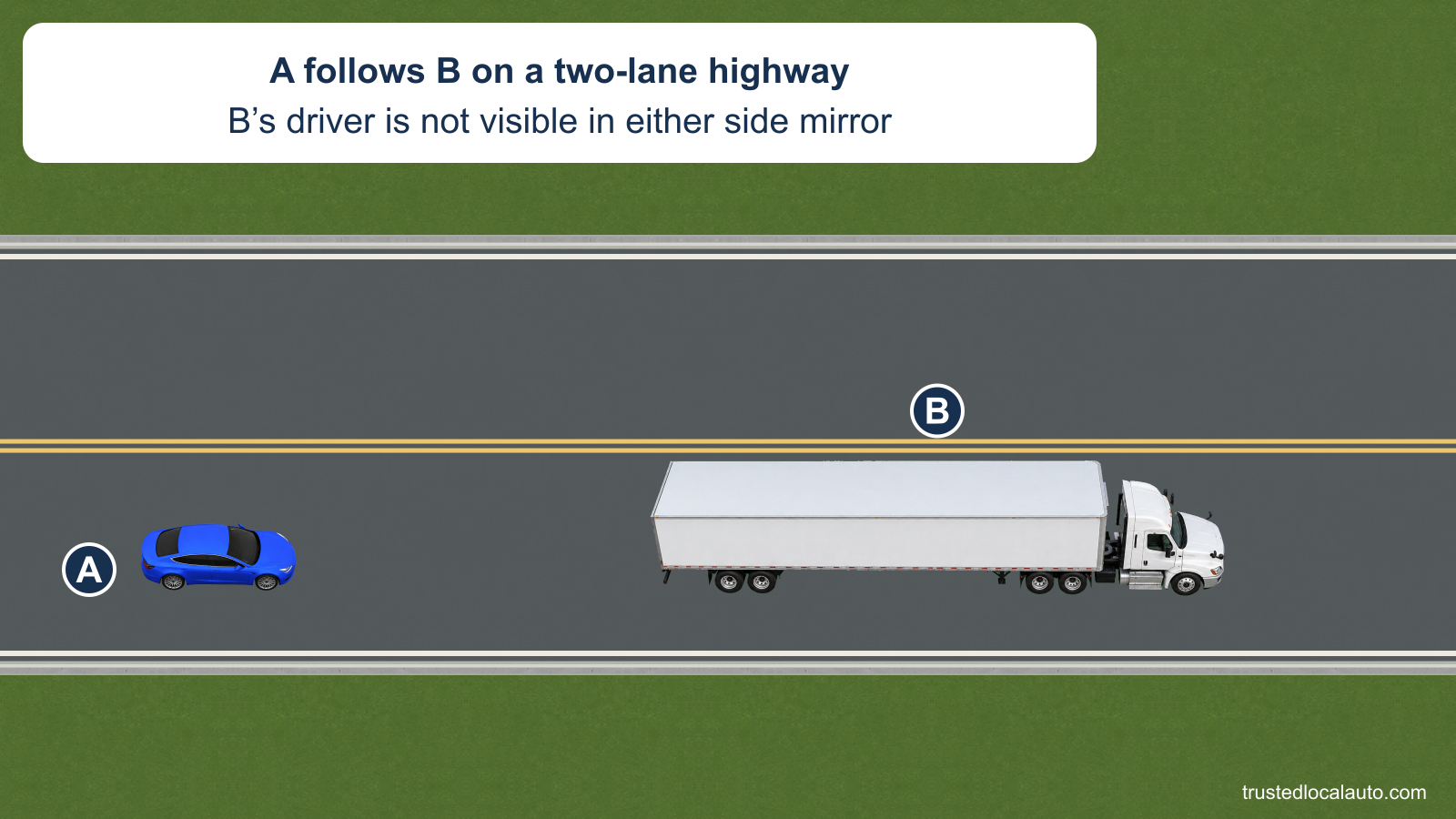
Correct answer: The truck driver probably cannot see your vehicle, so you should change your position.
Why
A tractor-trailer has large blind spots, called no-zones: up to 20 feet in front of the cab, along both sides with the largest area next to the cab, and up to 200 feet behind. A driver who stays in a no-zone cannot be seen when the trucker must change lanes or stop suddenly. When you pass a truck, pass completely on the left and do not stay beside it.
Verified against 2025-2027 Class D Noncommercial Driver License Manual · Sharing the road with trucks · p. 35, 36
Is this question correct and clear?
Continue learning
Related North Dakota questions
- You are driving through a residential area. A ball bounces into the street from between two parked cars. What should you do?
- A bicyclist ahead of you gives a left-turn hand signal. Then the rider moves from the right edge toward the center of the lane before an intersection. What should you do?
- On a two-lane highway, you come up behind a farm tractor with a slow-moving vehicle emblem. It moves at about 20 mph. A solid yellow line is on your side of the center line. What should you do?
- On a two-lane highway, you come up behind a farm tractor with a slow-moving vehicle emblem. It moves at about 20 mph. A solid yellow line is on your side of the center line. What should you do?
- On a two-lane highway, you follow a tractor-trailer about 150 feet behind it. You cannot see the truck driver in either of its side mirrors. What does this tell you?
- You wait to turn left at an intersection. An oncoming motorcycle seems far away and slow. What should you keep in mind before you turn?