
Practice question, Question 1 of 20
Passing target: 80% (16/20)
You follow a motorcycle on a city street that has potholes and loose gravel. How should you set your following distance?
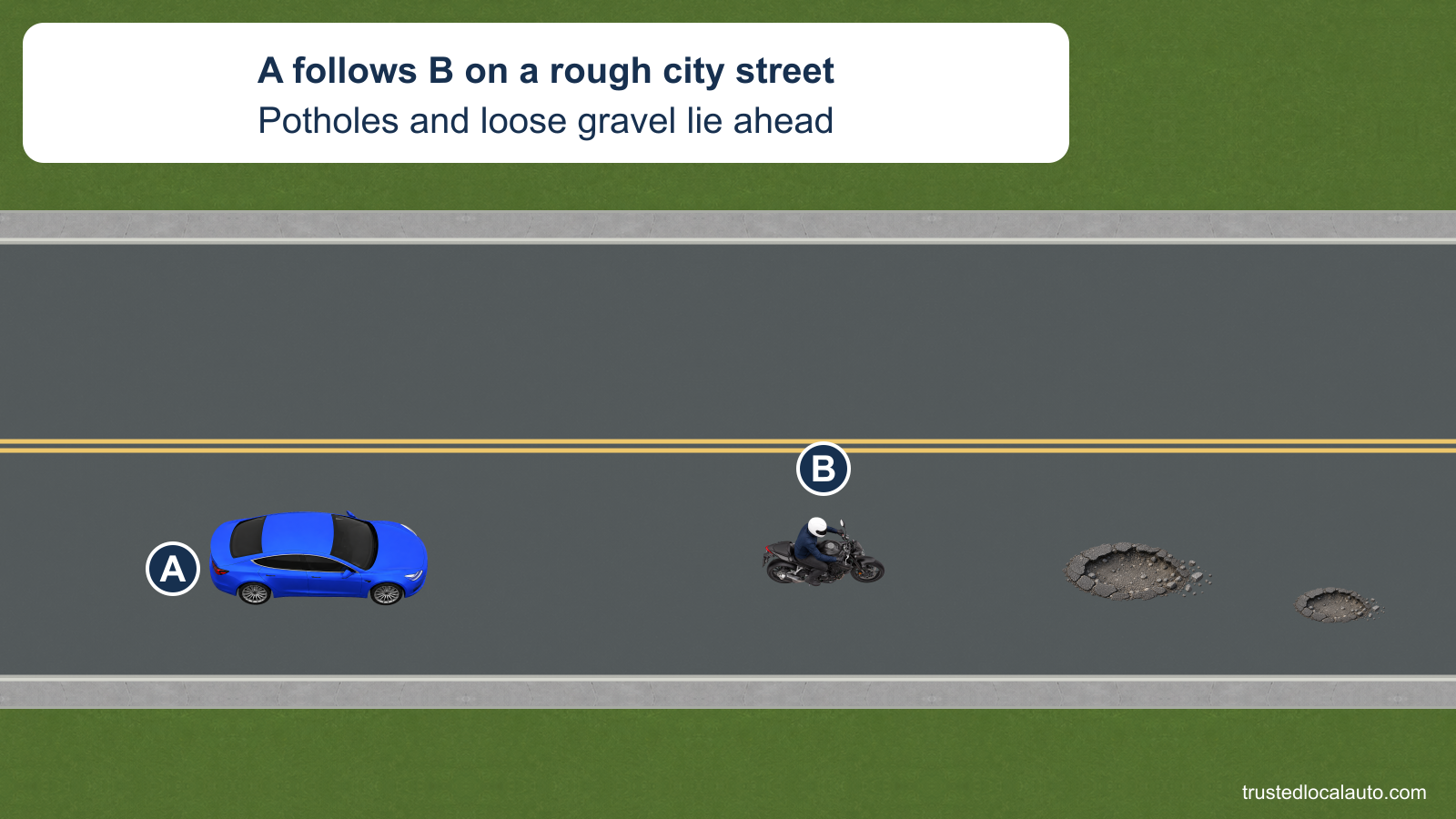
Correct answer: Keep more space than usual, because the rider may swerve or stop quickly for a hazard
Why
A motorcycle's narrow shape makes its distance and speed hard to judge, and a rider often changes position or slows to avoid potholes, gravel and wind blasts. The manual says to allow at least a three-second following distance behind a motorcycle, and to increase your gap when you follow a motorcycle, a large vehicle, or drive on slick roads, at night or in bad weather. Extra space gives you time to react and gives the rider room to handle an emergency.
Verified against Oklahoma Driver Manual · Sharing the road with motorcycles · p. 42, 53
Is this question correct and clear?
Continue learning
Related Oklahoma questions
- You drive on a city street and plan to turn right at the next corner. A bicyclist rides near the right edge of your lane, a short distance ahead of you. What should you do?
- You wait at a four-way stop. A bicyclist on the cross street slows at the stop sign, sees that no car is close enough to be a danger, and rides through without a full stop. Is this lawful in Oklahoma?
- A bicyclist comes to an intersection where the traffic light shows a steady red light. No vehicle or pedestrian is near. The bicyclist slows and rides through without a stop. Which rule applies to this bicyclist?
- On a two-lane road, a bicyclist rides near the middle of your narrow lane. A steady line of cars comes the other way, and your lane is too narrow for a car and a bike to share side by side. What should you do?
- You drive in the left lane of a city street with two lanes going your way. Ahead, a car in the right lane stops at the crosswalk of an intersection that has no signal. You cannot see why it stopped. What should you do?
- You follow a motorcycle on a city street that has potholes and loose gravel. Which statement is correct?