
Practice question, Question 1 of 18
Passing target: 83.3% (15/18)
You drive in the left lane of a three-lane highway. Your exit is 300 feet ahead on the right, and cars fill the center and right lanes. What should you do?
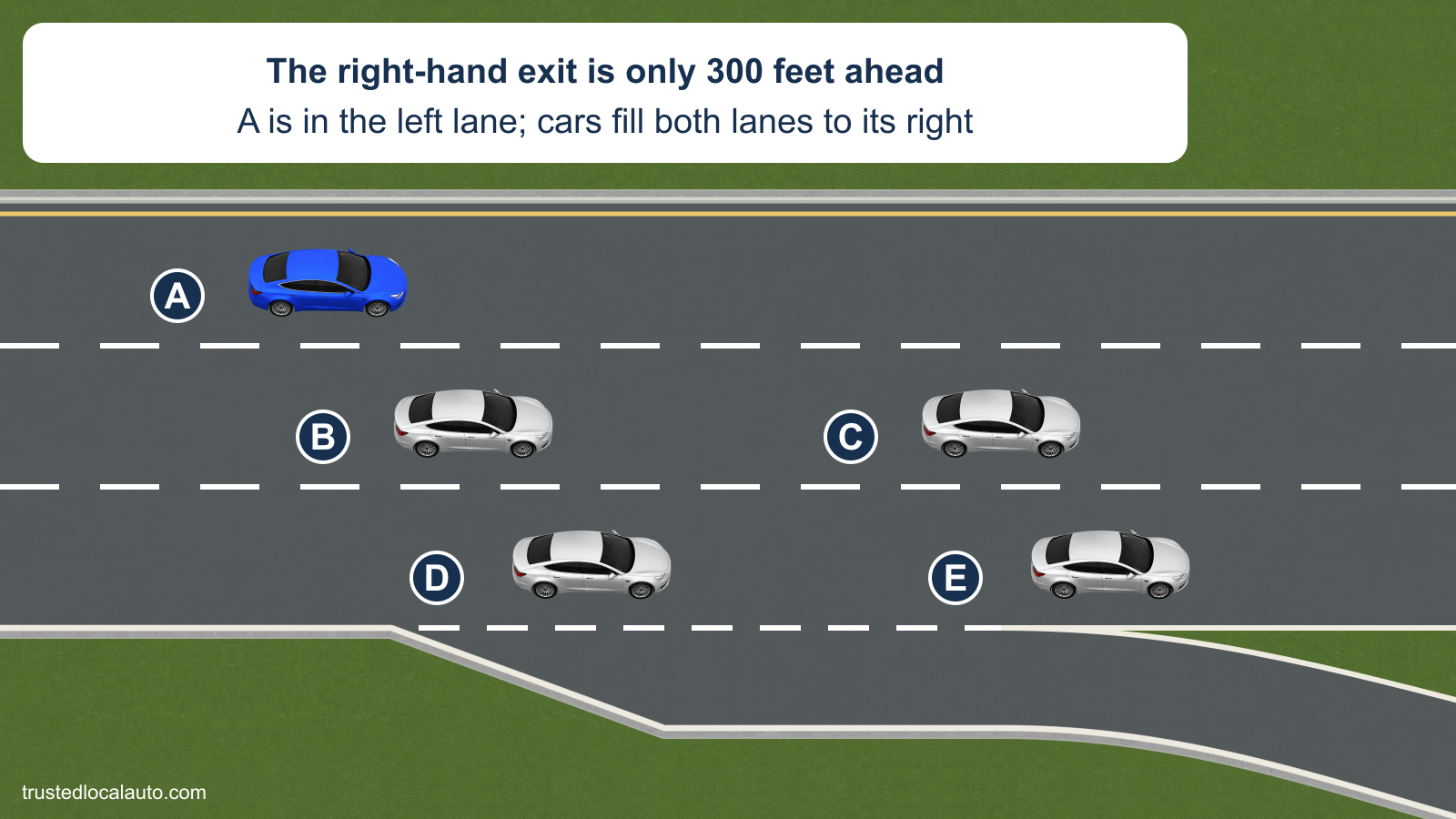
Correct answer: Stay in your lane, go past this exit, and use the next exit to turn back.
Why
The manual says that interchanges and lane changes are among the places of highest risk on a highway. It also says: if you miss your exit, take the next one, and do not stop, back up, cross the median or swerve across several lanes. Pennsylvania law (75 Pa.C.S. 3309) allows a lane change only when it is safe, 3311 limits median crossings, and 3702(b) forbids backing on a limited-access highway. To prevent this problem, move to the correct lane well before your exit.
Verified against Pennsylvania Driver's Manual · Exiting Highways · p. 56
Is this question correct and clear?
Continue learning
Related Pennsylvania questions
- The posted limit is 55 mph on a highway with two lanes in your direction. A disabled car with hazard flashers and road flares is on the right shoulder. You are in the right lane. The left lane is clear, so a lane change is safe and legal. What must you do?
- Your engine starts to fail on a highway, but the car can still move. Which plan follows the Pennsylvania manual?
- You drive at 65 mph on a busy interstate inside a pack of vehicles. The car ahead is only about 2 seconds away, a car follows close behind you, and you ride in the blind spot of a car in the next lane. How can you best get back a safe following space?
- On an interstate with two lanes in your direction, you move left to pass a slow truck. After the pass, you drive at the speed limit, and faster cars come up behind you. The right lane is clear. What should you do?
- You drive on a limited-access interstate with two lanes in your direction. You are in the left lane, the right lane is clear, and your exit leaves from the left side a short distance ahead. Which statement is correct?
- On a limited-access highway with two or more lanes in one direction, Pennsylvania law requires you to use the right-hand lanes, with some exceptions. Which statement is NOT correct?