
Practice question, Question 1 of 18
Passing target: 83.3% (15/18)
You pass a slow car on a two-lane road, and you signal that you will move back into the right lane. How can you tell that it is safe to move back in front of the car?
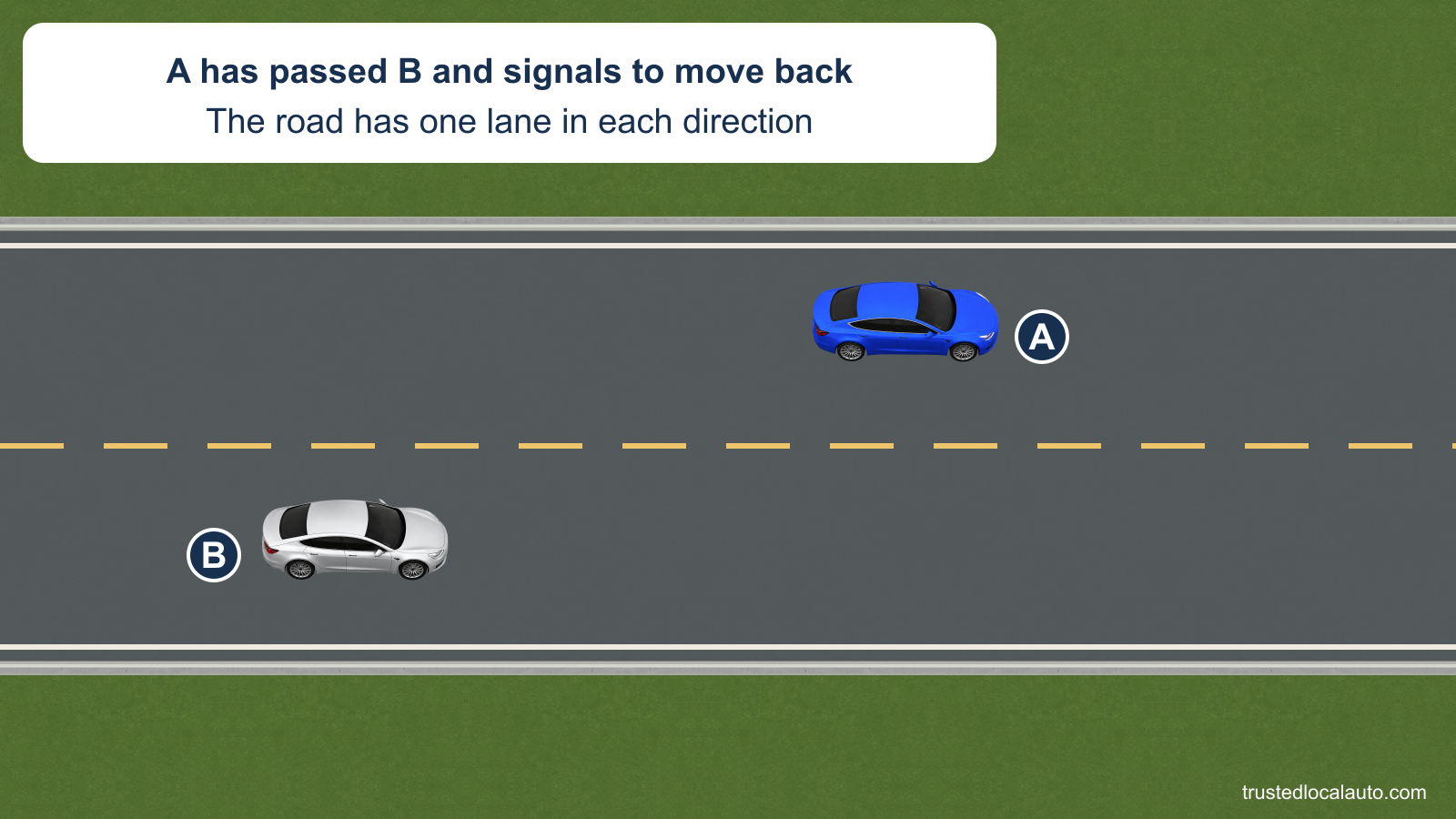
Correct answer: You can see both of its headlights in your inside rearview mirror.
Why
Pennsylvania law requires you to stay left until you are safely clear of the vehicle that you pass, and to return before you come within 200 feet of any oncoming vehicle. The driver who is being passed must not speed up until the pass is complete. Pass as quickly as you safely can, because the longer you stay in the other driver's blind spot, the longer you are both in danger.
Verified against Pennsylvania Driver's Manual · Passing · p. 51, 41
Is this question correct and clear?
Continue learning
Related Pennsylvania questions
- Your turn signals stop working, and you plan to turn right at the next corner. Which arm signal should you give from the driver's window?
- You drive on a road that has a center lane for left turns from both directions. You plan to turn left into a shopping center about half a mile ahead. How should you use the center lane?
- On a two-lane road, you follow a slow farm tractor. There is no railroad crossing, but an intersection is about 80 feet ahead. No sign or marking there allows passing, and the oncoming lane is empty. Which statement is correct?
- You want to go straight through the next intersection, but you notice too late that your lane has a right-turn arrow and the word ONLY on the sign above it and on the pavement. The lane beside you is full of traffic. What should you do?
- You drive on a one-way street with three lanes. You will turn left onto a two-way street that has two lanes in each direction. How should you make the turn?
- On a two-lane road, you follow a slow vehicle. A railroad crossing is about 90 feet ahead, and no sign or marking there allows passing. What no-passing distance before a railroad crossing does Pennsylvania law set?