
Practice question, Question 1 of 18
Passing target: 83.3% (15/18)
On a two-lane road you are behind a slow farm tractor. A railroad crossing is about 75 feet ahead, and no sign or marking there says that passing is allowed. The oncoming lane is empty. May you pass now?
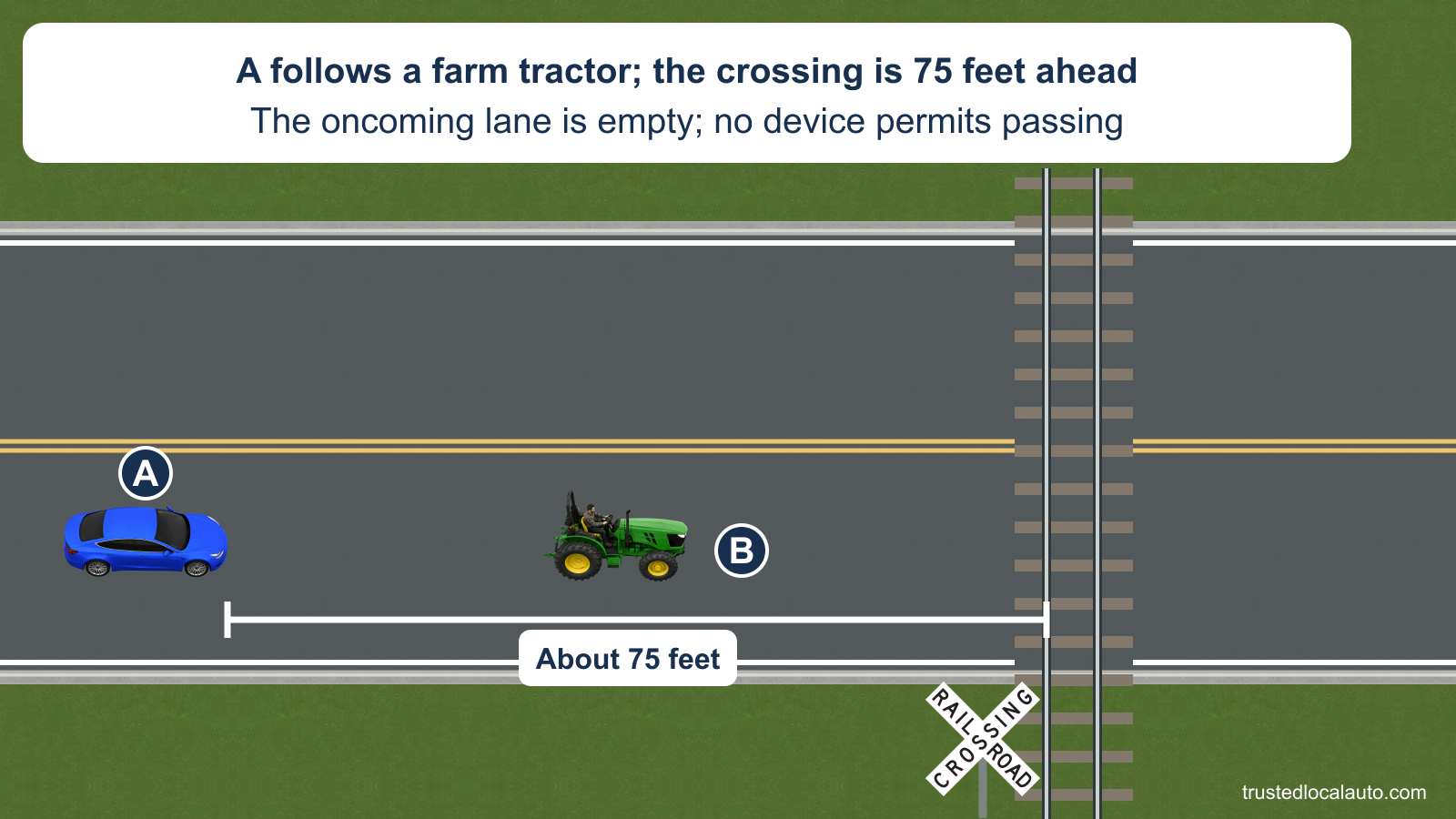
Correct answer: No, because you may not pass within 100 feet of a railroad crossing.
Why
Crossings and intersections are places where vehicles may stop, turn or enter the road, and a passing car in the wrong lane has nowhere to go. The same 100-foot rule applies near a bridge, viaduct or tunnel when your view is blocked, and you may not pass on a hill or curve that hides oncoming traffic. Stay back from a farm tractor, do not honk, and pass only where the road is clear and legal.
Verified against Pennsylvania Driver's Manual · Passing · p. 51
Is this question correct and clear?
Continue learning
Related Pennsylvania questions
- Your turn signals stop working, and you plan to turn right at the next corner. Which arm signal should you give from the driver's window?
- You drive on a road that has a center lane for left turns from both directions. You plan to turn left into a shopping center about half a mile ahead. How should you use the center lane?
- On a two-lane road, you follow a slow farm tractor. There is no railroad crossing, but an intersection is about 80 feet ahead. No sign or marking there allows passing, and the oncoming lane is empty. Which statement is correct?
- You want to go straight through the next intersection, but you notice too late that your lane has a right-turn arrow and the word ONLY on the sign above it and on the pavement. The lane beside you is full of traffic. What should you do?
- You drive on a one-way street with three lanes. You will turn left onto a two-way street that has two lanes in each direction. How should you make the turn?
- On a two-lane road, you follow a slow vehicle. A railroad crossing is about 90 feet ahead, and no sign or marking there allows passing. What no-passing distance before a railroad crossing does Pennsylvania law set?