
Practice question, Question 1 of 18
Passing target: 83.3% (15/18)
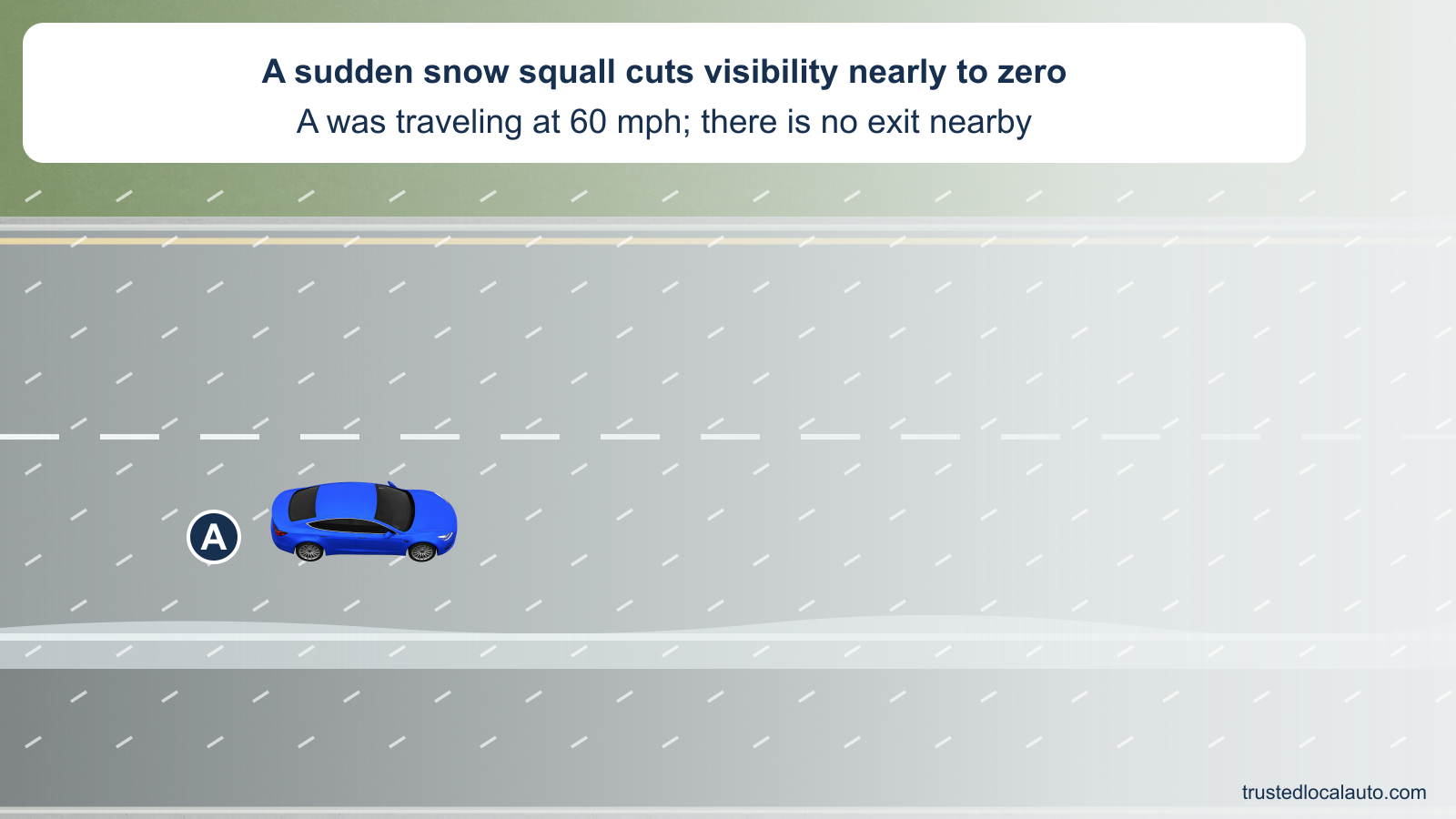
You drive at 60 mph on a clear interstate. A sudden snow squall cuts visibility almost to zero, and the road turns slick. There is no exit nearby. What should you do?
Correct answer: Slow down gradually and turn on your hazard lights so that other drivers can see you.
Why
Snow squalls often hit on otherwise clear days and have caused large multi-vehicle crashes on Pennsylvania interstates. Check the forecast and message boards, and if a squall is coming, leave the road and wait for it to pass. The National Weather Service issues Snow Squall Warnings for specific roads.
Verified against Pennsylvania Driver's Manual · Snow Squalls · p. 46, 47
Is this question correct and clear?
Continue learning
Related Pennsylvania questions
- On a highway, your gas pedal sticks down, and the car keeps speeding up. You tapped the pedal, but it did not come back up. What should you do next?
- You drive at 50 mph in heavy rain. Suddenly the steering feels light, and your car seems to float on the water. What should you do?
- It is 20 minutes before sunset on a dark, cloudy afternoon. Traffic is heavy, and you can see other vehicles only about 700 feet ahead. It is not raining, and your wipers are off. What does Pennsylvania law require?
- On a dark, cloudy afternoon before sunset, it is not raining and your wipers are off. You can see other vehicles only about 600 feet ahead. What does Pennsylvania law require?
- At night, you must switch from high beams to low beams within a set distance of other vehicles. Which pair of distances is correct?
- Your car has anti-lock brakes (ABS). On a dry road, traffic ahead stops suddenly, and you must stop as fast as you can. How should you brake?