
Practice question, Question 1 of 40
Passing target: 75% in each of the three areas
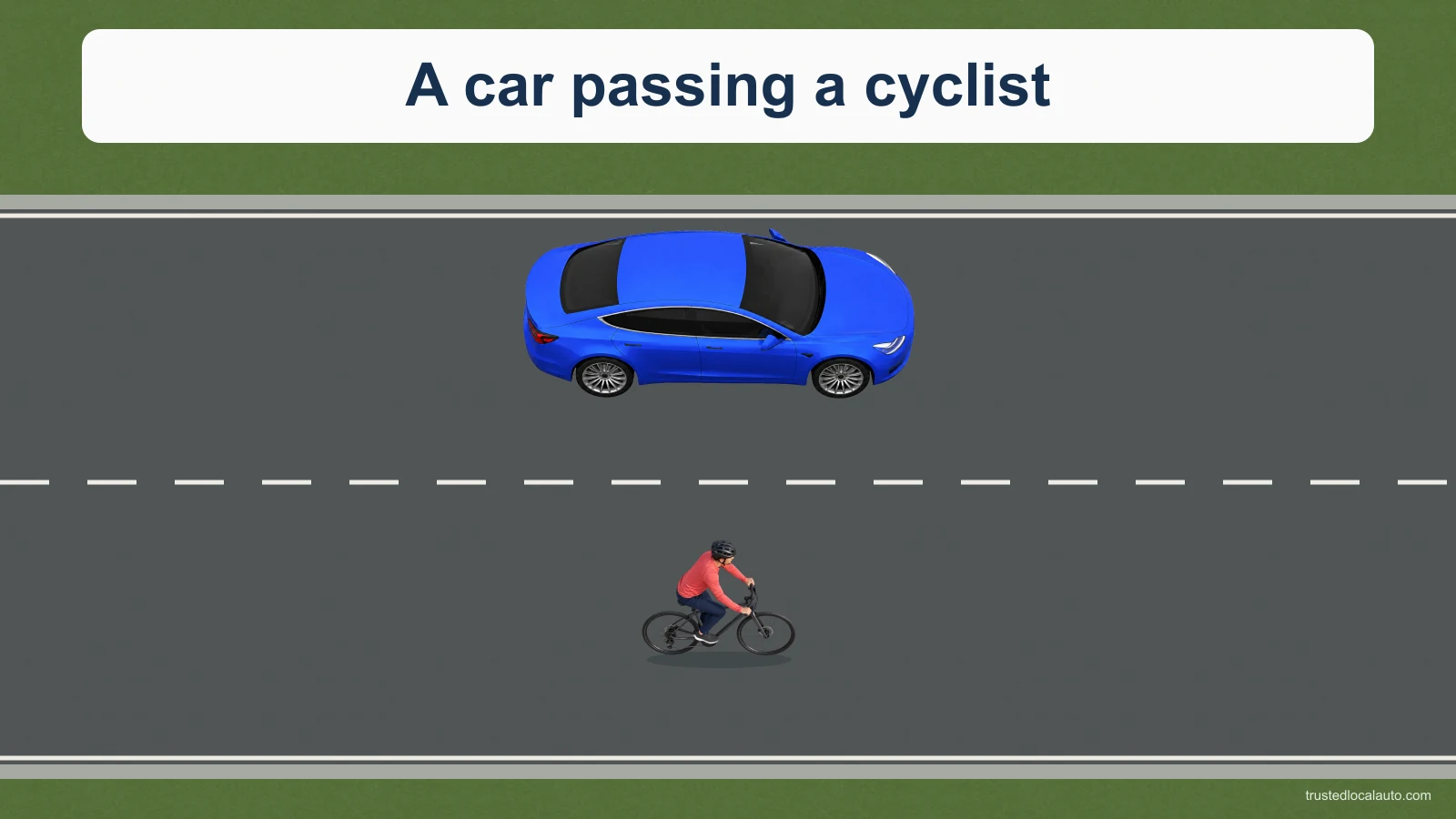
You are passing a cyclist on a Québec roadway that is not a designated shared street or bicycle boulevard. The cyclist is not on a physically separated cycle facility. What side clearance is required, in addition to reducing speed and passing only when safe?
Correct answer: 1 m at limits of 50 km/h or less; 1.5 m above 50 km/h
Why
Reduce speed and leave at least 1 m beside the cyclist where the maximum permitted road speed is 50 km/h or less, or 1.5 m where it is over 50 km/h. Maintain sufficient clearance throughout the pass. If you cannot pass safely with enough room, wait behind the cyclist. On designated shared streets and bicycle boulevards, the Code allows an exception to the fixed minimum distance when there is enough space to pass without danger; the duty to reduce speed and pass safely remains. That exception is outside the situation in this question.
Verified against Driver’s Handbook (SAAQ), English 2018 edition · Turns, lanes, passing and merging · p. 227
Is this question correct and clear?
Continue learning
Related Quebec questions
- Another driver is passing you in an ordinary, lawful pass on a two-way road. Which statement is correct?
- Another driver is passing you in an ordinary lawful passing situation. How should you respond?
- For an ordinary passenger car, what determines whether you may use a reserved lane at a particular time?
- On a road with one lane in your direction, the car ahead has stopped to turn left. There is enough room to pass on its right without driving on the shoulder. Which statement is correct?
- You continue straight on a two-way road. Your through lane moves slowly. The centre lane, designated for left turns in both directions, is empty. What should you do?
- You intend to continue straight on a two-way road. Your through lane is moving slowly, and an empty centre lane is designated for left turns in both directions. What should you do?