
Practice question, Question 1 of 30
Passing target: 80% (24/30)
At 10 p.m., you enter a highway work zone. Signs show a reduced speed limit of 45 mph, and the normal limit is 65 mph. You see no workers or machines. What speed should you drive?
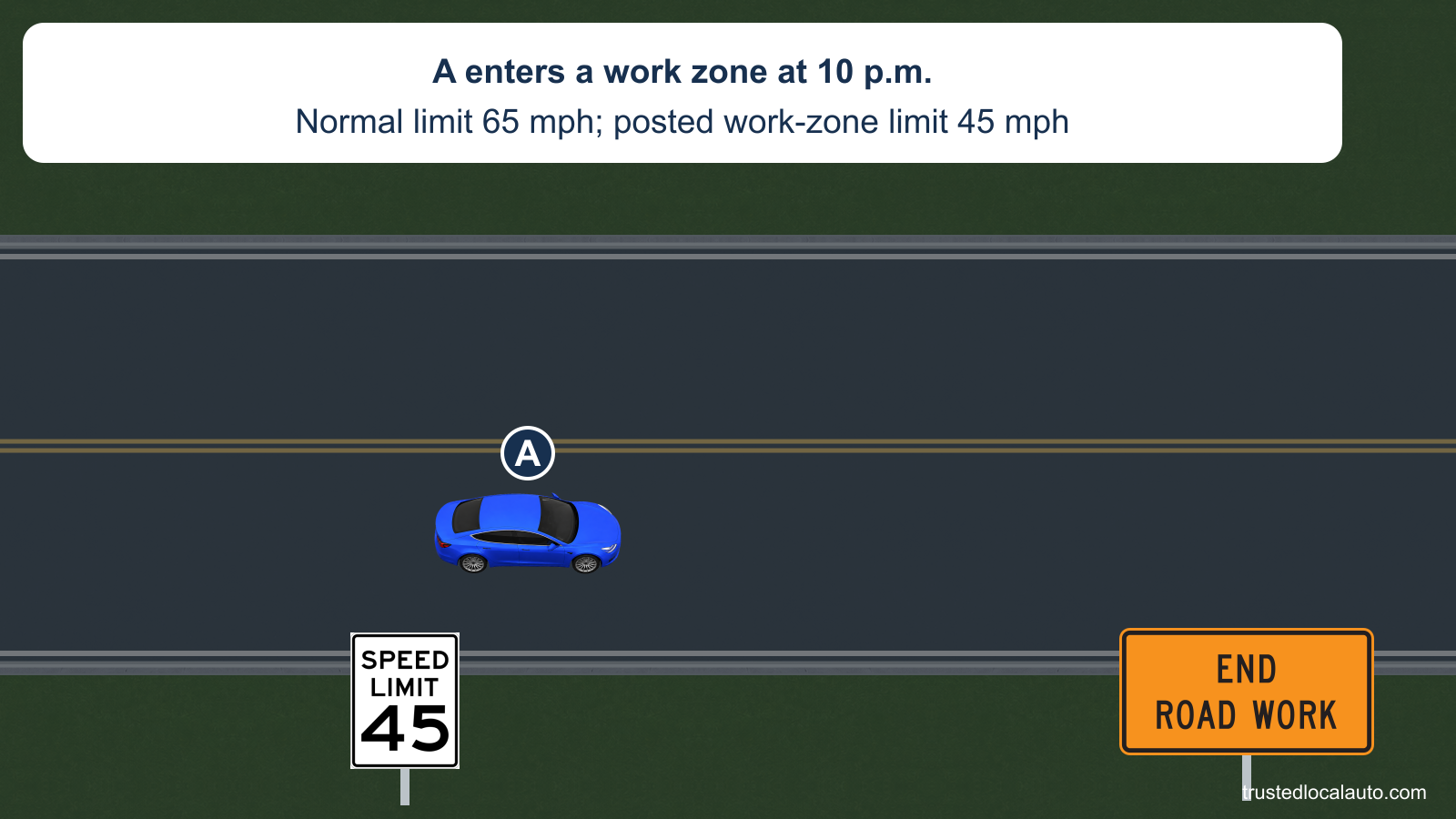
Correct answer: 45 mph or slower, because the posted limit applies even with no workers
Why
Work zones keep their hazards after the crews leave: narrow lanes, lane shifts, rough pavement and barriers close to traffic. South Dakota can set reduced speed zones through highway work areas; a posted limit is in effect when the signs are up, and speeding fines double when workers are present. At night, the manual calls for extreme caution in a work zone whether or not workers are there.
Verified against South Dakota Driver License Manual · Work Zones · p. 66, 34
Is this question correct and clear?
Continue learning
Related South Dakota questions
- You come to a railroad crossing with no gate. The side-by-side red lights on the crossbuck post start to flash, but you cannot see a train. What must you do?
- You are stopped at a crossing with two sets of tracks. A long freight train passes on the near track. After its last car clears, the red lights keep flashing and the gate stays down. What should you do?
- You are about 150 feet from a railroad crossing. The red lights start to flash and the gate arm begins to come down. You can see a train, but it looks far away. What should you do?
- A work zone on a two-lane highway closes one lane. A flagger holds up a STOP paddle toward you. The open lane ahead looks clear, and you cannot see workers or machines near it. What should you do?
- A school bus ahead is stopped with its red lights flashing, and you come toward it from the opposite direction. On which of these roads may you go on without stopping?
- On a two-lane road posted at 55 mph, a school bus ahead of you turns on its flashing amber lights. It has not stopped yet. If you pass it, what is the highest speed that South Dakota law allows?