
Practice question, Question 1 of 40
Passing target: 80% (32/40)
You drive toward an intersection, and the traffic light shows a steady red. The road has a marked crosswalk but no stop line, and you plan to go straight. What must you do?
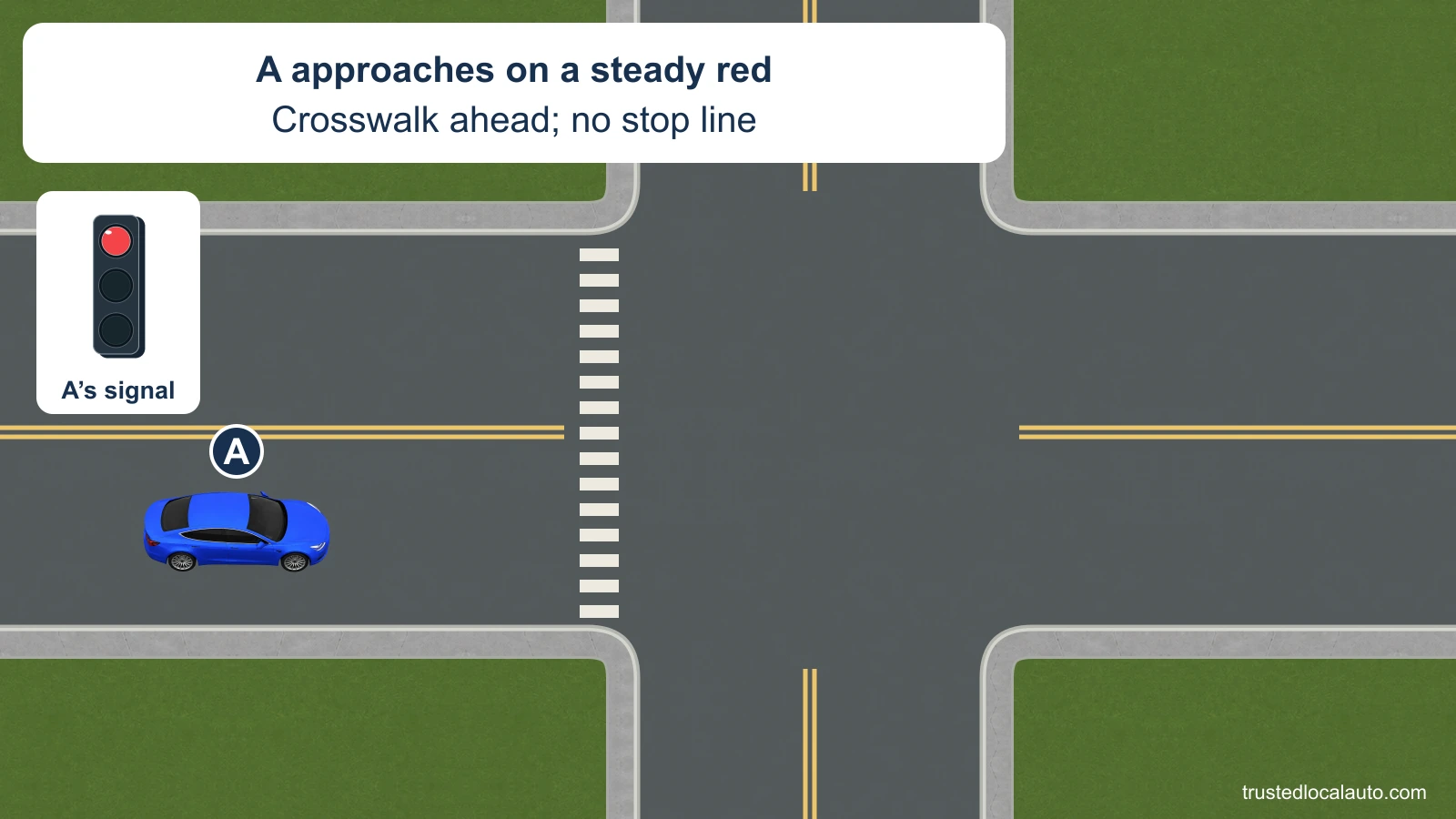
Correct answer: Stop before the crosswalk and stay stopped until the light turns green.
Why
A steady red light means stop and wait. Stop at the stop line if there is one; with no stop line, stop before the crosswalk; with neither, stop before you enter the intersection. Tennessee allows a right turn on red after a full stop, unless a sign prohibits it, but you must yield to pedestrians and cross traffic. A driver who goes straight waits for the green light.
Verified against Tennessee Comprehensive Driver License Manual · Traffic Signals — Steady red · p. 55, 57
Is this question correct and clear?
Continue learning
Related Tennessee questions
- You drive in the left lane of a one-way street with two lanes. A broken white line separates your lane from the right lane. You want to turn right at the next block. What does the broken white line allow?
- A railroad crossing has a crossbuck with red lights and no gate. Your car is already on the tracks when the red lights begin to flash. The car runs normally. What should you do?
- On a highway, double solid white lines separate your lane from the lane to your left. Both lanes go in your direction. Your lane slows down, and the lane on your left moves faster. What do the lines allow?
- On a highway, double solid white lines separate your lane from the lane to your right. Both lanes go in your direction. Your exit is ahead on the right, and you want to move into the right lane now. Which statement is correct?
- You drive across a railroad crossing that has a crossbuck with red lights and no gate. Your car is on the tracks when the red lights start to flash. What should you do?
- On your route you meet two intersections. At the first, the signal flashes red in your direction. At the second, it flashes yellow in your direction. Which pair states what each signal requires?