
Back to Utah
Utah Class D Written Knowledge Test Practice
Full test preview Question 1 of 50
0 answered 50 remaining
Passing target: 80% (40/50)
Weather, Visibility & EmergenciesStandalone practice
The car ahead stops suddenly on a wet road. Your car has anti-lock brakes (ABS), and you must stop as quickly as possible. How should you use the brake?
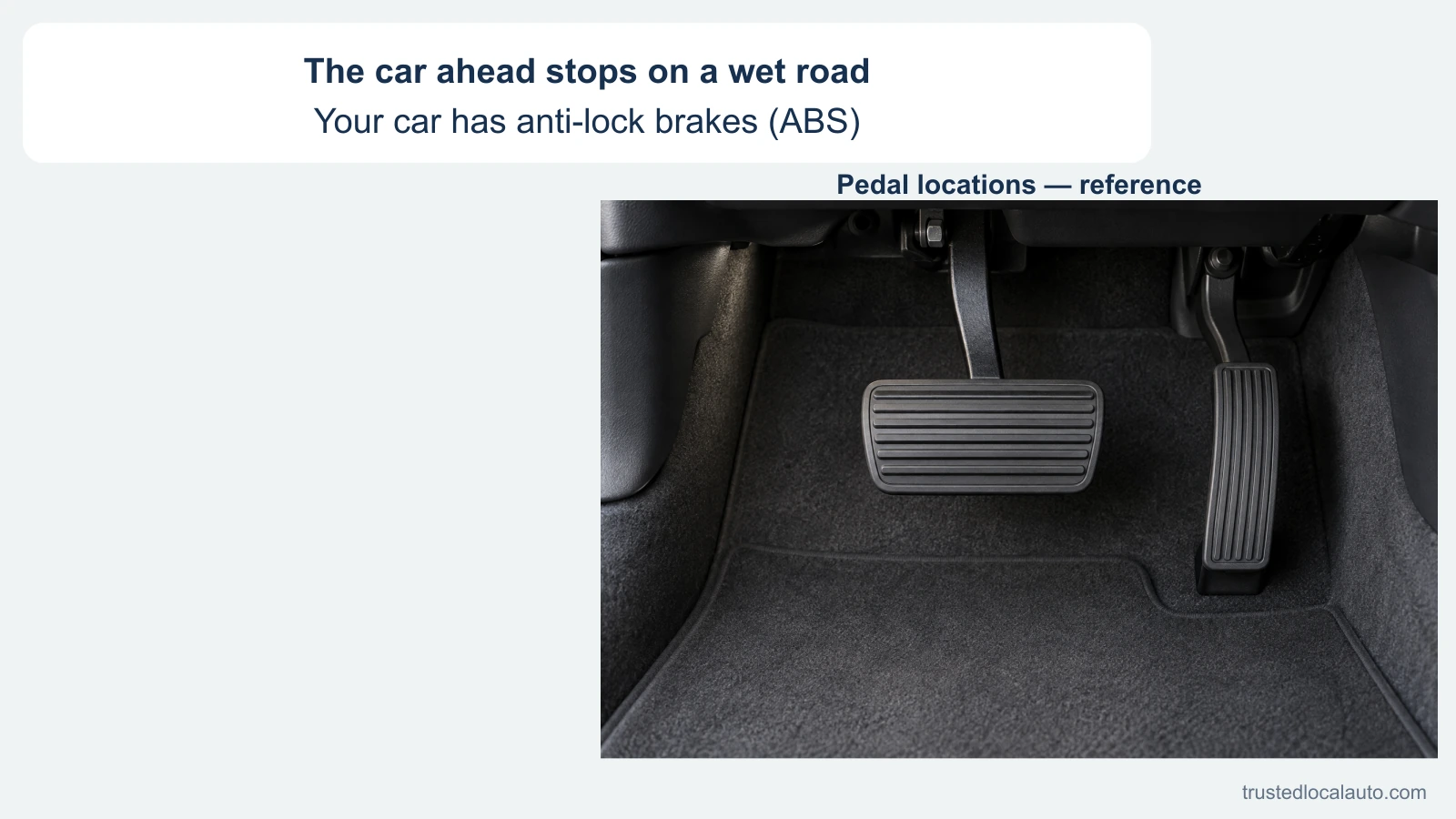
A neutral reference view shows the wide brake pedal and narrow accelerator with no foot on either. The card states that a car ahead stops on a wet road and this car has ABS.
Correct answer: Press the pedal firmly, keep steady pressure on it, and steer as you need to
Why
ABS keeps the wheels from locking, so you can still steer while you brake hard. Read your owner's manual to learn how your ABS works. If your vehicle has no ABS, follow the owner's manual for braking in an emergency.
Verified against Utah Driver Handbook · Braking and brake failure · p. 77, 100
Report a question issueContinue learning
Related Utah questions
On a hot summer day, your car breaks down on a desert highway. You see no call box and no buildings nearby. What should you do?After a night of snow, you have a short drive to work. Snow covers the whole car. What must you clear before you drive?At dusk, you drive on a two-lane highway. A deer stands on the shoulder ahead, and a car comes toward you in the other lane. What is the best action?A lightning storm starts while you drive a car with a hard metal roof, and there is no building nearby. What is the safest thing to do?Thick fog forms on a rural highway in the morning. You can see only about 200 feet ahead, and the speed limit is 65 mph. What should you do?A snowstorm strands you in your car, and you run the engine to stay warm. What should you do to prevent carbon monoxide poisoning?