
Practice question, Question 1 of 20
Passing target: 80% (16/20)
At an intersection with signals, a bicyclist in the roadway faces a steady red light, but the pedestrian signal for the same direction shows WALK. Under the Vermont law in force since July 1, 2026, what may the bicyclist do?
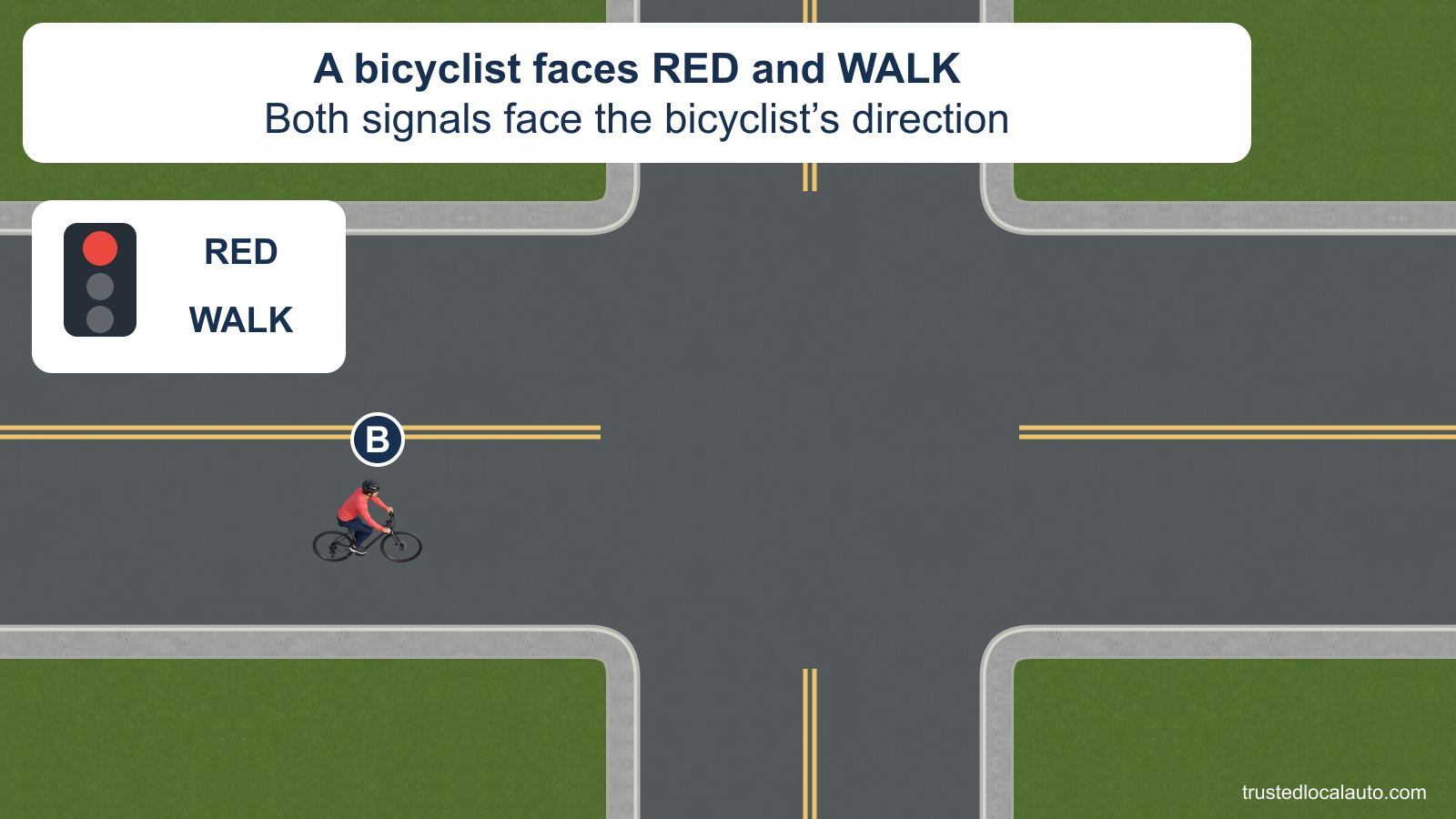
Correct answer: Cross with WALK, since it now covers bicycles, and yield to those already there.
Why
Since July 1, 2026, Vermont law says that a bicyclist must follow the traffic-control devices and signals for motor vehicles, but a bicyclist who faces a WALK signal may turn or cross in the direction of that signal, while yielding to vehicles and pedestrians in the roadway or intersection. Where a separate bicycle signal is installed, the bicyclist obeys that signal instead of the signal for motor vehicles (a rule in force since July 1, 2025). As a driver, expect bicyclists to move during the WALK phase, especially when you turn right on red.
Verified against Vermont Driver's Manual · Bicyclists · p. 42
Is this question correct and clear?
Continue learning
Related Vermont questions
- On a two-lane road you come up behind a person who rides a horse. The horse seems nervous. What should you do?
- Children were playing in the yard beside your driveway a few minutes ago. You now get into your car to back out. What is the safest plan?
- On a narrow two-lane road, two bicyclists ride side by side in your lane. A curve ahead hides oncoming traffic. What should you do?
- You drive on a two-lane road and come up behind a bicyclist who rides near the right edge. The oncoming lane is clear, and you can see far ahead. How must you pass?
- On a road with two lanes in your direction, a motorcycle rides in the left part of your lane ahead of you. You want to pass it. What should you do?
- You wait to turn left and see a single headlight coming toward you. It seems far away. Why should you take extra care before you turn?