
Practice question, Question 1 of 20
Passing target: 80% (16/20)
You are driving on a busy city street with parked cars, shops and crosswalks. Which way of looking helps you find hazards in time?
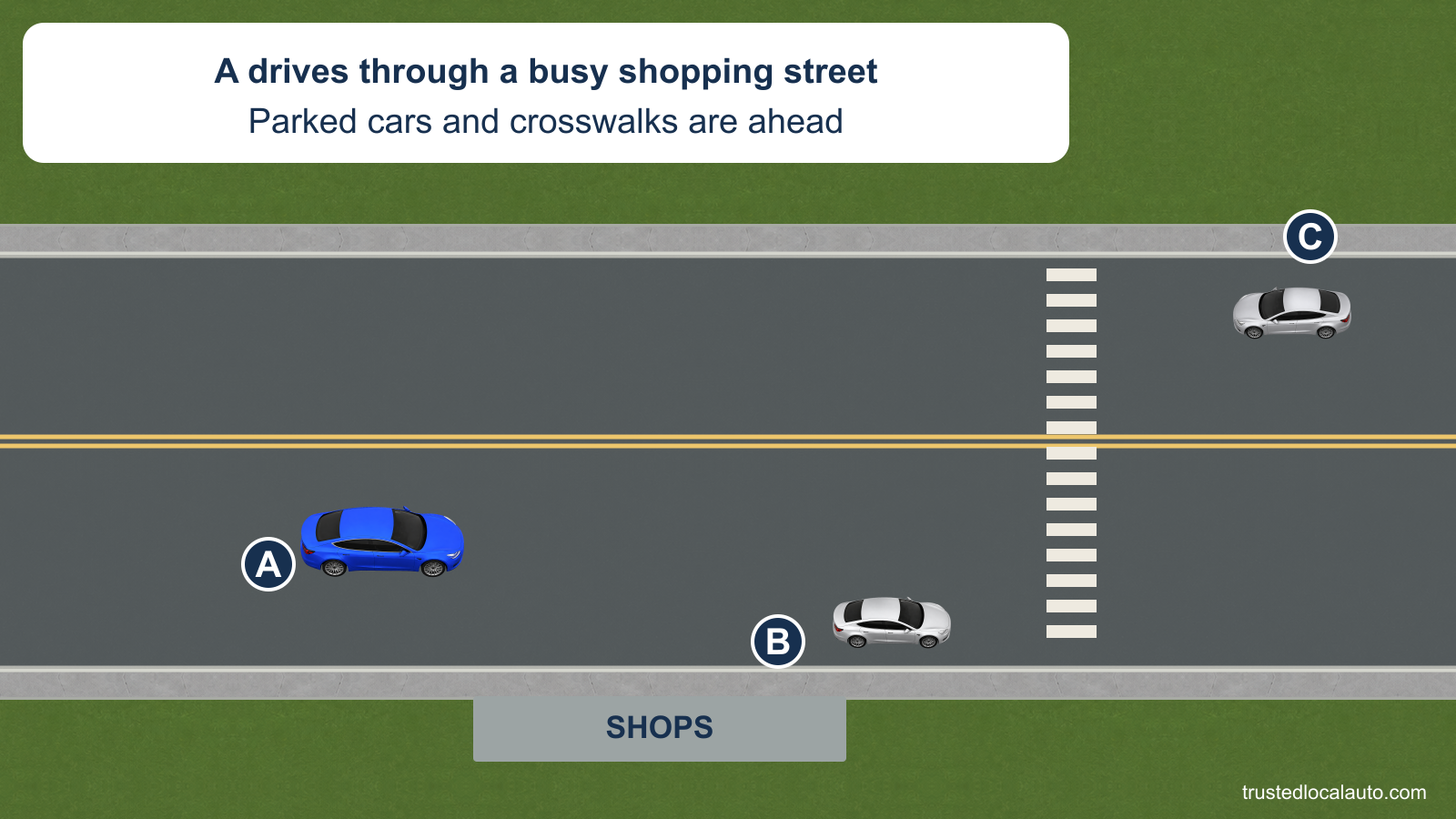
Correct answer: Use a repeating search: look well ahead, to both sides and in your mirrors, and repeat.
Why
A visual search pattern is an orderly way to check all around your vehicle: far ahead, near ahead, both sides and behind, again and again. It helps you see pedestrians, bicyclists and other vulnerable road users, and changes in the road, while you still have time to react. The manual gives the same advice for the interstate: keep your eyes moving and check your mirrors often. A driver who stares at one spot sees a new hazard later.
Verified against Vermont Driver's Manual · A Visual Search Pattern · p. 28, 51
Is this question correct and clear?
Continue learning
Related Vermont questions
- You are on the interstate and want to move from the right lane to the left lane to pass. Your inside mirror and your left side mirror show no vehicles. What should you do before you move over?
- Which statement about driving slower than other traffic is NOT correct?
- On a dry road in good weather, the rear of the car ahead passes a utility pole. You count "one thousand one, one thousand two, one thousand three," and then your car reaches the pole. Which statement is correct?
- You drive at 25 mph on a dry town street in good weather. The rear of the car ahead passes a sign post. You count "one thousand one, one thousand two, one thousand three," and then your car reaches the same post. Which statement is correct?
- You are driving on a dry road in good weather. The rear of the car ahead passes a utility pole. You count "one thousand one, one thousand two, one thousand three," and then your car reaches the same pole. What should you do?
- Snow covers the road, and you are driving an all-wheel-drive SUV behind another car. How much following distance should you keep?