
Practice question, Question 1 of 20
Passing target: 80% (16/20)
You are driving on a road posted at 40 mph. It has not rained for two weeks, and a light rain has just started. What speed does Vermont law require?
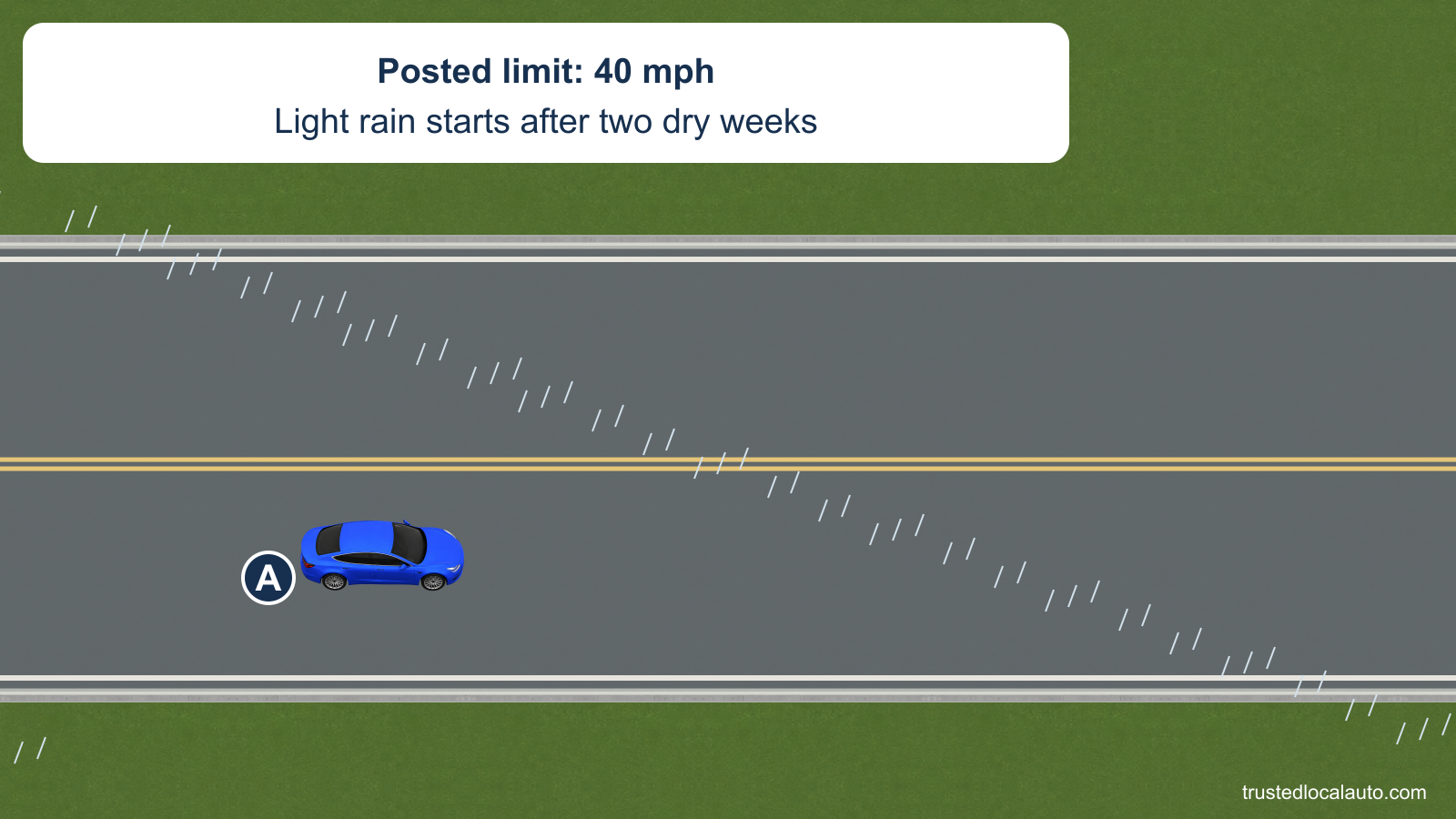
Correct answer: A speed that is safe for the slippery road, even if it is well below 40 mph.
Why
Vermont law says that you may never drive faster than is reasonable and prudent for the conditions, and that you must always keep your vehicle under control. A posted limit is the maximum for good conditions; in rain, fog, heavy traffic or near pedestrians, the safe speed can be much lower. The first rain after a dry period is often the most slippery, because oil, rubber and dirt on the road mix with the water and make your braking distance longer. Many crashes happen because a driver goes too fast for the conditions, even under the posted limit.
Verified against Vermont Driver's Manual · Speed Limits and Safe Speeds · p. 29, 27
Is this question correct and clear?
Continue learning
Related Vermont questions
- You are on the interstate and want to move from the right lane to the left lane to pass. Your inside mirror and your left side mirror show no vehicles. What should you do before you move over?
- Which statement about driving slower than other traffic is NOT correct?
- On a dry road in good weather, the rear of the car ahead passes a utility pole. You count "one thousand one, one thousand two, one thousand three," and then your car reaches the pole. Which statement is correct?
- You drive at 25 mph on a dry town street in good weather. The rear of the car ahead passes a sign post. You count "one thousand one, one thousand two, one thousand three," and then your car reaches the same post. Which statement is correct?
- You are driving on a dry road in good weather. The rear of the car ahead passes a utility pole. You count "one thousand one, one thousand two, one thousand three," and then your car reaches the same pole. What should you do?
- Snow covers the road, and you are driving an all-wheel-drive SUV behind another car. How much following distance should you keep?