
Back to Virginia
Virginia Passenger Knowledge Exam Practice
Full test preview Question 1 of 40
0 answered 40 remaining
Passing target: 85% (34/40)
Observation, Speed & SpaceStandalone practice
You drive at 30 mph with a 2-second gap behind another car. Heavy rain starts, and you can see less of the road ahead. What should you do with your following gap?
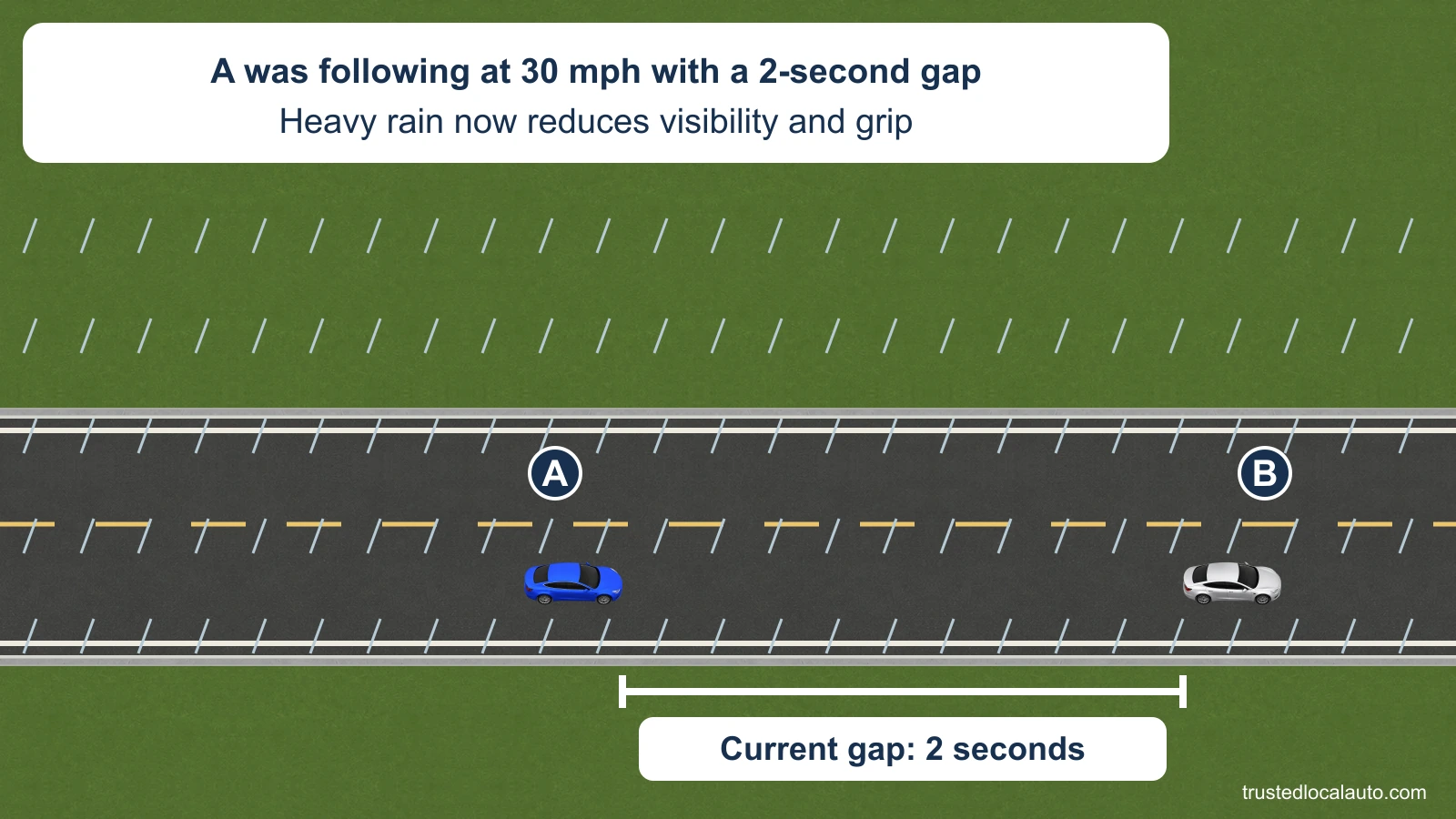
A follows B at 30 mph with the stated two-second gap as heavy rain begins.
Correct answer: Make it longer than 2 seconds for the wet road and poor view
Why
Wet pavement can double your braking distance. Rain also makes it harder to see vehicles and hazards ahead of you and in your blind spots. Also add seconds in heavy traffic, on poor pavement, or when your vehicle is in poor condition. A longer gap lets you slow down gently, which also helps the driver behind you.
Verified against Virginia Driver's Manual · Maintaining a Space Cushion: Following Distance (bad weather) · p. 21, 17, 25
Report a question issueContinue learning
Related Virginia questions
Your car has antilock brakes. On a dry street, a child runs out ahead and you must stop as quickly as you can. How should you use the brake pedal?You drive at 40 mph on a dry road. The car ahead passes a road sign, and you count the seconds until you reach the same sign. What is the least count that the Virginia following-distance rule accepts at this speed?You drive in the left lane of a four-lane highway and plan to move into the right lane. Your mirrors show that the right lane is clear, and your signal is on. What should you do just before you move?On a multilane highway, you have driven for some time just behind and to the side of a car in the next lane. What should you do?You follow a tractor-trailer at 50 mph on a two-lane road. The trailer blocks your view of the road ahead. What is the best action?A sign shows a speed limit of 45 mph. The road is dry, and traffic is light. Which statement about your speed is correct?