
Practice question, Question 1 of 30
Passing target: 80% (24/30)
You and another driver reach an intersection with no signs or signals at about the same time. The other car comes from the road on your right. Who must yield?
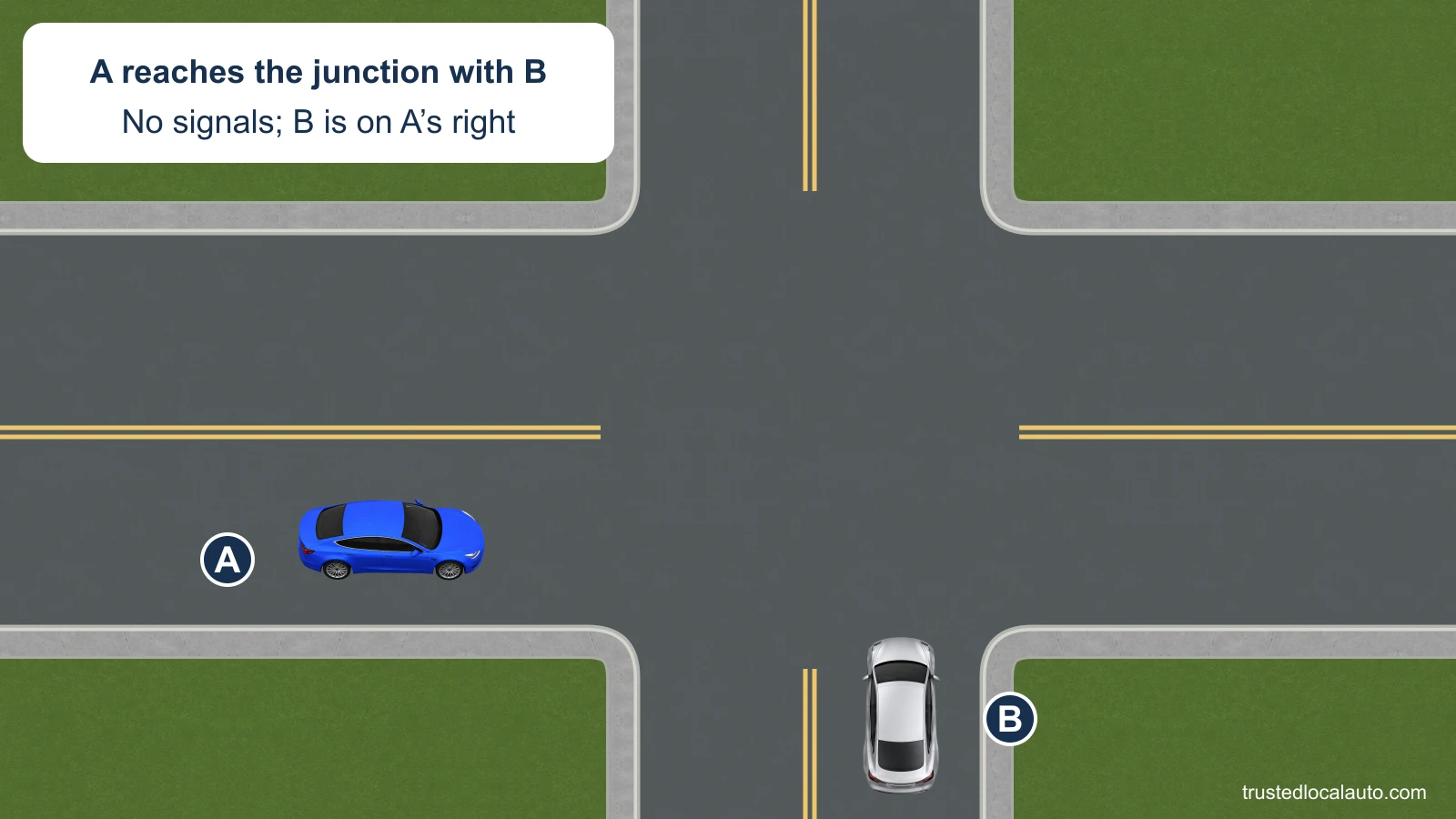
Correct answer: You must yield, because the other car is on your right.
Why
At an intersection with no signs or signals, a vehicle that is already in the intersection goes first. When two vehicles arrive at about the same time, the driver on the left yields to the driver on the right; the manual uses the same rule at four-way stops. Right-of-way is something you give, not take: if the other driver does not yield, let that driver go and avoid a crash.
Verified against West Virginia Driver's Licensing Handbook · Right-of-Way · p. 59
Is this question correct and clear?
Continue learning
Related West Virginia questions
- You are crossing an intersection on a green light and are in the middle of it. An ambulance with its siren on and its lights flashing comes up behind you. What should you do?
- You wait at the end of a private driveway to turn onto a two-lane road. A car on the road comes from your left and will pass in front of you. You are on that car's right side. Who has the right-of-way?
- You drive out of an alley onto a two-lane street. A car on the street comes from your left, so you are on its right side. You reached the edge of the street before the car came near. Who must yield?
- You are stopped in an intersection on a green light (no arrow), waiting to turn left. An oncoming car is close and will reach the intersection in a moment. What should you do?
- You are stopped at a red light on a one-way street. You want to turn left onto another one-way street. A NO TURN ON RED sign is posted and shows no days or times. No cars or pedestrians are in sight. May you turn left on this red light?
- Your traffic light is green, and a pavement arrow shows that your lane may turn left. A police officer in the intersection holds up a hand toward you to stop. What should you do?