
Practice question, Question 1 of 25
Passing target: 80% (20/25)
Two vehicles reach an ordinary uncontrolled intersection at approximately the same time. Neither approach has a special priority control. Which driver must yield?
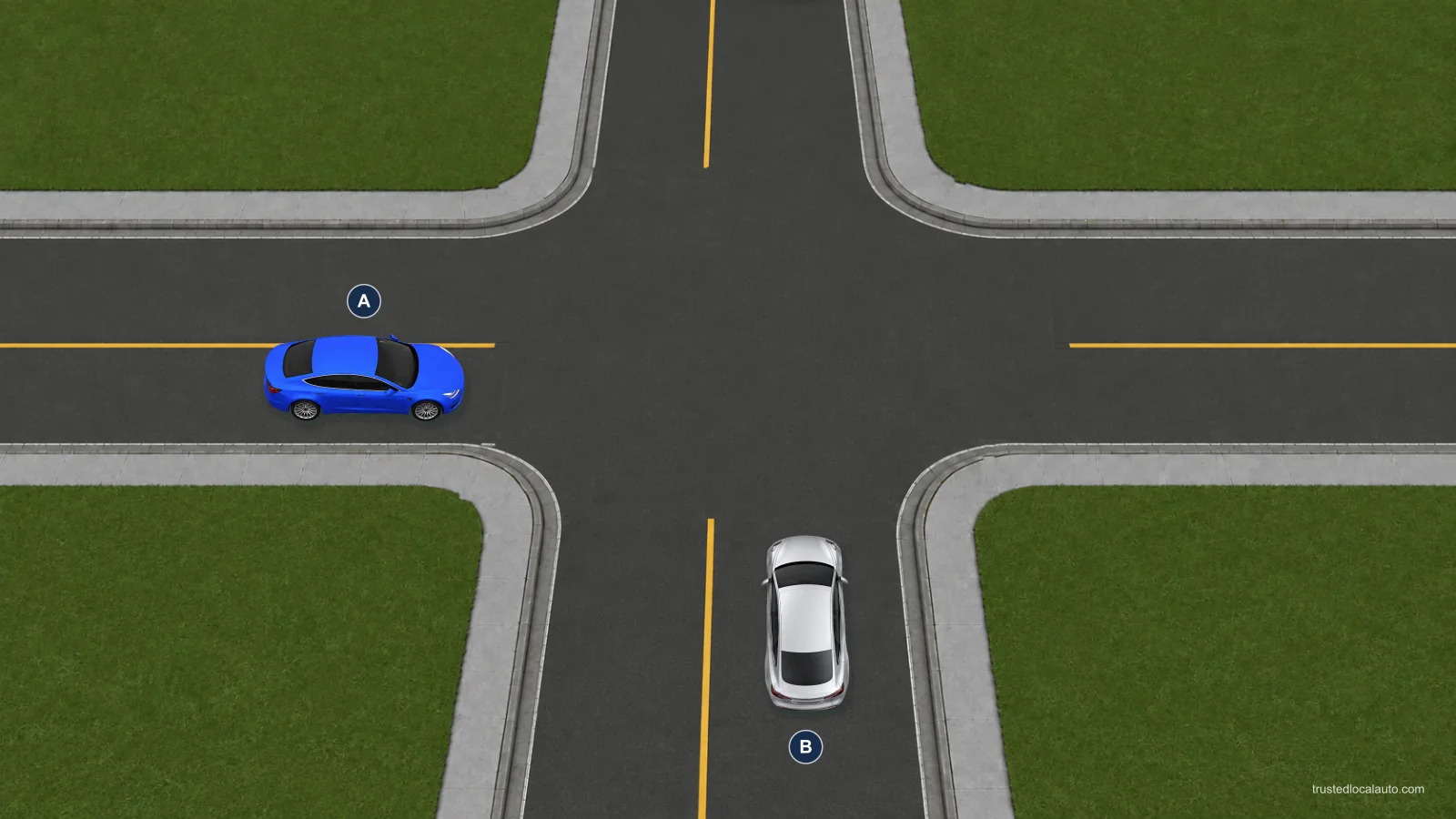
Correct answer: The driver on the left, to the driver on the right.
Why
The driver on the left yields to the driver on the right in this ordinary simultaneous-arrival situation. A driver must also yield to a vehicle already in the intersection. Do not infer through-road priority merely from the apparent width of a road, and avoid a collision even when another driver should yield.
Verified against Kansas Driving Handbook · Right-of-way · p. 18, 33
Is this question correct and clear?
Continue learning
Related Kansas questions
- What should a driver do before entering a roundabout?
- In a business or residence district, you are leaving an alley or driveway across a sidewalk to enter a highway. What must you do?
- In a business district, you leave a driveway to enter a street. There is no sidewalk area across the driveway, and no signal or STOP sign controls it. What must you do before you enter the street?
- You are waiting to turn left across oncoming traffic. No protected turn signal gives you priority. What must you do?
- You are in the proper left-turn lane of a one-way street, turning left onto another one-way street. The signal is circular red, no sign prohibits the turn, and the path can be clear. What may you do?
- No traffic signal is installed or operating. A pedestrian is in a marked crosswalk on your half of the road, or close enough from the other half to be in danger. What must you do?