
Maryland Class C Knowledge topic
Maryland Class C Knowledge Parking, Reversing & Roadside Stops
Practise safe parking, backing, turnarounds and stopping beside the road.
19 questions, free with an account. 7 of them are hard. Each one has its answer, an explanation and its official source.
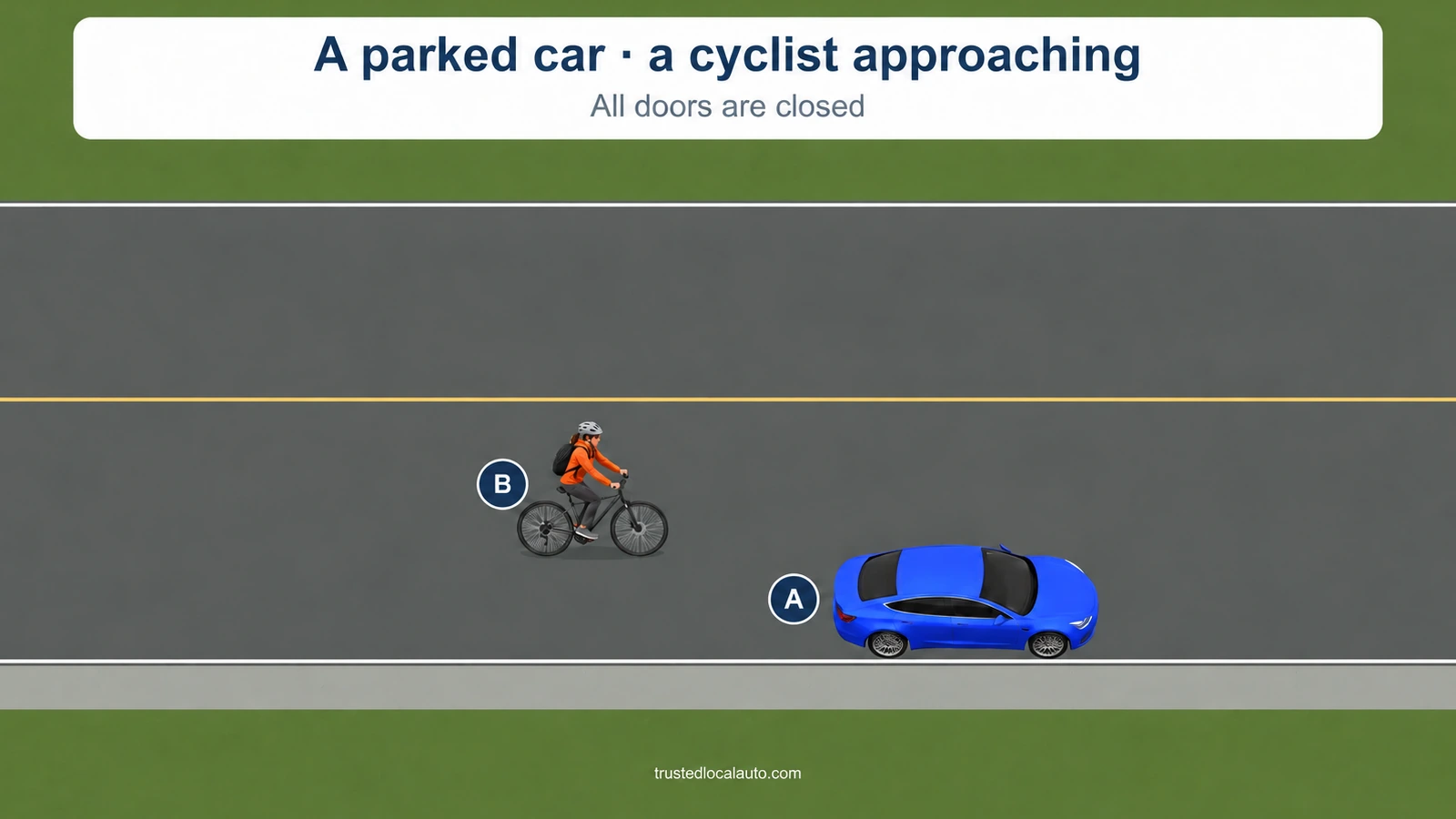
- 1 picture question
- 18 text questions
- 7 of them hard
1 picture question
Questions in this topic
Select a question to answer it. The answer and the explanation show after you answer.
18 text questions
More questions in this topic
- A driver has a valid disability placard. May the driver park in the striped access aisle beside a designated disability parking space?
- What is the safest way to begin backing into a parking space?
- You are choosing an ordinary parking place beside a fire hydrant. No officer or traffic-control device directs otherwise. What minimum clearance is required?
- If staying in a disabled vehicle is unsafe, where should occupants go when they can exit safely?
- On the approach to a traffic signal located at the side of the roadway, what is the minimum clearance for ordinary parking?
- Before leaving a parked vehicle, what should the driver do?
- When parallel parking at the right curb on an ordinary two-way road, how must the right-hand wheels be positioned?
- You want to park near a railroad crossing, with no officer or traffic-control device directing otherwise. What is the minimum ordinary parking clearance from the nearest rail?
- If it is safe to remain inside a disabled vehicle away from traffic, what should occupants do?
- After an officer signals you to stop, what should you do?
- If a vehicle becomes disabled, where should the driver try to move it?
- An open curb space would put your car 12 feet from a fire hydrant. It is ordinary parking, and no officer or traffic-control device directs otherwise. Which statement is correct? Hard
- A driver has a valid disability placard, and the placard holder is in the car. The marked disability space is occupied. The striped access aisle beside it is empty. Which statement is correct? Hard
- You parallel park at the right curb of an ordinary two-way road. What is the maximum distance between your right-hand wheels and the curb? Hard
- You want to parallel park at the right curb of an ordinary two-way road, on a block that has a fire hydrant. No officer or traffic-control device directs otherwise. Which pair of legal limits is correct for the distance of your right-hand wheels from the curb and your clearance from the hydrant? Hard
- You want to park beside a fire hydrant. It is ordinary parking, and no officer or traffic-control device directs otherwise. What is the minimum clearance from the hydrant? Hard
- Near a railroad crossing, Maryland sets a minimum ordinary parking clearance from the nearest rail. It also sets where you stop when an active crossing requires a stop. Which pair is correct? Hard
- In Maryland, 50 feet is the minimum ordinary clearance from which of these? Hard
Maryland Class C Knowledge
More Class C Knowledge topics
Road rules · 12 topics
- Licensing & Test Readiness27 questions
- Traffic Signals & Road Markings21 questions
- Observation, Speed & Space13 questions
- Intersections & Right-of-Way17 questions
- Turns, Lanes, Passing & Merging17 questions
- Parking, Reversing & Roadside Stops19 questions · This topic
- Sharing the Road18 questions
- Freeways & High-Speed Roads12 questions
- School Zones, Railways & Work Areas33 questions
- Weather, Visibility & Emergencies15 questions
- Vehicle Safety, Documents & Towing15 questions
- Safe & Responsible Driving19 questions
Each question page shows the answer, the explanation and the official source of the question.