
Practice question, Question 1 of 25
Passing target: 80% (20/25)
On a dry, level road, you speed up from 35 mph to 70 mph. About how long is your braking distance now, compared with before?
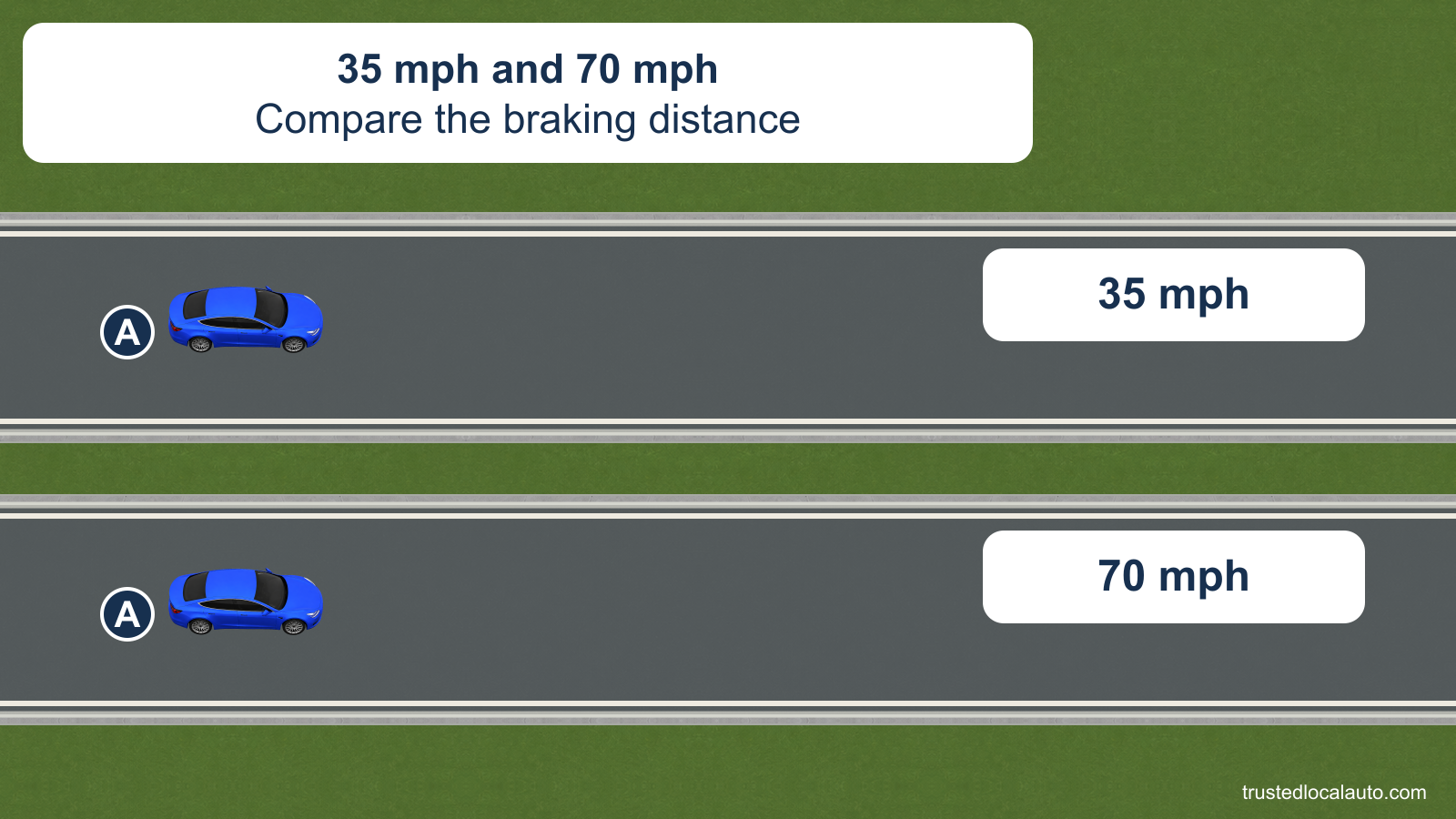
Correct answer: About four times as long
Why
Total stopping distance has two parts: the distance you travel while you see the danger and react, and the braking distance. The reaction part grows in step with your speed, but the braking part grows much faster. The handbook table shows that a car at 65 mph needs about 494 feet to stop on dry pavement. A small increase in speed can take away the space you need to avoid a crash.
Verified against Official Nevada Driver Handbook · Stopping · p. 41
Is this question correct and clear?
Continue learning
Related Nevada questions
- A yellow warning sign shows a sharp curve ahead on a two-lane road. When should you slow down?
- You are backing out of an angled parking space on a downtown street. As your car starts to move, you see a bicyclist coming up the street and a pedestrian about to walk behind your car. What should you do?
- You drive at 35 mph on a dry street. The car ahead passes a signpost, and your front bumper reaches the same post as you finish saying "one thousand one." What does this tell you?
- You drive at 35 mph on a dry street. You start to count when the rear of the car ahead passes a post: "one thousand one, one thousand two." Your front bumper reaches the post just as you finish the count. Which statement is correct?
- You drive on a residential street with cars parked on both sides. A ball rolls into the street from between two parked cars. What should you do?
- On a highway with two lanes in your direction, you have driven next to another car for some time. What should you do?