
Back to New Hampshire
New Hampshire Non-Commercial Operator Knowledge Practice Test
Full test preview Question 1 of 40
0 answered 40 remaining
Passing target: 80% (32/40)
Intersections & Right-of-WayStandalone practice
You and another driver stop at a four-way stop at the same moment. The other car is on the cross street to your right. Both of you plan to go straight. Who should go first?
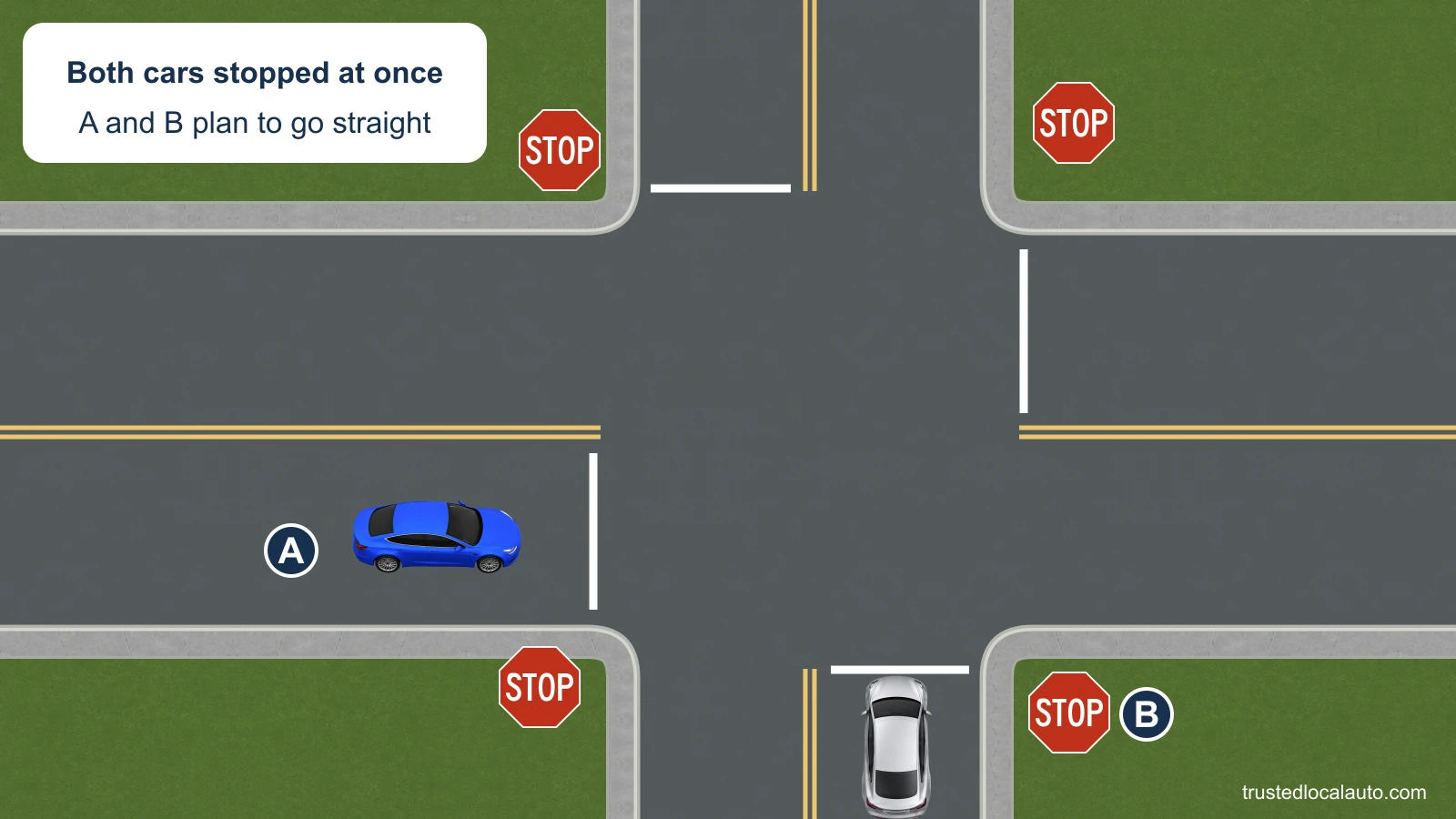
A and B are stopped at a four-way stop. B is on A’s right, both stopped together, and both plan to go straight.
Correct answer: The car on your right goes first, because the driver on the left yields.
Why
At an all-way stop, the first driver to stop is the first to go, and the yield-to-the-right rule settles a tie. The same rule applies at an intersection with no signs or signals. Even when you have the right-of-way, watch the other driver and be ready to wait, because that driver may not follow the rule.
Verified against New Hampshire Driver's Manual · Yielding right-of-way · p. 20
Report a question issueContinue learning
Related New Hampshire questions
You approach a two-lane roundabout with a YIELD sign at your entry. You are in the right entry lane to take the first exit. A car is circling in the inner lane toward your entry, and the outer lane is empty. What should you do?You drive out of a store's driveway in a downtown business district. A sidewalk crosses the driveway just before the street. What must you do?At a four-way stop, a car on your left comes to a full stop. A moment later, you come to a full stop too. Who should go first?Your light is solid green with no arrow. You want to turn left, and an oncoming car is close to the intersection. Who goes first?Your traffic signal shows a steady red light. A police officer standing in the intersection looks at you and waves you through. What should you do?On a rural road, you come to a narrow bridge that only one vehicle can cross at a time. An oncoming car reaches the far end of the bridge just before you reach your end. What should you do?